


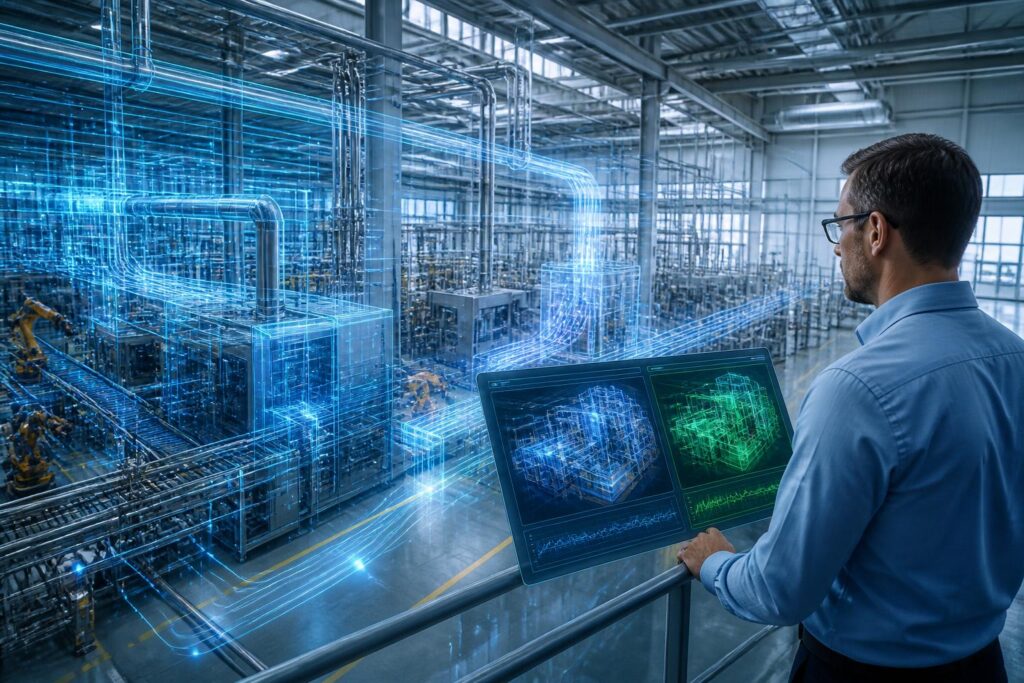
In many industries, operational decisions must be made while systems are constantly in motion. A factory needs to adjust its production line but cannot arbitrarily stop the machines to try every option. A building must balance energy consumption, occupant comfort, and equipment condition. A transportation infrastructure system needs to respond to fluctuations in traffic without having the means to create another version of the city for testing. Digital twins emerge from this need: to create a digital model capable of reflecting a real-world object, process, or environment while also receiving data to update its state over time.
What is notable about this technology is not the creation of an attractive three-dimensional image. The core value of a digital twin lies in connecting the model with operational data and the way people make decisions. When built properly, it can help an organization observe what is happening, understand the causes, simulate scenarios, and assess impacts before changing the real system. This marks a shift from merely recording the past to creating a testing ground capable of supporting the future.
How Is a Digital Twin Different from a Visual Model?
A visual model usually describes the shape, structure, or position of an object. It can be useful for design, training, or presentation, but it does not necessarily reflect the state currently unfolding in reality. In contrast, a digital twin requires a data connection to the object being simulated. That connection may come from sensors, management software, technical records, maintenance data, control systems, or other sources of information.
Not every digital twin needs to be updated every second, nor does it necessarily have to represent a single machine. Its scope may begin with one device and expand to a production line, building, supply network, or business process. A model designed for maintenance may focus on the condition of an engine and its operating history. A model intended for factory design may be concerned with material flows, capacity, and interactions between areas. Therefore, a digital twin should be viewed as an information and operations architecture rather than as a standalone interface product.
Three Layers of Value in a Simulation Space
Seeing the Current State
The first layer is the ability to create a unified picture of the system. In reality, data is often scattered across multiple software systems, formats, and departments. A person in charge may know that a piece of equipment is issuing an alert, but may not easily connect that alert with the maintenance schedule, load level, environmental conditions, or effects on subsequent stages. A digital twin can bring related signals together within the same context, making observation less dependent on separate data tables.
However, the ability to see does not mean the ability to understand correctly. Sensor data may be missing, delayed, or inaccurate. How accurately a displayed state reflects reality also depends on connection quality, asset identification methods, and data-processing rules. If an organization focuses only on the display while neglecting the data foundation, the digital twin can easily become a screen full of information but with little actionable value.
Testing Before Intervention
The second layer is simulation. Once the model has sufficient data and operating rules, users can ask “what if” questions: What happens if capacity is increased at one stage? Will a new maintenance schedule reduce downtime? How will changing movement flows in a building affect energy consumption? How will restricting activity in one area affect the entire process?
These questions do not automatically produce perfect answers. A simulation is reliable only within the scope of the assumptions and data it uses. Even so, it helps organizations identify inconsistencies, compare options, and recognize risks at a lower cost than direct testing on the real system. This is particularly important in environments where mistakes can lead to downtime, wasted resources, or safety risks.
Supporting Decision-Making and Controlled Automation
The third layer concerns decision-making. A digital twin can provide context for analytical systems, thereby supporting demand forecasting, the detection of unusual signs, or the recommendation of operating schedules. When combined with artificial intelligence, the model can process many relationships in the data that people would find difficult to track manually. However, AI’s role should be placed within a controlled process. Automated recommendations need to be accompanied by their data sources, applicable conditions, and sufficient explainability for the responsible person to evaluate them.
In critical systems, a digital twin should not become a reason to eliminate human judgment entirely. A recommendation that is optimal in terms of efficiency may create unwanted effects on safety, privacy, fairness, or system resilience. The practical value lies in coordinating simulation, operational experience, and clear approval mechanisms.
The Challenges Lie in Data and the Model’s Boundaries
Deploying a digital twin is often described as a technology project, but the most difficult aspects actually concern organizational issues and data governance. Each department may use a different name for the same asset. The equipment’s change history may be incomplete. Data from legacy systems may not be easy to connect to a new platform. Without resolving these foundational issues, the digital model will reflect a fragmented reality.
The model’s boundaries also need to be clearly defined. It is impossible to incorporate every element of the real world into a single twin while still maintaining its operability, verifiability, and maintainability. Businesses should begin with a specific question, such as reducing the time required to diagnose failures, improving maintenance planning, or testing energy-allocation options. The clearer the objective, the easier it is to determine the necessary data scope and level of detail.
Another risk is confusing prediction with certainty. A digital twin can simulate many possibilities, but the future is always influenced by factors that are not included in the model. Results should be presented together with their assumptions, confidence levels, and limiting conditions. An interface that displays only the final number may cause users to overestimate the system’s capabilities.
Privacy, Safety, and Control
The more detailed a digital twin is, the more likely it is to contain sensitive data. In a manufacturing environment, the data may reveal operational capacity, equipment weaknesses, or activity schedules. In buildings and cities, the data may relate to movement patterns, space usage, and people’s habits. Therefore, protecting a digital twin means not only protecting a database, but also protecting the relationship between the data and the real-world object.
The deployment architecture needs to assign permissions by role, record access histories, control connections to control systems, and separate areas with different levels of risk. Which data is collected, how long it is stored, who has the right to view it, and who is permitted to affect the real system are questions that must be answered from the outset. When the model is used to support decisions involving people, organizations also need to consider transparency and complaint mechanisms, rather than treating this solely as a technical issue.
A More Practical Way to Get Started
A digital-twin program can begin with a narrowly defined use case supported by sufficiently good data. The implementation team should map data flows, identify reliable sources, standardize asset identification, and establish evaluation criteria before building the interface. After the pilot phase, the results need to be compared with actual operations to identify discrepancies. The model should not be expanded merely because it has many features, but because it has demonstrated the ability to support a specific decision.
A digital twin should also be treated as a living system. Equipment changes, processes are updated, new data appears, and old assumptions may lose their validity. Model validation, maintenance, and user training are therefore no less important than the initial construction. A useful digital twin is not the one that looks most like reality, but the one that helps an organization better understand what it is operating and recognize the limits of what can be inferred.
As operational data becomes increasingly abundant, digital twins offer a notable approach: instead of waiting for a failure to occur and then reacting, organizations can observe, test, and learn in a digital space before taking action. This technology does not replace the real system, nor does it eliminate uncertainty. It creates an intermediate layer where people can test assumptions, see relationships, and make better-grounded decisions. When built with a focused objective, reliable data, and clear accountability, a digital twin can become an important foundation for flexible operations across many fields.
