


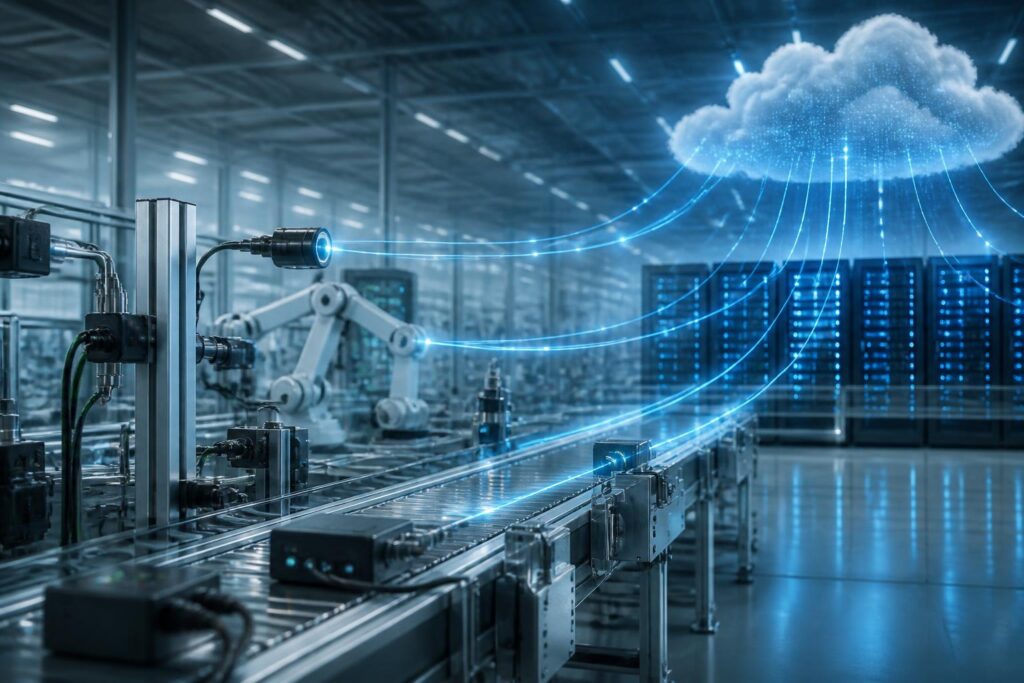
For many years, the common image of cloud computing was that all data was sent to large server centers for processing, after which the results returned to users’ devices. This model laid the foundation for many familiar services, from online storage and video conferencing to data analytics applications. However, as the number of connected devices has grown rapidly and systems have increasingly required near-instant responses, sending all data over a long distance to a server center has begun to reveal its limitations.
Edge computing emerged in this context. Instead of concentrating all processing in a remote location, this model distributes part of the computing and storage capacity closer to where data is generated. The “edge” may be a server located in a factory, a network device in a store, a controller in a building, or a small computer installed directly inside a vehicle. The goal is not to eliminate cloud computing, but to create a more flexible way to coordinate data centers, networks, and end devices.
Why Does Data Need to Be Processed Close to Its Source?
Every sensor, camera, measuring device, or application is generating more data than before. If all raw data is transferred to a central server, the system must use substantial bandwidth while also depending on the quality of the network connection. In applications that do not require a fast response, this latency may not be significant. But for a production line that needs to detect defective products, a traffic control system, or equipment that monitors machine activity, even a delay of a few seconds can reduce the value of the information.
Processing at the edge allows a system to analyze data right where it is generated. A camera in a factory can identify signs of abnormality and send only an alert or a condensed result to the central server. A measuring device in a building can detect an unusual increase in electricity consumption without continuously transmitting all its data to an external service. This approach reduces the amount of data that must be moved while shortening the path between the moment information appears and the moment the system takes action.
Edge computing is also useful in places where connectivity is unstable or limited. A transport vehicle, a remote production area, or an outdoor device does not always have a fast and continuous connection. If a system can maintain its core functions locally, it will be less dependent on frequent communication with a data center. Once connectivity is restored, aggregated data or necessary records can then be synchronized with the larger system.
How Does Edge Computing Differ from Cloud Computing?
Cloud computing typically concentrates resources in large-scale data centers. This model is convenient for scaling, centralized management, backups, and running tasks that require substantial computing capacity. Businesses can rent resources as needed instead of building all the infrastructure themselves. It remains an important choice for tasks such as long-term storage, model training, large-scale data analysis, or managing multiple locations.
By contrast, edge computing distributes resources across multiple locations closer to devices and users. Edge nodes are generally smaller in scale and handle specific tasks such as filtering data, classifying events, detecting anomalies, or controlling devices. A real-world system can combine both models: edge nodes process decisions that require a fast response, while the cloud stores data long term, trains models, and performs analysis at the system-wide level.
Therefore, edge computing should not be viewed as a complete replacement for the cloud. The two models address different parts of the same chain of operations. The edge helps reduce latency and keeps local functions operating more reliably. The cloud provides centralized capacity, broad visibility, and management tools at scale. The value lies in dividing the work appropriately, not simply in choosing one over the other.
Practical Applications That Are Easy to Recognize
In manufacturing, edge computing can connect with cameras, sensors, and control systems on a production line. Instead of sending all images to a remote server, a computer at the factory can screen for notable frames, identify defects according to established rules, or detect unusual changes in machine activity. Employees can still view consolidated reports, while decisions requiring a rapid response are made close to the production line.
In retail, edge devices can help monitor the condition of shelves, customer traffic, or the operation of equipment in a store. Businesses do not necessarily have to transmit all raw data to a central system. Processing in the store can produce general indicators, such as busy periods or an alert that a piece of equipment needs inspection. This both reduces the load on the connection and helps the store maintain certain operations even when connectivity is temporarily disrupted.
In buildings, edge computing can serve as a coordination layer for lighting, air conditioning, access control, and safety systems. Sensors record environmental conditions, while local processors provide responses based on configured rules. The aggregated data can then be transferred to a management platform to track energy-use trends or compare operations across multiple facilities.
For vehicles and automated systems, the ability to respond quickly is especially important. A device cannot always wait for a remote server to respond before handling a situation directly in front of it. Edge computing allows sensors and controllers to coordinate locally, while connections to the data center are used for software updates, historical storage, or improving algorithms. The system’s level of autonomy will depend on its design, but the general principle is that urgent decisions should be made as close to the data source as possible.
Privacy Benefits and Limitations to Consider
One frequently cited benefit of edge processing is its ability to limit the transmission of raw data. If a system sends only analytical results, alerts, or reduced data, the amount of information leaving the original location may be lower. This can support privacy protection in cases where the data contains images, audio, or information about people’s activities. However, local processing does not automatically make data secure. Data can still be accessed without authorization if devices, software, or management procedures are not properly protected.
A major challenge of edge computing is its distributed nature. A centralized data center is generally better suited to applying consistent policies for updates, monitoring, and backups. By contrast, a business may have to manage hundreds or thousands of devices at different locations. Each edge node needs to be authenticated, updated, checked for proper configuration, and monitored for operational status. If a device is neglected for a long period, it can become a weak point for the entire system.
Hardware capacity is another limitation. Edge devices are usually compact and energy-efficient, so they cannot handle every task that a large server center can. Businesses need to determine which data must be processed immediately, which data can be sent to the cloud, and which data only needs to be stored for a short time. An architecture without clear distinctions can increase costs, complicate operations, and create many unnecessary copies of data.
A Suitable Approach for Businesses
Businesses should not start by buying more devices and only afterward looking for ways to use them. The first step should be to map the data flows: where data is generated, how quickly a response is needed, whether there are special storage or security requirements, and what happens if the connection to the central system is interrupted. From there, businesses can identify the tasks that genuinely benefit from edge processing.
Implementation should also begin with a measurable scope. A single production line, one store, or a specific group of devices will help a business assess latency, resource consumption, manageability, and the impact on workflows. After the pilot phase, lessons about updates, monitoring, and recovery can be used for expansion. A step-by-step approach is often more practical than deploying everything at once without a clear operating model.
A sound architecture must account for both normal operation and failures. Edge devices need mechanisms for temporarily storing data, recovering after power outages, controlling access privileges, and recording logs. Local processing rules must also be reviewed periodically, because real-world data and conditions can change. In addition to technical factors, operational staff need to understand what decisions the system is making, what data those decisions are based on, and when manual processing is necessary.
Distributed Infrastructure Will Shape New Ways of Operating
Edge computing is not a slogan reserved for large businesses. Essentially, it is a way of organizing infrastructure so that data is processed in the most appropriate location. For some systems, that location is a data center. For others, it may be a server in a building, a factory, or directly on a device. The boundaries between these layers will become increasingly flexible as applications require faster responses and the amount of data continues to grow.
In the future, the important question will not only be how much data a business has, but also which data needs to be processed immediately, which data needs to be stored long term, and which data should not leave the place where it is generated. Edge computing offers one answer by bringing computing capacity closer to where decisions are made. But for the technology to deliver value, businesses will still need a clear architecture, rigorous security procedures, and an evaluation approach based on actual effectiveness rather than on following trends.
