


From Scattered Data to a Living Version of Equipment
In many factories, data about machinery already exists in multiple places: sensors record temperature, control systems store operating parameters, maintenance software tracks repair schedules, while technical staff note equipment conditions after each shift. The problem is not always a lack of data. The greater challenge is that this data is often fragmented, making it difficult for businesses to visualize the overall state of a production line at any given moment.
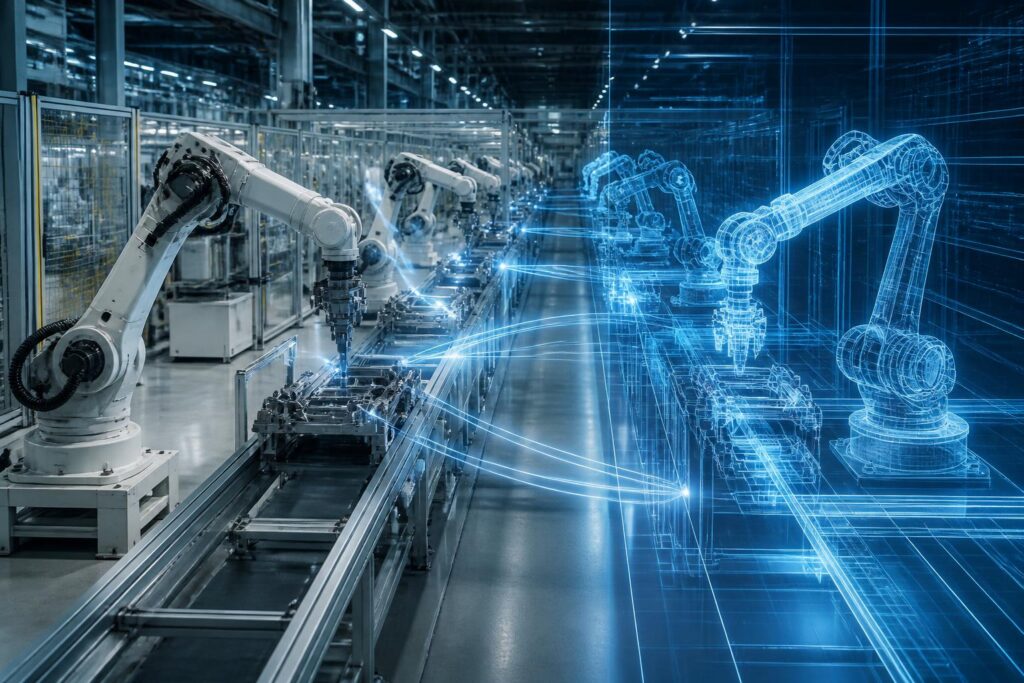
Digital twins were developed to address part of this problem. Simply put, a digital twin is a digital model representing a real-world object, process, or system. It is not merely a three-dimensional drawing or a technical file stored on a computer. When connected to operational data, a digital twin can change according to the actual condition of the object it represents. As a result, managers gain another way to observe, analyze, and test options before making decisions in the real world.
This concept can be applied to an engine, a robotic arm, an entire production line, a building, a transport vehicle, or a supply process. The complexity of a digital twin depends on its intended purpose. A model used to monitor temperature may be far simpler than one used to simulate the performance of an entire factory.
How Does a Digital Twin Work?
A digital twin system usually consists of three main components. The first is the real-world object, along with its measurement points or related data sources. Sensors, control devices, industrial cameras, management software, and employee reports can all provide information to the system, depending on the use case.
The second component is the digital model. This model describes the object’s important characteristics, such as its structure, technical specifications, operating status, relationships between components, and conditions that may affect performance. For a simple system, the model may rely primarily on technical rules. For a more complex system, it may combine historical data, physical simulations, and data analysis methods.
The final component is the connection and visualization layer. Data from the real equipment is fed into the model at an appropriate frequency, after which the results are presented on a dashboard or specialized software. Users can see which equipment is operating normally, which components show signs of abnormality, how energy consumption is changing, or how a particular adjustment may affect the production line.
The important point is that a digital twin does not automatically become useful simply because a business has built an attractive model. Its value comes from a reliable connection between the model and real-world data. If the data is delayed, incomplete, inaccurate, or not properly linked to the equipment, the digital twin may produce an inaccurate picture even if its interface looks highly modern.
Three Valuable Uses in Operations
Detecting Signs of Abnormality Earlier
Under traditional maintenance practices, businesses often repair machines after they break down or inspect them according to a fixed schedule. The first approach can cause unexpected disruptions, while the second may lead businesses to replace components that still have substantial working life. Digital twins open up an approach based on the actual condition of the equipment.
When operational data is monitored continuously, the system can identify changes that differ from normal conditions. A gradually increasing vibration level, consistently higher temperatures, a longer cycle completion time, or changes in electricity consumption may all be signals that require inspection. These signals do not necessarily prove that a machine is about to fail, but they give technical teams a basis for investigating early rather than waiting until the problem becomes serious.
This approach also changes the role of maintenance personnel. They do not merely respond to emergency calls; they can plan inspections based on priority, operating conditions, and the production schedule. However, the final decision still needs to be based on technical expertise and on-site inspection. A warning from the model is a starting point for investigation, not an absolute conclusion.
Testing Before Changing the Production Line
Adjusting a real production line is often time-consuming and risky. Changing the speed, equipment layout, operating schedule, or raw-material supply process can affect product quality and delivery schedules. A digital twin allows businesses to test certain scenarios in a simulated environment before implementing them in the real world.
The value of simulation does not lie in predicting everything perfectly. Simulation helps decision-makers see assumptions, dependencies, and potential trouble spots more clearly. If an adjustment improves productivity at one stage but creates a bottleneck at the next, the model can help identify this earlier. This reduces the number of costly experiments on an operating production line.
Training and Sharing Operational Knowledge
A complex system often depends heavily on the experience of people who have worked with it for many years. When personnel change or a business expands its production shifts, transferring knowledge becomes more difficult. A digital twin can provide an intuitive interface for new employees to learn about equipment structures, alert-handling procedures, and the relationships between components.
In a training environment, employees can observe simulated situations without directly affecting real machinery. They can also review how a past incident unfolded, compare conditions before and after it was addressed, and thereby gain a clearer understanding of the causes and consequences of each action. Technology does not completely replace instructors, but it helps operational knowledge be recorded and shared in a more systematic way.
The Benefits Go Beyond Reducing Downtime
When implemented with the right objectives, a digital twin can support many decisions beyond maintenance. Consolidated data helps businesses assess energy use, monitor equipment effectiveness, identify wasteful stages, and consider upgrade options. During the design phase of a new facility, a digital model also helps engineering, operations, and management teams communicate using a shared view rather than relying on disconnected sets of documents.
This technology can also support asset life-cycle management. From the time equipment is installed and operated through repairs and eventual replacement, related information can be linked in a unified record. This helps businesses understand not only the current condition of equipment but also why it reached that condition. Such data can provide a basis for deciding whether to repair, upgrade, or make a new investment.
Even so, a digital twin should not be viewed as a tool that automatically generates savings. If a business has no process for responding to alerts, assigns no one responsibility, or does not measure the results of each change, the system can easily become a screen displaying a great deal of data while having little impact on actual operations.
Barriers That Need to Be Considered from the Start
The first barrier is data quality. Older equipment may not have suitable sensors, data from different systems may use inconsistent formats, and information entered by people may be incomplete or inconsistent. Businesses need to determine which data is truly necessary, how frequently it needs to be updated, and how it will be checked before being fed into the model.
The second barrier is the ability to connect with existing systems. A factory often uses equipment from multiple suppliers and acquired through several investment phases. Bringing everything into a new platform may require changes to the technical architecture, the addition of an intermediary layer, or the development of separate governance processes. For this reason, implementing a digital twin within a limited scope is often more practical than attempting to model the entire business from the outset.
Information security is also an issue that cannot be taken lightly. As operational data becomes more interconnected, the number of points that need protection also increases. Businesses need to manage access rights, isolate critical networks, monitor unusual activity, and develop response plans for failures in connectivity or analytical systems. A digital twin should support safer operations, not become a new gateway that increases risk.
There are also human barriers. Technicians may not trust an alert if the system frequently generates false alarms. Managers may find the model difficult to use if the interface is overly complex. Addressing these issues requires businesses to test the system with actual users, clearly explain its limitations, and continuously adjust it based on feedback.
Businesses Should Start with a Specific Problem
A digital twin project has better prospects when it begins with a clear problem, such as reducing downtime for a group of machines, improving the ability to monitor operating conditions, or supporting training for a high-risk process. The more specific the objective, the easier it is for a business to determine what data needs to be collected, choose the model’s level of detail, and evaluate the results.
After the pilot stage, a business can consider expanding to related equipment or processes. Expansion should be accompanied by common standards for data, access rights, asset naming, and evaluation methods. If each department builds an isolated model, the organization may simply create new “data silos” under a more modern name.
A digital twin is not a promise that every failure will be predicted or every decision will become automated. It is a capability layer that helps people observe systems more effectively, conduct better-informed experiments, and preserve operational knowledge more completely. When built on reliable data, clear processes, and collaboration between technology and practical expertise, a digital twin can become an important foundation for more flexible and sustainable manufacturing operations.
In the period ahead, the important question for businesses is not only whether they should use a digital twin. The more practical questions are which object should be modeled first, which decisions will improve through the use of data, and whether the organization is ready to change its processes so that the digital model can be turned into action. How these questions are answered will determine whether a digital twin becomes a valuable investment or merely a visual representation detached from day-to-day operations.
