


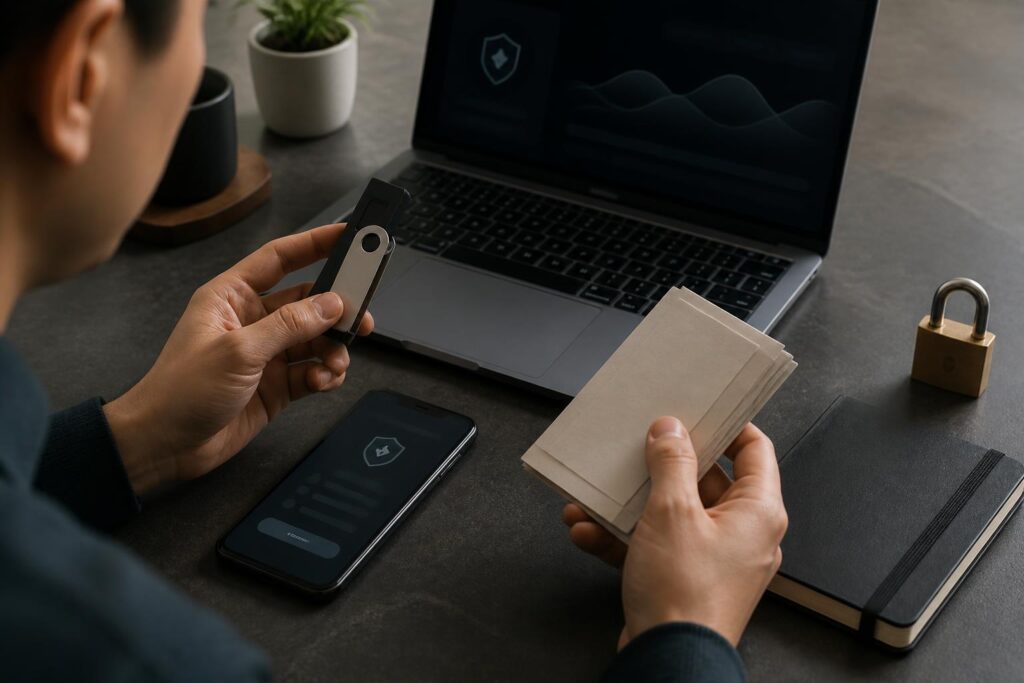
Self-custody is not an installation step
In cryptocurrency, the phrase “self-custody of assets” is often used to describe users directly controlling the keys that allow access to their assets. This approach differs from keeping assets on an intermediary platform, where users log in with an account and depend on the service provider’s system. However, self-custody does not mean that simply downloading a wallet app and clicking a few buttons will make everything secure.
A cryptocurrency wallet does not store coins in the ordinary sense. It stores or generates cryptographic information to prove control over assets on a blockchain network. The wallet interface helps users view balances, create transactions, and sign transactions, but the decisive element remains the private key or corresponding recovery mechanism. If someone else obtains this information, they may be able to carry out transactions without the owner’s consent. Conversely, if the owner loses the recovery information, regaining access can be very difficult, or even impossible.
Private keys and recovery phrases must be properly understood
A private key is secret information used to sign and confirm transactions. A recovery phrase, usually consisting of a sequence of words generated when setting up a wallet, can serve as a backup that recreates access to the wallet on a compatible device or application. The two concepts are related but should not be regarded as an ordinary type of password.
A password for logging into an application can be changed or reset through a service’s process. A recovery phrase, meanwhile, usually cannot be reissued on request by any support hotline. Users should also not send this phrase to anyone claiming to be a support employee, administrator, technical expert, or project representative. A request for the recovery phrase to “verify the wallet,” “unlock assets,” or “receive rewards” is a sign to stop and verify independently.
It is also necessary to distinguish a wallet address from secret information. An address may be shared when receiving assets, but the private key and recovery phrase must be kept confidential. Making an address public can still reveal transaction history and balances on transparent networks, so privacy is also part of wallet management, even though it does not replace the requirement to secure the keys.
Setting up a wallet: slowly, offline, and with cross-checking
The initial setup is when users should minimize haste as much as possible. A wallet application should be downloaded from an official source, and the developer’s name, domain name, or distribution channel should be carefully checked before installation. Applications with interfaces resembling familiar products may still be counterfeit. Users should not search and immediately click an advertising result or a link sent through a message without first verifying its source.
When the wallet generates a recovery phrase, users should write it down in the correct order and check every word. A paper backup can avoid certain risks from network-connected devices, but it must be stored in a dry, discreet place that is difficult for others to access. Taking screenshots, saving it in email, entering it into a cloud-synchronized notes application, or sending it through a messaging platform all create additional risk exposure. An infected device, a compromised cloud account, or an unnoticed automatic backup could all expose the information.
After recording it, users should carry out the recovery-check process according to the official instructions for the type of wallet being used. The purpose is to confirm that the backup was recorded accurately, not to experiment arbitrarily with a large amount of assets. For newcomers, sending a small amount first and then checking the receiving address on the device can help detect operational errors. It is important to remember that blockchain transactions generally do not have a simple “cancel” mechanism like transferring money within a banking application.
Weaknesses often lie in the process, not only in the software
Many people focus on choosing a well-known wallet while overlooking daily habits. The computer or phone used to manage a wallet should have its operating system and applications updated from trustworthy sources. Device passwords should be difficult enough to guess, and an additional authentication layer should be enabled for application-download accounts, email, and related services. However, two-factor authentication for an account cannot replace protecting the private key if the key has already been exposed.
Scams often exploit a sense of urgency. A website may announce that the user is about to lose access, needs to connect a wallet to receive assets, or must sign a transaction to complete verification. A professional presentation does not prove that the request is legitimate. Before connecting a wallet or signing, users should check the domain name, the source of the notification, the permission details, and the transaction’s actual purpose. If they do not understand what the transaction is requesting, the safer choice is not to sign and to find independent documentation for further reading.
Granting permissions to decentralized applications also needs to be considered separately. Connecting a wallet once does not always mean that assets are being transferred, but some transactions may allow a contract to interact with assets under certain conditions. Users should limit unnecessary permissions, review granted permissions if the wallet or network supports this feature, and be cautious with pages that repeatedly request actions to “fix an error” or “unlock” something.
Hardware wallets do not eliminate the user’s responsibility
Hardware wallets are often chosen to separate transaction signing from computers or phones that are frequently connected to the internet. This can be a useful layer of protection for people managing assets over the long term, but it does not reduce risk to zero. The device may still be mistakenly purchased from an untrustworthy source, have its initialization process altered, or be used incorrectly.
Users should initialize the device according to the manufacturer’s instructions and should not accept a recovery phrase that was generated in advance or included beforehand. The recovery phrase must be generated during the user’s own setup process. When signing a transaction, the address and important information should be cross-checked on the device’s trusted screen, not merely viewed on a computer display that may have been tampered with. A hardware device also does not protect users from accidentally signing a malicious transaction or being persuaded to enter the recovery phrase on a fake website.
Backups must account for loss, damage, and inheritance
A single backup can create a single point of failure. If it is lost in an incident at home, damaged by environmental conditions, or obtained by someone else, control over the assets may be affected. Conversely, creating too many copies in too many places also increases the chance that one copy will be exposed. The balance depends on the value of the assets, living conditions, and the extent to which the user can control the storage locations.
Users should make a specific plan instead of merely thinking that they “will back it up later.” The plan can answer practical questions: Where is the backup located? Who knows it exists? In an emergency, who can legally access it? And how can an authorized person avoid knowing more than necessary? If using a multisignature mechanism or dividing access rights, users need to understand the recovery process clearly before placing assets into it. A complex structure that has never been tested may be harder to manage than a simple, clearly documented option.
Checklist before putting assets into a wallet
Before transferring a significant amount, users should confirm that they are using the correct application and the correct network. The receiving address should be checked character by character, especially when copied from an intermediary device. A test transaction with a small value can help confirm the process, but it does not eliminate the need to recheck the later transaction. Note that assets with the same name may exist on different networks, while sending to the wrong network can lead to a complicated recovery process.
After the transaction, the necessary information for verification, such as the time, address, network, and transaction ID, should be recorded, but it should not be stored in the same place as the recovery phrase if doing so increases the risk of linking an identity to the assets. Users should also establish in advance the maximum amount allowed to be held in a frequently connected wallet, a wallet used for experimentation, and a long-term storage wallet. Separating purposes helps reduce the impact if an application or a single interaction is compromised.
Self-custody of cryptocurrency wallets is a choice that comes with corresponding control and responsibility. What matters is not finding an app with the most attractive design, but building a repeatable process: protecting the recovery phrase, checking software sources, reading transactions carefully, limiting permissions granted to applications, and preparing a recovery plan. When security is treated as a chain of behaviors rather than a single product, users have a better chance of recognizing mistakes earlier and managing digital assets more cautiously.
