


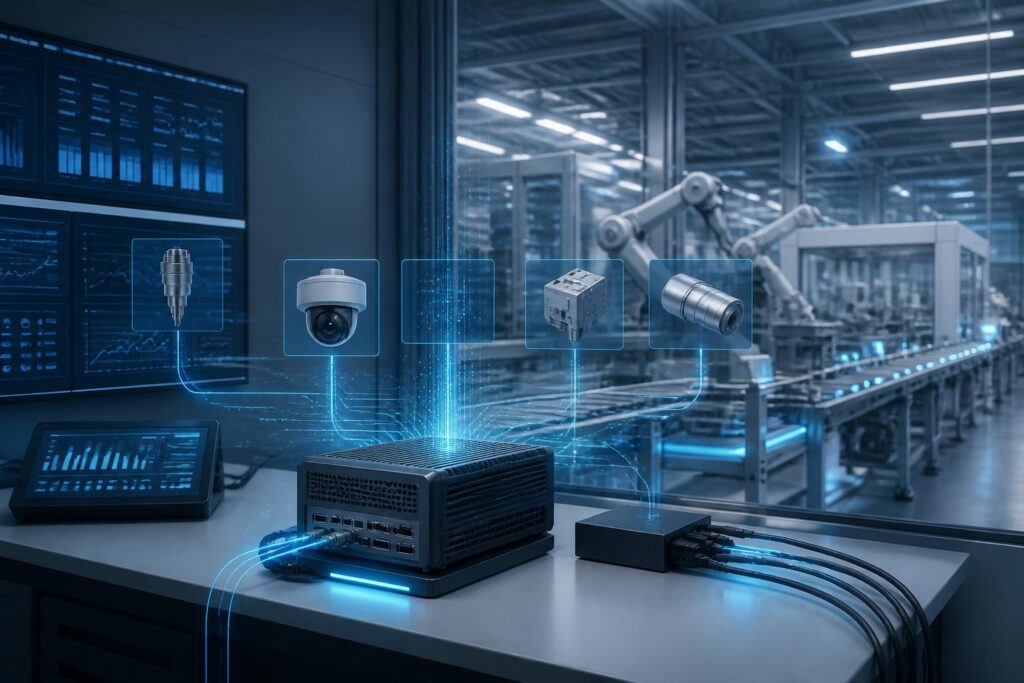
For many years, cloud computing was considered the natural answer to the problem of storing and processing data. Devices in the field collected information and then sent everything to a remote data center for analysis. This approach provided scalability, ease of management, and the ability to take advantage of powerful hardware systems. However, as the number of sensors, cameras, connected machinery, and mobile devices has grown rapidly, pushing all data to the cloud has begun to reveal limitations in latency, bandwidth, transmission costs, and control.
Edge computing emerged from the need to bring some computing capacity closer to where data is generated. Instead of viewing endpoint devices merely as passive sources of signals, this model adds processing layers at factories, stores, hospitals, telecommunications stations, or local clusters of devices. Data can be filtered, analyzed, and transformed there before the necessary results are sent to the central system.
What Problem Does Edge Computing Actually Solve?
The most important point about edge computing is not to bring an entire data center down to every device. The more practical goal is to allocate workloads to the appropriate locations. Tasks requiring responses within a very short time can be performed at the edge, while aggregation, model training, long-term reporting, or historical storage can still be sent to the cloud.
Imagine a production line with multiple cameras monitoring product quality. If every frame has to travel over the network to a data center and then return with a processing command, the system will depend heavily on connection quality. Even a brief delay or interruption can cause alerts to appear late. An edge server located in the factory can analyze images on-site, detect signs of abnormalities, and send only the necessary results or data samples back to the central system.
The same applies to temperature-monitoring systems, robot control, energy management, and vehicle tracking. When decisions need to be made where an event occurs, shortening the distance data travels provides clear value. However, edge computing is not a promise that all latency problems will disappear. Its effectiveness also depends on hardware, software, network design, and the way data is organized.
Edge Does Not Mean Being Separate from the Cloud
A common misconception is to view edge computing and cloud computing as mutually exclusive choices. In reality, the two models often complement each other. Edge devices can handle data collection, noise filtering, and immediate responses. The cloud still plays a role in centralized storage, coordination across multiple locations, trend analysis, and the provision of management tools.
This hybrid architecture requires businesses to classify data according to its value and processing requirements. Some data only needs to be used for a few seconds to control a specific action. Other data needs to be retained for comparison, auditing, or detecting patterns over time. If all data is kept intact and transmitted, the system will consume resources. If filtering is too aggressive at the edge, the business may lose information that would be useful for later analysis.
Therefore, good design usually does not begin with the question of whether to use the cloud or an edge server. A more appropriate question is which data needs to be processed where, under what conditions, with what level of reliability, and who has access rights. This approach turns edge computing into an overall architectural challenge rather than simply a matter of purchasing an additional computing device.
Fields That Benefit Clearly
In manufacturing, edge computing can support machinery monitoring, defect detection on production lines, and process adjustments when operating conditions change. Devices at factories often generate large amounts of data, but not every piece of information needs to be sent in full to a central location. An on-site processing layer helps reduce redundant data while maintaining the ability to respond when external connectivity is unstable.
In healthcare, this model can be used to process data from monitoring devices, support the operation of imaging systems, or control equipment in hospitals. This is a field that requires particular caution. Processing data close to its source can help reduce the need to transmit sensitive information, but it does not mean that the data is automatically safer. The system still needs access controls, encryption, activity logging, and clear inspection procedures.
In retail and logistics, edge servers can help stores, warehouses, or distribution centers respond quickly to equipment conditions, goods flows, and local demand. Locations with unstable connectivity can also maintain some basic functions instead of having to stop completely when communication with the central system is lost.
For cities, edge computing is often mentioned in connection with transportation, lighting, environmental monitoring, and building management systems. A processing node placed near the area being observed can aggregate signals from multiple sensors and then send out the necessary alerts or indicators. This approach helps reduce transmission volume, but data collection in public spaces still needs to be considered in terms of privacy and purpose of use.
The Challenges Lie in Management, Not Only in Hardware
Deploying edge computing is often more difficult than putting a server in a server room. A system may consist of dozens or thousands of nodes located in many places, under different temperature, power, and network-quality conditions. Each node needs to be installed, updated, monitored, and replaced when problems occur. If management procedures are not consistent, these seemingly small, scattered devices will quickly become a large risk surface.
Security is a prominent challenge. An edge server placed in a production area or store may be more accessible than a strictly protected data center. Attackers may target not only the data but also attempt to alter software, seize control, or disrupt operations. Therefore, devices need to be authenticated before joining the network, software must have a reliable update mechanism, and all important activities need to be recorded for investigation.
Businesses also need to consider how operations will continue when connectivity is lost. A good edge system should not have only two states: fully operational or completely stopped. It needs to determine which functions are still permitted to run independently, which data must be stored temporarily, how long it should be retained, and how synchronization will occur when connectivity returns. This policy must be tested, because a plan that exists only in documentation will be of little help during an actual incident.
From Small Experiments to a Scalable Architecture
Businesses do not necessarily have to begin with a large-scale deployment program. A cautious approach is to select a process with clearly defined boundaries, in which the benefits of faster responses or reduced data transmission can be measured. After the pilot phase, the team can evaluate stability, operating costs, integration capabilities, and impacts on users before expanding.
Hardware selection also needs to be tied to the real-world environment. Equipment used in an office is not necessarily suitable for a factory with significant dust, vibration, or high temperatures. In addition to performance, it is necessary to consider replaceability, update support, power consumption, configuration backup options, and the length of support provided by the vendor. A system with strong specifications but that is difficult to maintain may create greater-than-expected long-term costs.
At the software layer, applications need to be designed to withstand intermittent connectivity and differences between nodes. Data must have rules for formatting, synchronization, and conflict handling. Analytical models running at the edge also need to be monitored to detect quality degradation caused by changes in the environment or data. If software is updated without checking the results, a business may maintain a system that is operating but is no longer reliable.
Edge Computing Will Develop Toward Controlled Distribution
The value of edge computing lies in its ability to combine multiple computing layers rather than replace one model with another. Devices can perform simple operations, local servers can handle tasks requiring rapid responses, and the cloud can take on large-scale analysis and overall management. Each layer has its own role, but they form a useful system only when connected by clear rules.
In the coming period, interest in edge computing may continue to grow along with the number of connected devices and the need to process data locally. However, deployment decisions should not be based on the technology’s name. Businesses need to start with operational problems, response-time requirements, the sensitivity of the data, and their existing management capabilities. When these questions are answered specifically, edge computing can become a truly useful infrastructure layer rather than a difficult-to-control distributed investment.
