


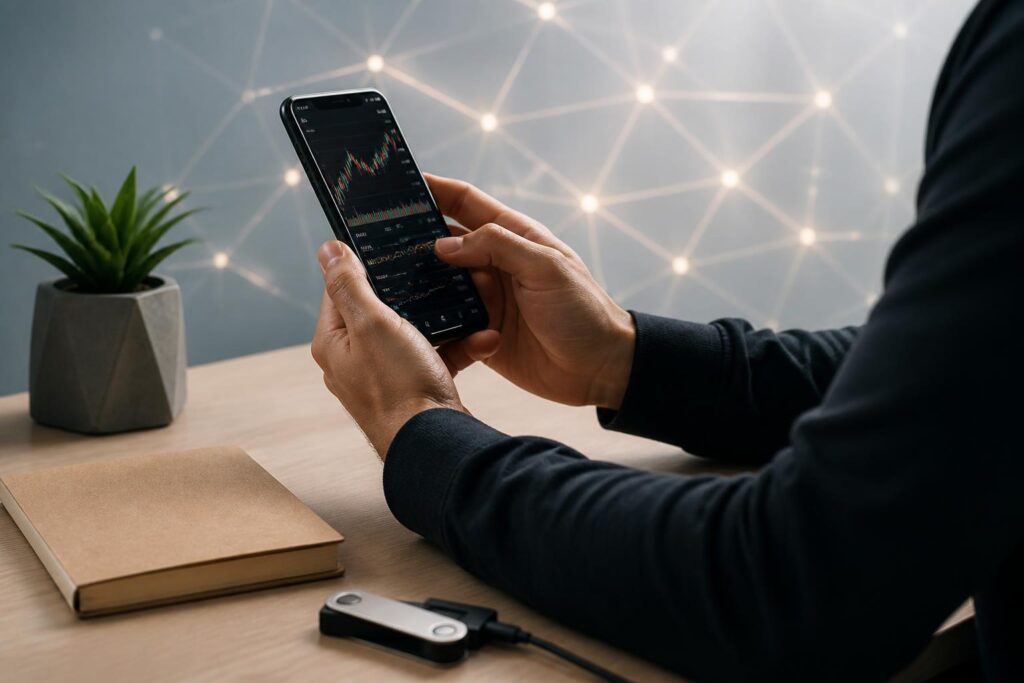
In the world of cryptocurrency, the phrase “not your keys, not your coins” is often used to describe the difference between assets held on an intermediary platform and assets held in a self-custody wallet. This expression emphasizes an important principle: the ability to use assets on a blockchain is tied to control of the private key, not merely to seeing a number in an account.
A self-custody wallet can provide a greater degree of personal control, but it is not automatically a safe solution in every situation. Users do not transfer security responsibilities to an exchange or custodial service; they must protect their own recovery information, verify the recipient address themselves, choose the network themselves and accept the consequences if they make a mistake. Therefore, understanding self-custody wallets should not stop at knowing how to install an application. More important is understanding the control model, the points that are easy to confuse and the process for using the wallet cautiously.
What Does a Self-Custody Wallet Actually Control?
A blockchain does not store a “wallet” in the physical sense. On the network, assets are recorded through addresses and transaction states. A wallet is a tool that helps users create, manage and use the cryptographic information needed to interact with those addresses. In a self-custody model, the wallet application typically generates a private key or information that can be used to recover a private key. Whoever controls this information can sign transactions from the corresponding address.
This does not mean that the wallet application can arbitrarily take the user’s assets, nor does it mean that the assets are stored on the phone. A phone, computer or hardware device is merely a place where control information is stored or used. The assets remain recorded on the blockchain. When a user sends funds, the wallet creates a transaction and uses the private key to confirm that the transaction originated from the person who controls the address.
This distinction helps explain why losing a device does not necessarily mean losing the assets, as long as the user still has valid recovery information. Conversely, if the recovery phrase is exposed, someone else can restore the wallet on another device. In that case, still having the old phone does not guarantee that the assets remain safe.
A Recovery Phrase Is Not an Ordinary Password
Many wallets for individual users use a recovery phrase consisting of multiple words generated according to a specific process. This phrase can help recreate access to the wallet, so it should be treated as a copy of the master key. Users should not enter the recovery phrase into an online form, send it through messages, save a photo of it in the phone’s gallery or give it to anyone claiming to be a support representative.
An application password and a recovery phrase serve different purposes. A password can help lock the application on a particular device, while a recovery phrase can provide a way to restore the wallet on another device. If an application requests the recovery phrase while logging in to a website that is not the official wallet application, that is a sign to stop and investigate. Ordinary transaction support does not require users to disclose information capable of controlling the entire wallet.
The appropriate storage method depends on each person’s circumstances, but the general principle is to create an offline record that is easy to read and keep it in a private, durable place with limited exposure to fire, moisture or loss. Users also need to consider whether they themselves will be able to find that record again after a long period of time. A method that is overly secret but cannot realistically be recovered creates no less risk than careless storage.
Checks to Make Before Sending Assets
Cryptocurrency transactions often do not have a simple reversal mechanism like some traditional forms of money transfer. Therefore, the process before pressing the confirmation button should be treated as a mandatory layer of protection, not an unnecessary formality.
First, users need to identify the correct asset and the correct network supported by the recipient. An asset name may appear on several different networks, while an address or identifier only has meaning in the context of the corresponding network. Choosing the wrong network may cause the assets not to appear where expected or may result in a complicated recovery process. Users should not assume that two networks with similar names will always be compatible.
Next, the recipient address should be checked across multiple groups of characters, rather than by looking only at a few characters at the beginning and end. If the address is copied from the clipboard, users should paste it and compare it again with the original address. Malware may attempt to replace data during the copying process, and misreading even a single character is enough to send a transaction somewhere else. For large amounts, a small test transaction can help verify the process, although fees and network conditions still need to be taken into account.
Finally, users must review the transaction fee, the amount to be received and every notification on the signing screen. Some interfaces may display technical information that is difficult to understand, especially when users connect a wallet to a decentralized application. If users do not understand what permissions the transaction is requesting, they should not sign simply because they want to complete it quickly.
Connecting a Wallet to an Application: Convenience Is Also a Risk
Self-custody wallets are often used to connect to applications on the blockchain. Connecting may allow an application to read certain public information or ask the user to sign a transaction. However, a “connect” button does not mean that assets are immediately transferred, while a “sign” button can create a commitment far more significant than simply logging in.
Users need to distinguish between different types of requests. Some requests only confirm ownership of an address through a signature that does not incur a fee. Some authorize a contract to use a particular type of asset within a specified scope. Others directly transfer assets or carry out an irreversible action. Names and presentation vary by wallet, network and application, so no simple rule can be applied to every situation.
Before connecting, users should verify the application’s correct domain name or installation source and avoid accessing it through unfamiliar links in messages or comments. After use, users can review the list of connections and permissions granted in the wallet or in a tool appropriate for the network being used. Disconnecting the interface does not always mean that all granted permissions have been revoked. If a permission allowing a contract to interact with assets is still active, users need to find the correct function to revoke or adjust that permission.
Software Wallets and Hardware Wallets
Software wallets are often convenient for daily transactions because they can be installed on a phone or browser. This convenience comes with the need to protect the device, operating system, browser and extensions. A device infected with malware, unlocked by someone else or used in an unsafe environment can all increase the risk of information being exposed.
Hardware wallets separate part of the transaction-signing process from an ordinary computer or phone. Users still need to confirm the information on the device and protect the recovery phrase, because a hardware device cannot turn a careless process into an absolutely safe one. If a device is purchased from an untrustworthy source, the initial verification step is skipped or a pre-supplied recovery phrase is entered, users may put themselves at risk from the outset.
No type of wallet is suitable for every need. A wallet used for small amounts and frequent transactions may be organized differently from one intended for long-term storage. A practical approach is to separate purposes, limit the balance in wallets that are frequently connected to applications and sign only transactions that one clearly understands. This separation does not eliminate risk, but it can limit the impact if an account or device encounters a problem.
Mistakes Often Begin with Haste
Asset losses do not always originate from a sophisticated attack technique. Many risks arise when users are quick to believe promises of profits, mistake a fake support account for an official channel, scan a code without checking it or sign a transaction out of fear of missing an opportunity. Scammers often exploit time pressure and a lack of clarity in the interface rather than relying solely on a technical error.
Offers that ask users to provide their recovery phrase to “verify,” “unlock,” “receive a reward” or “protect assets” should be treated as danger signs. Similarly, a program that requires users to send money first in order to receive a larger amount in return should be viewed skeptically. The fact that an account has a profile picture, a particular name or a large number of followers should not be considered sufficient proof of its identity.
If users suspect that they have signed an unusual transaction, they should stop all further actions, check their balance and transaction history through a trustworthy source and consider moving the remaining safe assets to a new wallet if the private key or recovery phrase may have been exposed. Changing the application password cannot remedy a situation in which someone else has learned the private key. In cases involving decentralized applications, users also need to review the permissions that have been granted, not just the most recent transaction.
Turning Control into a Disciplined Process
Self-custody should not be understood as having to remember every technical detail on one’s own. Users can establish a simple, repeatable process suited to their level of knowledge. This process may begin by categorizing wallets according to their purpose, recording recovery information offline, updating applications from official sources, checking the network before transferring funds and taking time to read the transaction details before signing.
For beginners, experimenting with small amounts in a familiar environment is generally safer than immediately interacting with multiple applications. Users should also learn to identify addresses, networks, transaction fees, access permissions and activity histories before managing assets of significant value. When using shared assets or assisting others, it is important to clearly agree on who holds the recovery information, who is permitted to sign transactions and what arrangements apply if the person responsible can no longer access the wallet.
The core of self-custody wallets is not the elimination of every intermediary, but bringing decision-making power and security responsibility closer to the user. Personal control can help users manage assets in a way that suits them, but it also requires patience, the ability to verify information and the willingness not to sign when something is not understood. In a context where blockchain transactions are often difficult to reverse, a slow and consistent process is more valuable than chasing convenience each time the wallet is used.
Therefore, before choosing a wallet, the important question is not only which application is easiest to use. Users also need to ask themselves how they can protect their recovery information, how they will check transactions and what plan they have if they lose a device or detect unusual access. Once they can answer those questions, a self-custody wallet can become a genuine tool of control rather than merely an application filled with confusing buttons.
