


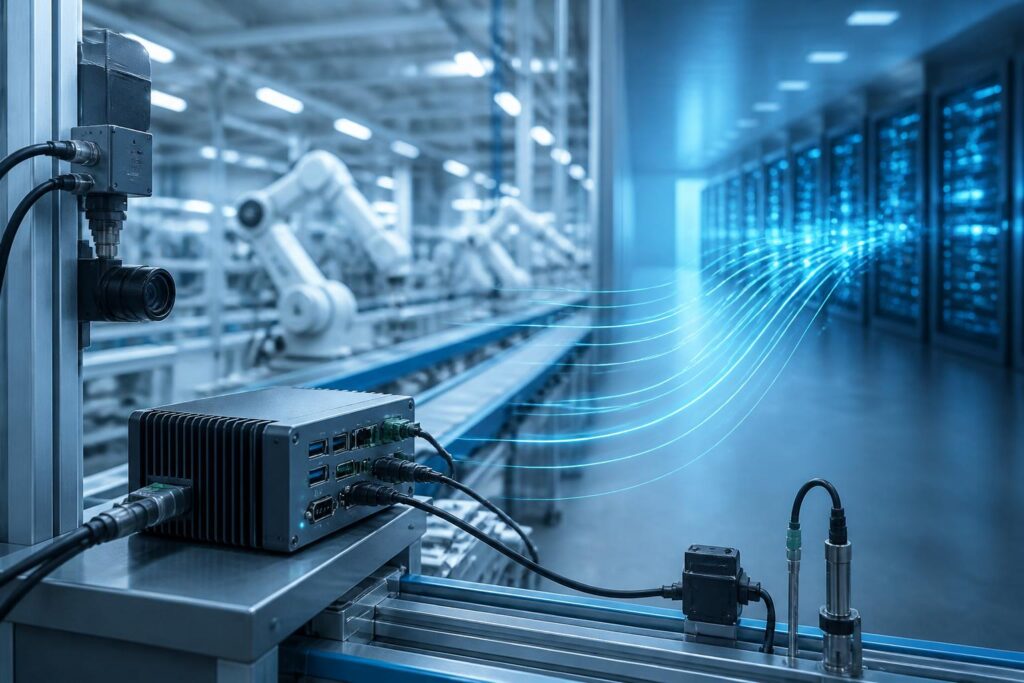
For many years, the common approach to data processing was to send information from users’ devices to a data center or cloud platform, then receive the results in return. This model has provided the foundation for many online services, from storage and collaboration to large-scale data analysis. However, as the number of sensors, cameras, industrial devices, and real-time applications has increased, sending all data through a centralized processing point has begun to reveal its limitations.
Edge computing has emerged as an alternative approach. Instead of always sending data to a remote center, a system can process some or all of the information close to where the data is generated. This could be a computer placed in a factory, a network device at a store, a small server in a building, or the endpoint device itself. This organizational model does not eliminate cloud computing; rather, it redistributes work among the cloud, data centers, and processing nodes located closer to users.
How Does Edge Computing Work?
In the traditional model, a sensor records data, sends it over a network, waits for a server to process it, and then receives a response command. If the data is used only to prepare periodic reports, a delay of a few seconds or minutes may not matter. But in situations that require a rapid response, every transmission stage can introduce latency while also increasing the amount of data that must be moved.
Edge computing adds a processing layer close to the source of the data. For example, a camera in a production area can use a recognition model to filter images directly on the device or on an internal server. The system sends only noteworthy events, analysis results, or aggregated data to the central platform. Data that needs to be stored for a long time, used to train models, or analyzed on a broad scale can still be sent to the cloud.
The important point is that edge computing does not mean that all processing must take place offline. Many edge architectures still depend on connections to central systems to synchronize configurations, update software, back up data, and monitor device status. The difference is that the system can make certain decisions locally instead of waiting for the entire process to be completed elsewhere.
Why Are Businesses Interested in This Model?
The most obvious benefit is reduced latency. A production-line monitoring system can detect signs of abnormality and issue an alert immediately within the local network. An application in a store can continue performing certain functions when its connection to the central system is temporarily unstable. For interactive services, faster responses also make the user experience feel more natural.
Edge computing also helps reduce pressure on network connections. Not all generated data needs to be sent in its entirety to a central location. Sensor data can be filtered, compressed, aggregated, or converted into events before being transmitted. This is particularly significant in environments with many devices operating simultaneously, where the volume of raw data grows faster than transmission or storage capacity.
Local processing also creates another option for data governance. Businesses can design systems so that some sensitive information is analyzed locally, with only the necessary results being sent rather than the entire original data set. However, this is not an automatic guarantee of privacy. The level of security still depends on how devices are configured, how data is encrypted, how access is controlled, and how copies are managed.
Another benefit is the ability to maintain operations under unstable connectivity conditions. Remote locations, moving vehicles, or systems that require continuous operation can use local processing capacity to perform essential tasks. When connectivity is restored, data and operational status can be synchronized according to established policies.
Fields That May Benefit
In manufacturing, edge computing is often associated with equipment monitoring, quality inspection, and anomaly detection. Data from machinery can be analyzed near the production line to identify signals that require early action. The resulting aggregated data can then be sent to central systems to support planning, maintenance, and comparisons among facilities.
In retail, devices in stores can handle activities such as monitoring the condition of shelves and displays, supporting inventory management, or providing near-real-time operational information. This approach needs to be considered carefully if it involves customers’ images, behavior, or personal data. The goal of optimizing operations cannot be separated from the requirements to provide notice, limit collection, and protect information.
In transportation and urban infrastructure, processing data near cameras, sensors, or vehicles can help systems respond to events more quickly. However, decisions that affect human safety need verification mechanisms, fallback plans, and clear limits on automation. An alert that is generated quickly but is frequently inaccurate can still reduce the effectiveness of the entire system.
For artificial intelligence applications, edge devices can run optimized models to recognize, classify, or make predictions where the data appears. This reduces the need to send data continuously to a server. Even so, models running on devices often have to balance accuracy, speed, energy consumption, and hardware capabilities.
The Challenges Go Beyond Hardware
Deploying edge computing is not simply a matter of buying additional small computers and placing them in multiple locations. Each edge node becomes a component that must be installed, monitored, updated, and protected. As the number of devices grows, manual management quickly becomes costly and prone to errors.
The attack surface may also expand. Devices located outside data centers may be vulnerable to physical access, loss of connectivity, or the use of outdated software. Businesses need to manage device identities, apply least-privilege access, encrypt data both in transit and at rest, and be able to detect abnormal behavior. Procedures for recalling or replacing devices must also be considered from the design stage.
A distributed architecture also creates a data-consistency challenge. When an edge node operates temporarily without a connection to the central system, the system must determine which data may be changed, which data must wait for confirmation, and how conflicting versions should be handled. Without clear rules, a business may find that different locations are maintaining different states.
Costs also need to be considered comprehensively. Edge computing may reduce data-transmission costs in some cases, but it also creates costs for equipment, installation, maintenance, monitoring, and replacement. A project should not be evaluated solely by the number of servers or the reduction in network traffic. Long-term operability, staffing requirements, and the cost of resolving incidents are also part of the economic equation.
An Appropriate Approach for Businesses
Businesses should start with a specific operational problem rather than chase a technology label. A process that requires a rapid response, incurs high data-transmission costs, or frequently experiences connectivity disruptions may be a suitable candidate. Conversely, tasks that are not time-sensitive and already operate effectively in the cloud may not need to be moved to an edge model.
The next step is to classify the data and decide where each type of processing should take place. Data requiring an immediate response can be processed locally. Data requiring broad analysis can be aggregated and sent to a central system. Sensitive data needs its own rules regarding storage, access, backup, and retention periods. This division helps avoid the extreme assumption that all data must be at the edge or that all data must be in the cloud.
Small-scale testing is also very important. A pilot project should measure response time, error rates, the ability to operate during connection loss, the amount of data transmitted, and the administrative effort required. These indicators should be compared with the current approach to determine the actual benefits. During this process, a business may also uncover issues involving power supplies, installation environments, access rights, or local support capacity.
Finally, the architecture must be designed for a lifecycle longer than a single deployment. Devices need mechanisms for secure updates, configuration recovery, logging, and replacement at the end of their lifecycles. Edge software should be managed consistently while remaining flexible enough to accommodate different conditions. When these requirements are prepared from the beginning, edge computing becomes an operational capability rather than a collection of disconnected devices.
A Distributed but Not Separate Trend
Edge computing is not an absolute replacement for cloud computing. The two models complement each other in a layered architecture. Devices and edge nodes handle responses that require speed, local operation, and data filtering. Central systems handle long-term storage, centralized management, overall analysis, and the training of larger models.
The value of this model lies in placing each task in the appropriate location. Processing data as close as possible to where it is generated is not always better, just as moving everything to the cloud is not always more efficient. The right decision should be based on latency, cost, security requirements, connection reliability, and management capabilities.
As smart devices continue to appear in a wide range of environments, edge computing will increasingly be viewed as a way of organizing systems rather than as a single technology. Businesses that understand their data, identify which decisions need to be made locally, and build appropriate protection processes will have more opportunities to gain the benefits of this model without turning their infrastructure into a difficult-to-control burden.
