


Not a Faster Computer for Everything
Quantum computing is often described in terms of its enormous potential: simulating matter at the microscopic level, supporting drug design, optimizing networks, and creating computational methods that are difficult for classical computers to match. However, the idea that quantum computers will replace today’s computers for every task is inaccurate. This is a different computing model, suited to certain types of problems and offering no automatic advantage for familiar activities such as writing documents, browsing the web, or storing data.
The key point lies in how information is represented and processed. Conventional computers use bits with a value of 0 or 1, while quantum computers use qubits. A qubit can exist in a superposition of states before it is measured, while multiple qubits can be linked through the property of quantum entanglement. These characteristics make it possible to design algorithms that exploit quantum interference to amplify desired possibilities and reduce unsuitable ones. Even so, superposition does not mean that a computer tries every answer and then immediately reads out the best one. The algorithm still has to be carefully designed so that the result can be observed and verified.
Chemical and Materials Simulation Is a Natural Candidate
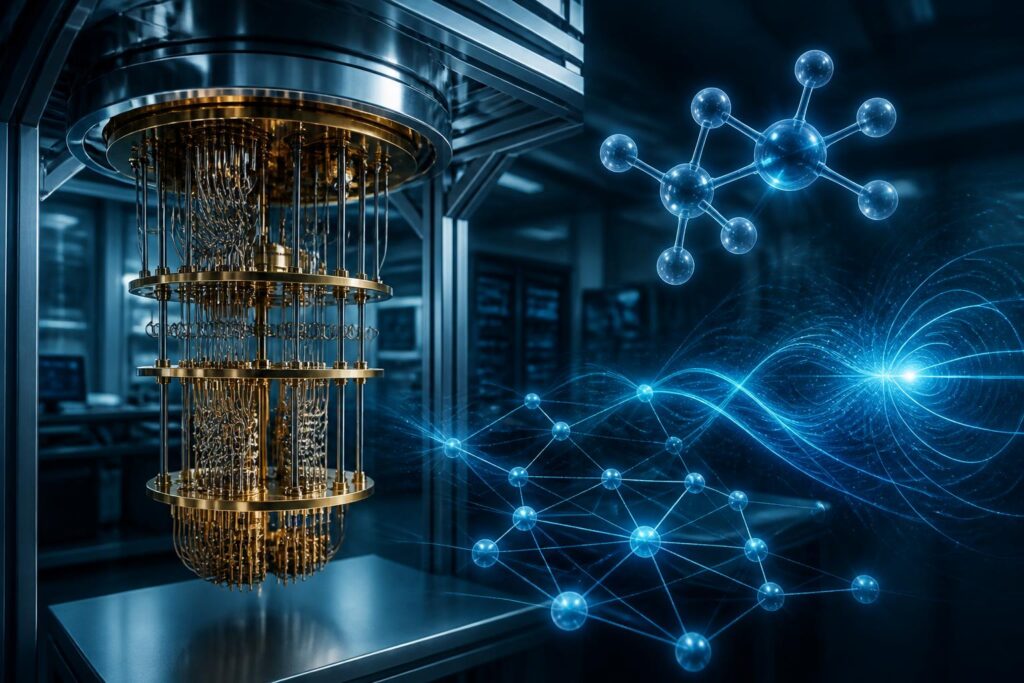
One of the most frequently mentioned directions is the simulation of quantum systems. Molecules, atoms, and materials already operate according to quantum laws. When they are described using classical computers, the computational cost can rise very rapidly as the number of particles and states under consideration increases. Quantum computers share the same physical foundations as the objects being simulated, so in principle they can represent certain chemical and material states more naturally.
The potential applications do not lie solely in creating a visual representation of a molecule. A sufficiently capable system could help estimate quantities related to energy, chemical reactions, or material properties. That information could support the screening of compounds, research into catalysts, batteries, semiconductor materials, and many other fields. A quantum computer does not automatically invent a drug or a complete material; it can only provide valuable computational data for chemists, materials scientists, and engineers to continue evaluating in the laboratory.
This is also an area with relatively clear verification criteria. Results from a quantum circuit can be compared with approximate methods, classical simulations, or experimental data in cases that are small enough. Such verification is very important because current quantum devices are still affected by noise and can produce incorrect results. In the early stages, the practical goal does not necessarily have to be simulating a system larger than any classical computer can handle. It could instead be to produce reliable results for small but scientifically meaningful problems.
Optimization: Great Promise but No Magic Solution
Optimization is another group of problems commonly associated with quantum computing. Businesses may need to schedule production, allocate vehicles, design networks, or choose an option from a very large set. In many cases, the number of possible arrangements grows so quickly that checking them all is impractical. The objective then is to find a sufficiently good option that satisfies multiple constraints and has a low cost.
Some quantum methods seek to represent an optimization problem as an energy function or objective function, and then guide the system toward states with better values. Approaches such as quantum annealing or variational algorithms can combine quantum hardware with classical computers. The classical computer controls the process, selects parameters, and analyzes the results; the quantum processor performs part of the computation. This hybrid model fits current realities, as quantum devices remain limited in their number of qubits, operating time, and error-correction capabilities.
However, an optimization problem should not be equated with a quantum computer always finding the best option faster. Many optimization problems have complex structures, unstable input data, or constraints that are difficult to represent on quantum hardware. A quantum method must also compete with increasingly effective classical algorithms that have been developed over many decades. An advantage is meaningful only when the total time required to prepare data, transfer data into the device, run the circuit, and check the results remains lower than that of the existing method.
Data Analysis and Machine Learning Require Careful Assessment
Quantum computing is also being studied for tasks related to linear algebra, sampling, and machine learning. Some theoretical algorithms indicate the possibility of significant speedups when data is prepared in a suitable way. But this is not an easy condition to meet. Real-world data is usually stored in classical form, so encoding a large amount of data into a quantum state can consume substantial resources. If the cost of loading data into the system is greater than the time saved, the theoretical advantage will not translate into an advantage in practice.
For this reason, claims about “quantum machine learning” should be evaluated through specific problems rather than through the name itself. It is necessary to ask what type of data is involved, which step the quantum model performs, how the results can be compared with those of a classical model, and whether measuring the state destroys necessary information. In some cases, a quantum computer may serve as a specialized component in a larger process rather than as a platform that replaces the entire data-analysis system.
Cryptography Is an Area of Both Risk and Opportunity
Cryptography illustrates how the impact of quantum computing could emerge in both directions. A sufficiently large and stable quantum computer could threaten some public-key cryptography systems currently in use, because suitable quantum algorithms could exploit the mathematical structure of the problems underlying them. This does not mean that all current encryption will be broken as soon as the first quantum device becomes operational. The device would need to reach a very high level of scale, accuracy, and error-correction capability to perform such calculations in practice.
Although the specific timing remains difficult to determine, the transition to methods designed to withstand the quantum threat needs to be prepared for early. An organization must know which types of algorithms it is using, which data needs to remain secure for a long time, and which systems are difficult to upgrade. This is a technology-management problem, not merely a matter of purchasing a new device. Alongside the risks, quantum principles are also being studied for forms of key distribution and communication with distinctive security properties, although these methods have their own infrastructure requirements and operating models.
The Biggest Obstacles Lie in Hardware and Processes
For the applications above to become practical tools, the quantum-computing industry must solve many problems at the same time. Qubits are highly sensitive to their environment and can easily be affected by heat, vibrations, radiation, or unintended interactions. Errors can arise during initialization, the execution of quantum gates, and the measurement of results. As circuits become longer, errors can accumulate and make the results worthless.
Hardware therefore cannot be evaluated solely by the number of qubits. It is necessary to consider qubit quality, gate accuracy, state-maintenance time, the ability to connect qubits, and the effectiveness of the error-correction process. A device with many qubits but high noise is not necessarily more useful than a smaller system with more stable computations. In addition, operating different platforms requires corresponding control systems, circuit-compilation software, and calibration methods.
Quantum error correction creates the prospect of using physical qubits to form more reliable logical qubits, but the cost is the need for additional hardware resources and complex control procedures. Therefore, the path from a laboratory experiment to a commercial product will depend on more than simply increasing the number of qubits. It will also depend on the ability to manufacture systems consistently, reduce operating costs, develop programming tools, and demonstrate that the results provide greater value than classical approaches.
How Should Businesses Approach It?
While waiting for the technology to mature, businesses do not need to chase every claim made in quantum-computing marketing. A reasonable first step is to identify problems with high computational costs, important data, or simulation requirements for which current methods are reaching their limits. After that, an organization can build a classical version as a benchmark, clearly define the success criteria, and test a small-scale quantum model if appropriate.
This approach helps distinguish scientific potential from immediate business benefits. A worthwhile experiment does not necessarily have to prove that quantum computers have surpassed all classical computers. It may show how the data is represented, which steps the algorithm is still missing, where integration costs arise, and which results need further verification. At the same time, businesses should pay attention to interdisciplinary talent, because quantum projects often require cooperation among domain experts, mathematicians, software engineers, and people with a strong understanding of hardware.
Real Value Will Come from the Right Problems
Quantum computing has great potential, but that potential does not lie in a vague promise that every computation will be faster. The technology’s value will be determined by the fit among the algorithm, the data, the hardware, and practical needs. Chemical and materials simulation may be a natural direction because the objects being studied are inherently quantum in nature. Optimization, machine learning, and cryptography also have significant potential, but each field comes with its own conditions and limitations.
A clear-headed view helps the public avoid two extremes: treating quantum computers as miraculous technology, or assuming that all current results are merely demonstrations. This is a developing field with many unresolved technical questions. When those questions are answered through more stable hardware, more practical algorithms, and more transparent measurements, quantum computing could become an important specialized tool alongside classical computers rather than a comprehensive replacement for them.
