


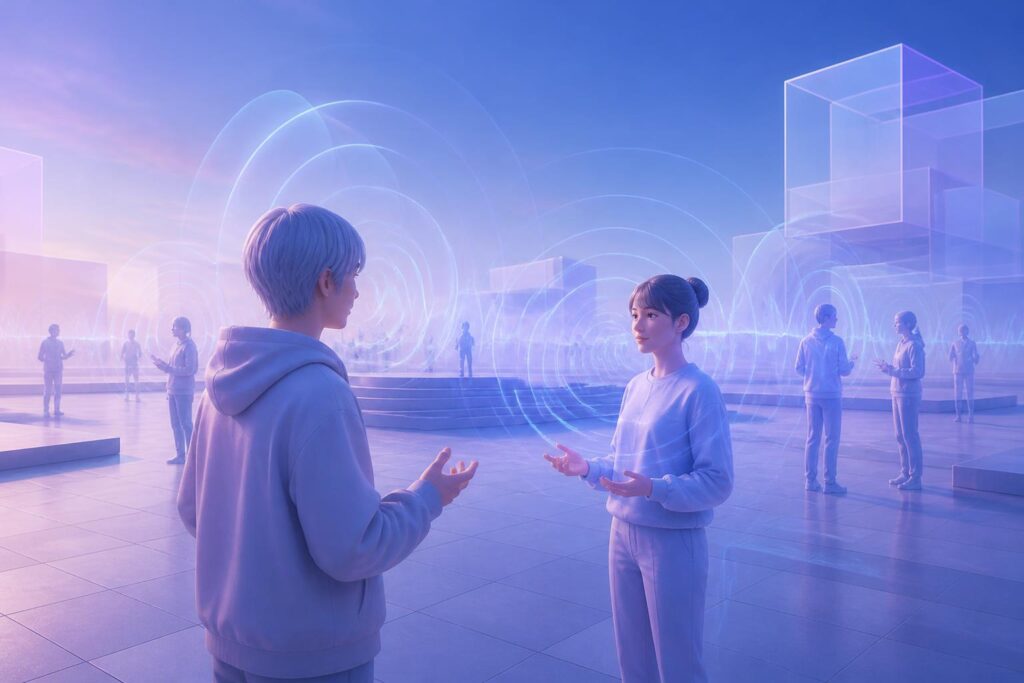
When people talk about virtual worlds, most of the attention is usually devoted to visuals, headsets, avatars, or the ability to interact with digital objects. However, the sense of presence is not created through sight alone. A voice coming from the left, footsteps fading as someone walks away, or sound muffled behind a virtual wall can all change how users understand and respond to a space. Spatial audio is therefore becoming an important infrastructure layer for highly interactive digital environments.
Unlike playing audio uniformly to everyone in a chat room, spatial audio attempts to simulate the relationship between the listener, the sound source, and the surrounding context. Users can sense whether someone is standing near or far away, in front of or behind them, even without looking directly at that person’s avatar. This is not merely a decorative detail. It helps determine whether a virtual world feels like a place where people are present together or merely a conversation interface dressed up with visuals.
How does spatial audio work?
At a basic level, a spatial audio system determines the relative positions of the sound source and the listener, then adjusts the volume, delay, direction, and characteristics of the sound. When someone moves closer, their voice may become clearer. When they move to one side, the sound is distributed differently between the two audio channels. If an object lies between the two parties, the system can simulate sound reduction or changes in reverberation.
These effects do not necessarily have to reproduce every acoustic rule of the real world perfectly. As long as the signals are sufficiently consistent, users can form a sense of distance and direction. The brain naturally combines multiple cues at once to assess an environment. In virtual spaces, sound provides information that visuals do not always offer, especially when users are facing away, have their view obstructed, or are taking part in a conversation involving multiple small groups.
What is notable is that spatial audio does not depend solely on the device. The way a platform establishes rules for voices, ambient sounds, and transitions between areas also greatly affects the experience. A well-designed space needs to make clear which sounds belong to a conversation, which are system signals, and which are intended only to create atmosphere. If every layer of sound is given the same priority, users can easily become overwhelmed and lose the ability to distinguish what matters.
From hearing sound to sensing presence
In an in-person meeting, people recognize the presence of others through more than their faces. They also rely on the direction of a voice, movement patterns, pauses, and very small sounds in the environment. Virtual worlds do not contain all of these physical cues, so sound can help fill part of the gap. When a voice changes according to an avatar’s position, participants have another way to direct their attention without constantly looking at a name list or chat window.
This is especially useful in spaces where many activities are taking place at the same time. One group may be discussing something in one corner while another group talks in a nearby area. Users do not need to hear every conversation clearly. They only need to recognize where interaction is taking place, who is approaching, and whether they want to join. Sound creates a kind of soft boundary, allowing conversations to coexist without forcing all users into a shared channel.
However, a natural-feeling experience also has a downside. An overly convincing audio environment may cause users to forget that they are in a programmed system. They may react quickly to an unexpected voice, a sound behind them, or the feeling that someone is approaching. Therefore, audio design should not focus solely on making the virtual world more like real life. A more important goal is to create an environment that is easy to understand, controllable, and does not leave users constantly on guard.
Privacy is not only about visuals
When entering a virtual space, users often think about who can see their avatar, activity status, or location. But a voice is also identifiable data linked to behavior. A platform may know when a user speaks, whom they are speaking to, which area they are in, and how long they speak. If audio design is not accompanied by clear choices, users may find it difficult to know who can hear their voice.
Privacy controls therefore need to be built into the way audio operates. Users should be able to easily tell when their microphone is on, who can hear them, and whether the audio is being recorded. Actions such as muting oneself, blocking someone, lowering the volume of an area, or leaving the range of a conversation should be easy to find and provide clear feedback. When too many steps are required, users may remain in a conversation they no longer want to participate in.
It should not be assumed that all users want to communicate by voice. Some people only want to hear instructions, some need a quiet space, and some cannot use a microphone or do not feel comfortable speaking in front of strangers. An inclusive virtual world needs to allow flexible switching between voice, text, captions, and visual cues. Turning off audio should not mean losing the ability to understand what is happening altogether.
Accessibility and the risk of sensory overload
Spatial audio can help users navigate, but it can also become a barrier if designed without sufficient consideration. People with different hearing abilities may not perceive the direction of sound in the same way. Some people are sensitive to volume, frequency, or the repetition of sounds. Sounds that seem harmless to a designer can become tiring when they occur continuously over a long period.
For this reason, a good system should provide multiple levels of adjustment rather than only an on-or-off button. Users may need to separate voice volume from ambient sound, reduce directional effects, change how captions are displayed, or prioritize important notifications. Visual cues should also be used to supplement audio, such as showing the source of a sound, who is speaking, or the area from which the sound originates. There is no single configuration that suits everyone.
Captions in virtual worlds should also be understood as more than simply transcribing speech. A useful system can distinguish who is speaking, provide indications of warning sounds, and show when a voice is coming from a distance. Even so, the displayed information must be organized in moderation. If captions constantly cover the user’s field of view or turn too many sounds into text, users will face another form of overload.
Audio design should serve a purpose, not merely create an impression
In many digital products, audio is often added after the visuals and core functions have been completed. This approach can easily produce catchy effects without a clear role. A sound should help users understand something, direct their attention, or provide feedback for an action. If audio is intended only to make a space feel “lively,” it can quickly become noise.
Designers also need to consider differences between contexts. A virtual classroom needs to prioritize the ability to hear the instructor and recognize when one is invited to speak. An exhibition space may need gentle background audio while keeping the narration accessible. In a game or social experience, sound may play a stronger role in guidance and emotional impact. The same rules cannot be used for every environment simply because they are all called virtual worlds.
Consistency is just as important as realism. If audio distance changes unpredictably, users will have difficulty knowing who can hear them. If sound is cut off abruptly when crossing a boundary between areas, they may mistakenly think the connection has failed. Simple rules applied consistently often help users build a better mental model than complex but unpredictable effects.
Users should actively manage their listening experience
For users, managing audio does not have to begin with complicated technical settings. They can check their audio equipment in advance, test the microphone in a private space, and locate the mute, block, and volume-control buttons. When entering a new environment, they should observe the range to which their voice is being transmitted and whether there are signs indicating that the conversation is being recorded.
If they feel tired, have difficulty concentrating, or are being disturbed, users do not necessarily need to leave the entire platform. They can lower ambient sound, turn off unnecessary audio sources, switch to text, or leave a specific area. These choices help preserve their control instead of forcing them to accept the entire experience or abandon it completely.
For children and new users, explaining the range of what can be heard also deserves attention. Someone may think they are speaking only to an avatar standing in front of them, while in reality their voice is being played to many people in the same area. Understanding this mechanism helps reduce unintended disclosures and encourages more cautious communication habits.
How will sound shape virtual worlds?
Virtual worlds are not built only from attractive landscapes. They are also shaped by how users know where they are, who is nearby, and how easily they can leave an interaction. Spatial audio plays a particularly important role in this process because it connects the perception of location with social behavior. It can make a meeting feel more natural, but it can also expose weaknesses in privacy and accessibility.
In the future, the important question will not be how to reproduce the sounds of real life perfectly. The better question is how that audio environment helps users understand, choose, and control their experience. Responsible design will allow users to know what is being heard, what is being transmitted, and how to turn off or change audio layers when necessary.
When placed within a transparent system, spatial audio can become a foundation that makes virtual worlds feel more familiar without sacrificing safety. It creates a sense of presence, supports communication, and offers additional ways to interact for people who do not want to depend entirely on visuals. But the value of the technology ultimately lies in the control it gives people, not merely in the realism of its effects.
