


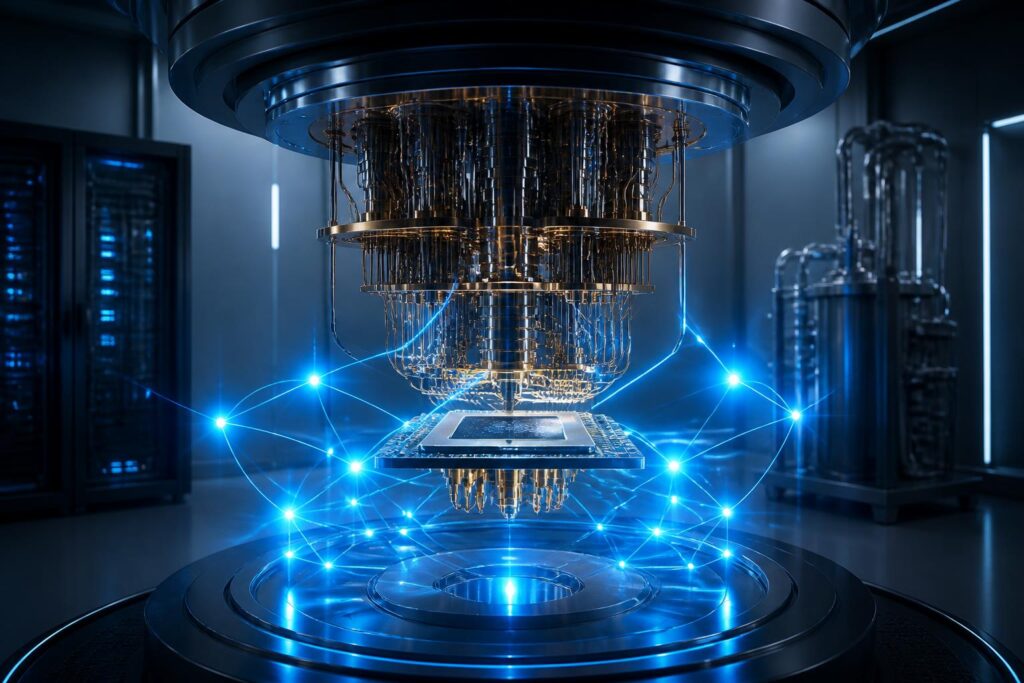
For many decades, computers have developed primarily along a familiar path: components have become smaller, processors more powerful, and software increasingly effective at making use of hardware capabilities. Quantum computing has emerged as a fundamentally different direction. Rather than simply seeking to perform more calculations on traditional bits, quantum computers take advantage of the laws of quantum mechanics to represent and transform information.
This has led quantum computing to often be described in terms of very ambitious expectations, from drug discovery and supply chain optimization to the analysis of new materials. However, it is not a computer that can replace personal computers or conventional servers for every task. Its value, if realized, lies in certain groups of problems with special structures that are difficult to process efficiently using classical methods.
How Are Qubits Different from Traditional Bits?
A bit is the basic unit of information in today’s computers. A bit can take one of two states, usually represented as 0 or 1. From these simple states, logic circuits combine billions of bits to store data, run programs, and create familiar digital services.
A qubit, or quantum bit, can also be measured and yield 0 or 1, but before measurement, it can exist in a combined state of both possibilities. This property is commonly called superposition. It is important to understand that superposition does not mean that a single qubit simply stores two independent bits at the same time. Quantum information is described through amplitudes and probabilities, while the final measurement still produces a specific state.
The important point lies in how multiple qubits interact within an algorithm. When prepared and controlled correctly, they can create interference patterns that amplify desired results and suppress unsuitable ones. This is the foundation that allows some quantum algorithms to solve problems differently from checking each possibility one at a time.
What Roles Do Superposition and Quantum Entanglement Play?
Superposition is one of the concepts mentioned most often when discussing quantum computers, but it does not automatically make every calculation faster. Without a suitable algorithm, having many qubits does not guarantee that a system will provide a practical advantage. Developers must design a sequence of transformations so that quantum information evolves in a way that is useful for a specific problem.
Quantum entanglement is another phenomenon in which the states of qubits can be related to one another in a way that cannot be described by treating each qubit independently. This connection helps quantum algorithms process a complex state space. However, quantum entanglement is not an instantaneous data transmission channel and does not allow information to be sent faster than light. It is a resource in quantum information processing that must be created, maintained, and measured with high precision.
In practice, these two phenomena are meaningful only when combined with quantum gates, measurement, algorithms, and suitable control systems. In other words, the difficult part of quantum computing is not only creating qubits but also controlling them stably enough for the results to be verified.
Why Is Building a Quantum Computer Difficult?
Qubits are highly sensitive to their environment. Heat, vibration, electromagnetic radiation, errors in control pulses, or unintended interactions can all cause a quantum state to degrade. This phenomenon is commonly known as quantum decoherence. When decoherence occurs before an algorithm is complete, the result can become unreliable.
To limit noise, many quantum architectures require special operating environments, such as extremely low temperatures or sophisticated isolation and control systems. Other platforms use different methods to create and control qubits. Each approach has its own advantages, limitations, hardware requirements, and scaling path. As a result, competition in this field is taking place not only at the algorithmic level but also in materials, measurement devices, control engineering, and system design.
Errors are a core issue. Traditional computers also experience errors, but digital circuits are generally designed so that signals representing 0 and 1 have clear margins, while many error-detection and correction techniques can be applied. With qubits, directly measuring them can alter the state that needs to be protected. Quantum error correction therefore requires a complex approach, often using many physical qubits to create a logical qubit with greater reliability.
The gap between physical qubits and logical qubits is one of the reasons scaling a quantum computer cannot be assessed simply by counting qubits. A system with many qubits but high noise may not be more useful than a smaller system if the smaller system can be controlled and verified more effectively.
Groups of Problems That Could Benefit
One important area of application is the simulation of quantum systems. Nature at the atomic and molecular levels follows quantum mechanics, while accurately simulating such systems on traditional computers can become extremely resource-intensive as the system grows. Quantum computers may provide a more suitable representation for certain problems involving materials, chemical reactions, and molecular structures.
In pharmaceuticals, the ability to perform simulations does not mean that a quantum computer will automatically discover a new drug. The research process still requires data, modeling, laboratory experiments, safety assessments, and many stages of verification. If it achieves sufficient reliability, quantum computing could serve as a supporting tool for screening or analyzing certain molecular interactions that are difficult to handle using current methods.
Optimization is another group of problems that often receives attention. Scheduling, resource allocation, transportation route design, or selecting options in a system with many constraints can all produce very large search spaces. However, not every optimization problem is suitable for a quantum computer. Any advantage must be demonstrated for each problem structure, while also taking into account the cost of transferring data, the time required to prepare inputs, and the process of checking results.
Some quantum algorithms also relate to searching, processing algebraic structures, and analyzing arithmetic problems. In cryptography, this is a particularly notable topic because some widely used cryptographic systems rely on the assumption that certain problems are very difficult to solve with classical computers. A sufficiently large quantum computer with suitable error-correction capabilities could change assessments of the security of those systems.
Impact on Information Security
Quantum risk does not mean that all data encrypted today will immediately be decrypted. Quantum computers with the necessary capabilities remain technically difficult to build, while the extent of the impact depends on the algorithm, key size, implementation, and type of cryptographic system being used. Nevertheless, the long lifespan of some data means organizations should not wait until quantum computers are fully developed before beginning preparations.
One issue often discussed is the possibility that attackers could collect data encrypted today and seek to decrypt it in the future. Information that remains valuable for many years, such as personal records, trade secrets, or research data, could be exposed in this way. Organizations therefore need to inventory cryptographic assets, identify sensitive data, check where algorithms are being used, and monitor the transition toward options designed to resist threats from quantum computers.
The transition involves more than replacing an encryption library. It may affect digital certificates, network protocols, hardware devices, identity systems, legacy software, and key-management processes. A sound plan needs to test compatibility, monitor performance, and ensure that upgrades do not create new vulnerabilities.
Will Quantum Computers Replace Today’s Computers?
This is not a realistic goal for the industry. Quantum computers are not suitable for writing documents, streaming video, managing files, or running most office applications. Traditional computers remain more efficient, flexible, and economical for those tasks. A more convincing scenario is a hybrid model in which classical computers handle data preparation, task coordination, and result processing, while quantum processors perform a specialized portion of the computation.
Hybrid models also introduce new requirements. Data must be transferred into the quantum system in an appropriate way, measurements typically produce probabilistic results, and programs may need to be run repeatedly to estimate an outcome. If the communication cost between the classical and quantum components is too high, the theoretical advantage may be significantly reduced in practical applications.
Therefore, evaluating a quantum technology requires avoiding a focus solely on the number of qubits or short demonstrations on specially designed problems. More important criteria include gate fidelity, error-correction capabilities, runtime, stability, scalability, operating costs, and suitability for specific needs.
What Should Businesses and Learners Prepare For?
For businesses, the first step does not necessarily involve immediately investing in quantum hardware. A more practical approach is to identify processes that depend on complex optimization, materials simulation, long-term cryptography, or problems with large search spaces. Businesses can then monitor research, conduct experiments on cloud platforms, and assess benefits using specific business criteria rather than chasing technology labels.
Technology teams also need to combine multiple capabilities: knowledge of algorithms, linear algebra, probability, quantum physics, programming, and information security. Not every engineer needs to become a physics expert, but understanding the technology’s limitations will help organizations distinguish between a research prototype and a product that can operate reliably.
For learners, quantum computing can be approached in stages. A foundation in mathematics and programming is the starting point, followed by concepts such as qubits, quantum gates, measurement, and algorithms. Equally important is learning how to check results, because quantum programs often produce probabilistic outputs and are easily affected by noise. This mindset helps learners avoid viewing quantum computing as a magical version of an ordinary computer.
Technology Should Be Viewed with Realistic Expectations
Quantum computing is expanding the boundaries of computer science, but the path from principles to large-scale applications still involves many steps. Challenges involving stability, error correction, hardware scaling, algorithm design, and operating costs may all determine the pace of progress in this field.
The value of quantum computing does not lie in replacing every device that currently exists, but in its potential to provide a new tool for problems where current approaches face limitations. When evaluating this technology, the important question is not how many times faster a quantum computer is in every situation, but what kinds of problems it can solve, with what level of reliability, and how it can create value. A cautious but open-minded perspective will help businesses, developers, and users prepare appropriately for a new era of computation.
