


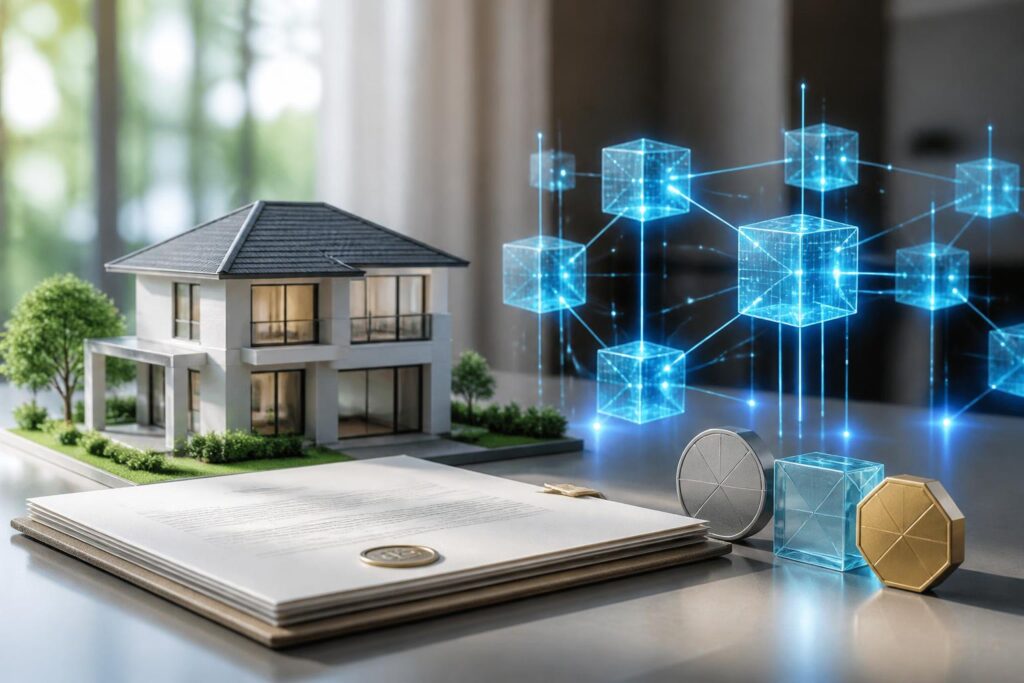
In its early years, blockchain was often discussed alongside cryptocurrencies and transactions taking place entirely in digital environments. This approach remains an important foundation, but the scope of blockchain applications is expanding in another direction: the tokenization of real-world assets. The concept describes representing ownership, beneficial interests, or participation rights in an off-chain asset through tokens issued and managed on a blockchain.
Tokenized assets may include a fractional interest in real estate, bonds, receivables, commodities, works of art, or other types of assets. However, it should not be assumed that simply putting information about an asset on a blockchain automatically makes that asset valuable, easy to trade, or legally protected. A token only has meaning when it is tied to a specific right, established by valid documentation, and supported by a reliable mechanism.
What Is Real-World Asset Tokenization?
At its core, tokenization is the process of converting a right or economic benefit into a digital unit that can be issued, transferred, and tracked on a blockchain. A token may represent an entire asset, a portion of an asset, or the right to receive cash flows generated by that asset. The specific structure depends on the type of asset, the legal model, and the regulations in the jurisdiction where it is implemented.
For example, a project may issue tokens representing the right to receive a portion of the revenue from a rental asset. In another case, a token may be linked to a debt or the right to receive payment under specified conditions. The key point lies in the connection between the on-chain token and the off-chain right. If a token does not come with a clearly defined right to make a claim, vote, receive an asset, or receive cash flows, its holder may own nothing more than a digital record with little practical value.
Blockchain helps record the history of a token’s issuance and transfers in a way that can be verified across the network. However, blockchain does not independently confirm that the underlying asset actually exists, guarantee that the issuer has rights to the asset, or resolve disputes. Those matters still require legal documentation, custodial organizations, audits, governance mechanisms, and off-chain institutions.
Why Are Businesses and Investors Interested?
The first motivation for tokenization is the ability to fractionalize interests. A high-value asset is often difficult for individuals to access if it can only be traded as a whole asset. Dividing interests into smaller units may broaden the group of participants, subject to legal limits and the conditions of the product. This is a change in how ownership or beneficial interests are structured, not a promise that every asset will immediately become liquid.
The second motivation is the ability to automate certain processes. Conditions such as payment dates, distribution ratios, or transfer restrictions can be expressed in smart contracts. When the conditions are met, the system can help execute the programmed process, reducing some manual steps. Nevertheless, automation is effective only when the input data is accurate and the legal conditions have been designed appropriately.
Tokenization may also create a more unified information layer for participating parties. Transfer histories, the number of tokens in circulation, and certain asset statuses can be tracked on the same system. This does not mean that all data is public or that everyone can see all information. Privacy, commercial confidentiality, and data regulations still need to be addressed in the product design.
The Gap Between Tokens and Real-World Assets
The greatest challenge of tokenization is not creating a token, but maintaining a reliable connection between the token and the asset it represents. On a blockchain, a token can be transferred from one wallet to another according to the rules of the network. But rights to real estate, commodities, or cash flows are usually established through contracts, registration documents, custodial systems, and regulations issued by competent authorities.
This gap creates a fundamental question: if the issuing entity breaches its commitments, what will token holders rely on to protect their interests? The answer must be set out before the product is brought to market. Participants need to know what right the token represents, who holds the underlying asset, whether the asset is encumbered, how cash flows are distributed, and what process will apply if the project ceases operations.
In some models, the underlying asset is placed in a legal entity or entrusted to an independent custodian. In other models, the token represents only a payment obligation of the issuer. These two cases involve very different levels of protection and risk. Therefore, looking only at labels such as “real estate token” or “asset-backed digital asset” is not enough. The offering documents must be read carefully, and the actual legal rights attached to the token must be identified.
Risks That Need to Be Assessed
Legal and Compliance Risks
Tokenization can touch multiple areas at the same time, such as property ownership, securities, fundraising, anti-money laundering, investor protection, and taxation. A token issued in one jurisdiction may not necessarily be transferable or recognized in another. Regulations may also distinguish between tokens representing ownership rights, tokens representing debt, and tokens used to access a service.
Accordingly, a project needs to clearly identify eligible participants, customer identification procedures, transfer restrictions, and reporting responsibilities. From the user’s perspective, the appearance of a product on a trading platform does not automatically prove that the product is licensed or suitable for every investor.
Risks From the Underlying Asset and Issuer
The value of a token depends significantly on the asset and the organization behind it. If the underlying asset is misvalued, loses value, becomes subject to a dispute, or fails to generate the expected cash flows, the token may be affected even if the blockchain continues to operate normally. Similarly, if the issuer becomes insolvent, token holders may have to go through a complicated process to assert their rights.
Practical questions that should be asked include: What method is used to value the asset? Who verifies that the asset exists? Is the asset segregated from the issuer’s assets? How frequently is the data updated? Who is responsible when the information is inaccurate? These factors have a more direct impact than the trading interface or the speed of token issuance.
Technology and Liquidity Risks
Smart contracts may contain errors, governance rights may be abused, and private keys may be lost or stolen. A network failure may also disrupt transfers or access to information. In addition, issuing a token does not mean that buyers and sellers will always be available. Liquidity requires a market, trading rules, real demand, and the participation of qualified parties.
Some tokens may also have transfer restrictions to meet legal requirements. In such cases, holders cannot freely transfer the token to any address. These control rules may reduce convenience, but they are necessary to ensure that the product is not misused or transferred to ineligible individuals.
Conditions for Sustainable Development of the Model
Tokenization can create lasting value only when technology is placed behind a clear rights structure. First, the offering documents must describe in plain language what the token represents and what it does not represent. Participants need to distinguish between direct ownership, beneficial interests, the right to receive payments, and the right to use a service.
Next, there must be mechanisms to verify the underlying asset and update information throughout the product’s life cycle. Verification should not take place only at the time of issuance. The value, legal status, custodial rights, and obligations associated with the asset may change over time. A reliable system must have procedures for disclosing changes, handling discrepancies, and resolving complaints.
Interoperability is also an important factor. If each platform uses its own standard and cannot connect with others, users may become locked into a small ecosystem. However, expanding interoperability must go hand in hand with access controls, security, and compliance. A token that is easier to transfer is not always a safer token.
Finally, tokenization should be viewed as a method for organizing and distributing rights, not as a tool that automatically increases an asset’s value. Blockchain can help make certain processes more transparent, reduce friction in transfers, and open up new approaches to financial interests. But it does not replace due diligence, the law, risk management, or the issuer’s responsibilities.
Conclusion
Real-world asset tokenization is expanding the blockchain narrative from purely digital assets to interests tied to the real-world economy. The model’s potential lies in its ability to fractionalize interests, automate certain processes, and create transaction records that are easier to verify. Nevertheless, the most difficult part remains ensuring that the token has a substantive connection to the asset and the rights it claims to represent.
For users, a cautious approach is to begin by asking, “What right do I own?” rather than focusing only on where the token is traded. For businesses, a sustainable tokenized product needs to combine blockchain infrastructure with a legal framework, custodial mechanisms, information disclosure, and participant protection. When these foundational layers are built seriously, blockchain may become a tool that supports ownership and value distribution, rather than merely a technical shell for a product whose nature remains unclear.
