


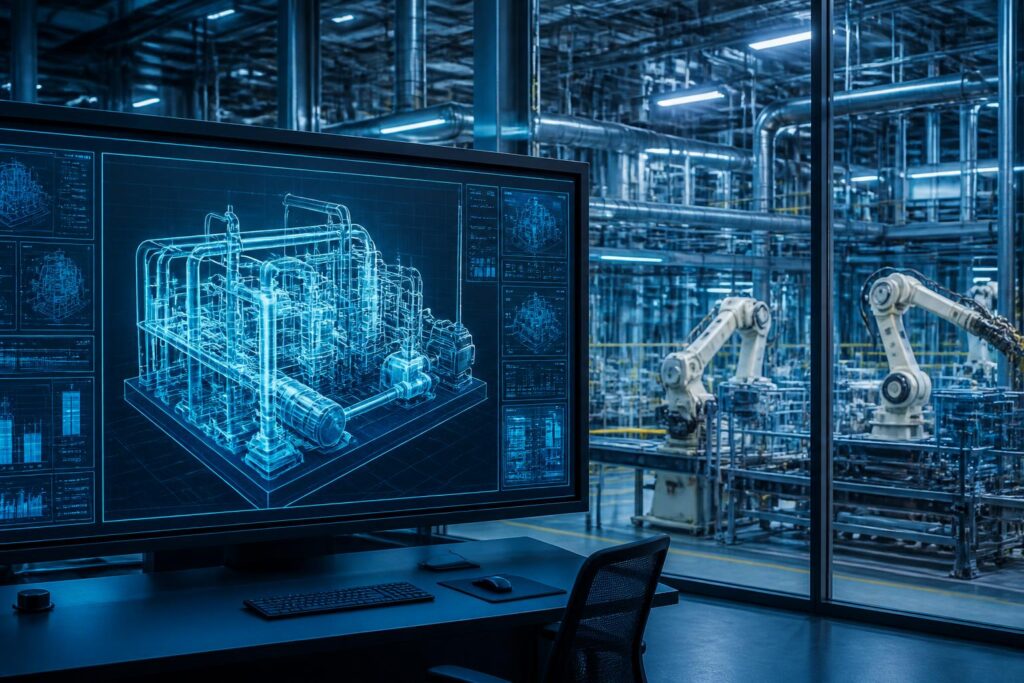
In many industrial and urban activities, a wrong decision can lead to significant costs. Changing production-line parameters, adjusting maintenance schedules, reorganizing traffic flows, or operating a building all require consideration based on real-world data. Digital twins were developed to support precisely this need: creating a digital model capable of reflecting the condition, characteristics, and developments of a real-world object or system.
Unlike a static model that only describes a shape or structure, a digital twin is connected to data generated during operation. As a result, it can show not only how a device is designed but also how it is operating, where signs of abnormalities are emerging, and what changes in operating conditions may lead to. This technology does not completely replace on-site observation and inspection, but it introduces an analytical layer that allows people to test scenarios before making decisions in the real world.
How Do Digital Twins Work?
A digital-twin system typically consists of three main components. The first is the real object or process, such as machinery, a production line, a building, a vehicle, an energy network, or an urban area. The second is a digital model describing the attributes and relationships of that object. The third is the data and connectivity layer that enables information to be exchanged between the real entity and the digital model.
Data may come from sensors, measuring devices, management software, technical records, or user activity. A temperature sensor on an engine can send information to a monitoring system. After being processed, that data updates the corresponding status in the digital model. If the system also has data on rotational speed, energy consumption, and maintenance history, the model can provide a more complete picture instead of reflecting only one isolated indicator.
The important point lies in the two-way, or nearly two-way, relationship between the model and reality. A digital twin is not merely a digitized drawing. It needs to be updated in line with changes in the object, while also being usable to simulate changes before people implement them. In some cases, simulation results are converted into recommendations or control commands, but the level of automation must be appropriate to the safety requirements of each system.
From Monitoring to Prediction
The most readily apparent application of digital twins is monitoring. Instead of having to inspect each device according to a fixed schedule, employees can monitor the status of many assets through a unified interface. When an indicator deviates from normal conditions, the system can issue a signal for the person in charge to conduct a more thorough inspection.
Greater value emerges when digital twins are used for trend analysis and prediction. Small changes in temperature, vibration, pressure, or electricity consumption may not be enough to cause an immediate failure, but if they persist or appear alongside certain other signs, they may indicate that equipment is operating unstably. A digital model helps aggregate related data, compare it with previous conditions, and support an assessment of the likelihood of a problem occurring.
This approach can help businesses shift from reactive maintenance to condition-based maintenance. Instead of waiting for equipment to fail before repairing or replacing it, or replacing everything according to a rigid schedule, operators have more grounds for determining when intervention is needed. However, a digital twin does not automatically produce accurate predictions in every situation. The quality of the results depends on sensor reliability, data completeness, the way the model is built, and the user’s ability to interpret the results.
Testing Scenarios in a Safer Environment
Another advantage of digital twins is their ability to simulate scenarios without immediately affecting the real system. A factory can assess the impact of changing production speed, rearranging a process step, or adjusting the operating schedule. A building management organization can examine the effects of different air-conditioning and lighting options on energy consumption. In transportation, a model can support analysis of changes in traffic flows or signal allocation.
Simulation does not mean making a certain prediction about the future. It is a way of applying assumptions to a model and observing the possible consequences under selected conditions. If the input data is incomplete or the model overlooks an important factor, the results may differ greatly from reality. Therefore, a digital twin should be viewed as a decision-support tool, not an absolute guarantee.
During product design, a digital model can help identify aspects that need adjustment before a prototype is manufactured. After the product enters use, the same model can continue to be updated with operational data. This life cycle creates a link between design, production, use, and maintenance, rather than leaving each stage to store data in separate systems.
Fields That Can Benefit
In manufacturing, digital twins can simulate production lines, monitor equipment performance, and help balance productivity with quality. A model can also help employees envision the impact of a change before implementation, particularly when the real system is difficult to stop or direct experimentation is costly.
In energy and infrastructure, this technology can be used to monitor substations, pipelines, buildings, or distribution networks. Operators can combine real-time data with design information and maintenance history to assess risks, plan inspections, and allocate resources. For construction projects, a digital model can also help link information from design and construction progress with asset management after the project is completed.
In healthcare, the concept of a digital twin can be applied at various levels, from models of hospital operations to models supporting research and analysis. This is a field requiring particular caution because the data relates directly to people, while all clinical support tools must comply with appropriate professional requirements and regulations. A simulation model should not be equated with a diagnosis or treatment decision.
At the urban scale, digital twins can help authorities understand the relationships among transportation, energy, construction, and the environment. However, the broader the scope, the more complex the data challenge becomes. A city is not merely a collection of buildings and roads; it is also a social system with changing behavior, multiple governing entities, and goals that are sometimes inconsistent.
Barriers Involving Data, Standards, and Accountability
Implementing a digital twin does not begin with buying software and connecting every device. First, an organization needs to clearly define the problem it wants to solve, which objects need to be simulated, and which decisions will be supported. If the objective is unclear, the project can easily become an expensive visualization layer that creates no change in operations.
Data quality is a core challenge. Different sensors may use different units of measurement, recording frequencies, and naming conventions. Data from legacy systems is also often difficult to connect to new platforms. When information is missing, delayed, or inaccurate, a digital model can create an impression of precision without truly reflecting the current situation. Therefore, processes for checking, cleaning, synchronizing, and governing data need to be designed from the outset.
Interoperability also determines the system’s longevity. A digital twin may need to receive data from multiple vendors and share results with many user groups. If each system uses its own form of representation, expansion will be costly and can easily create dependence on a single platform. Principles concerning data standards, access rights, and connection interfaces need to be considered alongside technical objectives.
Cybersecurity and privacy are issues that cannot be taken lightly. A digital twin may concentrate detailed information about equipment, infrastructure, production activities, or usage behavior. If an account is compromised or data is altered, the consequences may extend beyond the screen and affect real operations. Organizations need to assign permissions by role, protect data transmissions, record access activity, and have recovery plans in place for when incidents occur.
In addition, responsibility must be clearly defined when a recommendation from the model leads to an inappropriate decision. Operators, software providers, and data-owning organizations may all participate in the decision-making chain, but each party’s role must be delineated. A transparent system should allow users to know which data was used, which assumptions were made, and why the model issued a particular alert or recommendation.
Implementing in Stages to Create Real Value
A cautious approach often begins with a sufficiently manageable scope. A business can select one critical piece of equipment, a process with a bottleneck, or a specific maintenance problem. After the pilot phase, the organization assesses whether the model has helped reduce inspection time, improve the ability to detect abnormalities, or support better decisions. Only after value has been demonstrated should the scope be expanded.
People are no less important than technology. Engineers, operators, and managers need to understand what the model is reflecting, where its limitations lie, and how to respond when the data is abnormal. If the system is designed separately from daily workflows, users may regard it as a secondary dashboard and gradually ignore its alerts. User experience design, training, and feedback mechanisms must therefore be developed alongside the software and sensors.
Digital twins are most effective when viewed as a long-term operational capability, not a short-term demonstration project. The model needs to be updated when equipment changes, processes are adjusted, or new data shows that previous assumptions are no longer appropriate. Regular evaluation helps organizations identify the gap between simulation and reality, thereby improving both the system and the way its results are used.
A Tool for Better Decision-Making
Digital twins are taking simulation beyond the scope of design and expanding it across the entire life cycle of assets, processes, and infrastructure. The ability to combine real-world data with models helps businesses observe more clearly, test in a more controlled manner, and respond more proactively to change. Even so, the value of the technology does not lie in three-dimensional images or modern interfaces, but in the quality of the questions it helps answer.
A reliable digital twin requires suitable data, a validated model, stable connectivity, and clear accountability mechanisms. When these conditions are ensured, the technology can become a useful support layer for operational decisions. When they are overlooked, a digital twin merely creates a digitized version of inaccuracy. Therefore, the effective path is not to simulate everything at once, but to start with a problem of genuine value, measure the results, and expand on a validated foundation.
