


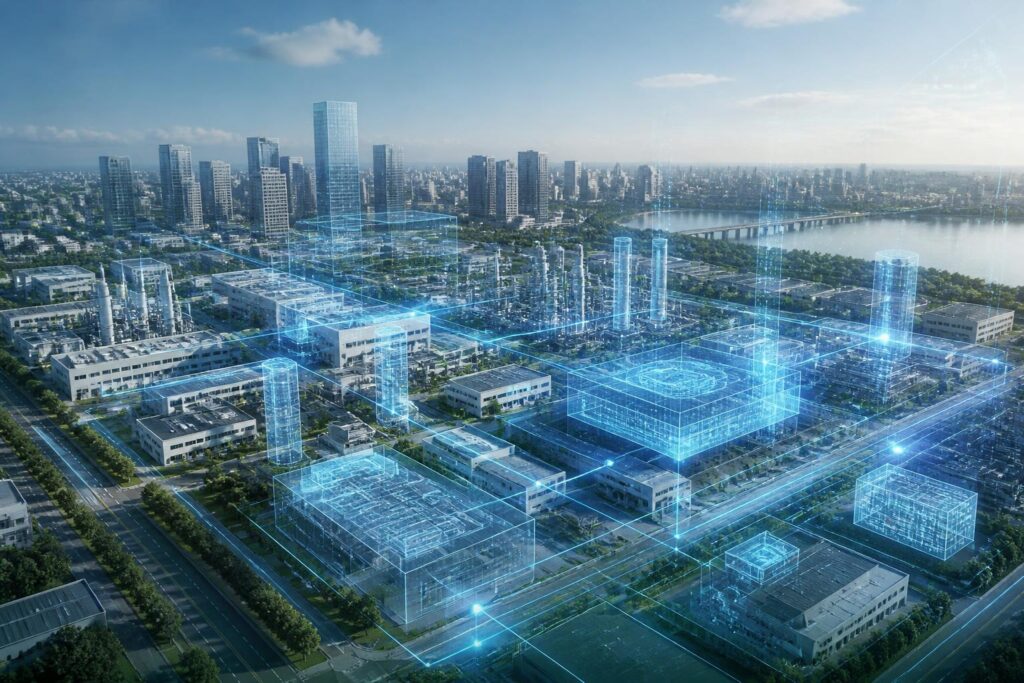
The virtual world is often imagined through highly imaginative images: cities without physical limits, meeting rooms populated by digital characters, or spaces where users can interact through avatars. However, another direction of development is making this concept more practical. That is the digital twin, or a digital model built to reflect an object, space, or process in the real world.
A digital twin is not simply a three-dimensional image of an object. Its value lies in its connection to data and operational status. A building recreated in a virtual environment can show its layout, equipment, and functional areas. When connected to appropriate data, the model can also reflect temperature, energy consumption, the condition of machinery, or changes in the space over time. From this point, the virtual world becomes a layer of observation and experimentation connected to material life, rather than existing in complete isolation.
From Simulated Images to Responsive Models
The important difference between an ordinary three-dimensional model and a digital twin lies in the degree of its connection to the real object. A model can be created to present a design, provide usage instructions, or support tours. It generally remains unchanged until a person edits it. A digital twin, by contrast, is designed to receive data, update information, and support the assessment of possible situations.
For example, a virtual factory can simulate the layout of production lines, the movement of materials, and the operation of equipment. If operational data is fed into it, managers can observe which areas are functioning normally, where there are signs of abnormalities, or which stages are prone to creating delays. The model does not automatically replace the real factory, but it helps people see the bigger picture and conduct certain experiments without immediately intervening in the physical system.
This approach can also be applied to buildings, vehicles, urban areas, water-supply systems, warehouses, or training processes. Each case requires different types of data, but the general principle remains the same: creating a digital space with a sufficiently clear connection to reality so that observation and decision-making become useful.
Why Are Digital Twins Suited to the Virtual World?
The virtual world provides the ability to represent space in an intuitive and interactive way. Instead of reading a collection of separate specifications, users can enter the model, change their viewpoint, select an area, and follow the related information. When multiple people access it at the same time, technical teams, managers, and users can communicate within the same visual context.
This capability is particularly useful for systems with multiple layers of information. An urban area, for example, consists of more than roads and buildings. It also involves traffic, energy, the environment, safety, and patterns of use. When layers of data are arranged within the same virtual space, viewers can understand the relationships between them more easily than when looking at separate reports one by one.
The virtual world also facilitates scenario-based experimentation. Users can ask what would happen if an area were expanded, a piece of equipment stopped operating, the number of people gathering increased, or a process were reorganized. Such experiments still require suitable data, assumptions, and evaluation methods, but they allow teams to consider multiple possibilities before making decisions in the real world.
Data Determines the Reliability of the Model
A digital twin that is visually appealing but lacks reliable data will be no more than a demonstration space. It may look like reality, but it will not have a sufficient basis for reflecting the current state or supporting analysis. Therefore, the quality of a digital twin depends greatly on how data is collected, updated, checked, and interpreted.
Data can come from design records, management systems, measuring devices, cameras, sensors, or human data entry. Each source has its own limitations. A sensor may stop working, design information may be outdated, and data entered by people may be inconsistent. If these issues are not identified, the virtual model will create a sense of accuracy while leading to incorrect conclusions.
Not all information needs to be updated at the same speed. The position of a wall may change very little, while the condition of a piece of equipment may need to be monitored more frequently. Designing a digital twin is therefore not simply a matter of putting all data into one system. Its developers must determine which data is important, which data needs updating, who has the right to edit it, and how users will understand the model’s status.
Limitations That Cannot Be Ignored
Digital twins are often discussed as tools for prediction and optimization, but they should not be regarded as perfect copies of the real world. Every model is built from particular choices, assumptions, and defined scopes. A building model may describe energy consumption well but fail to fully reflect the user experience. A traffic model may show movement flows, yet struggle to encompass every unexpected human behavior.
The gap between the model and reality can emerge when data is delayed, incomplete, or interpreted incorrectly. In addition, connecting multiple systems often creates problems involving formats, access rights, and governance responsibilities. If each department uses its own way of recording data, integrating the information into a single virtual space will not happen automatically.
Privacy is also an issue that needs to be addressed from the outset. A digital twin of a public building may require only information about its structure and equipment. But a model involving a hospital, workplace, residential area, or movement patterns may contain sensitive data. The more detailed the virtual space, the clearer the requirements for access control, anonymization, and limitations on the purpose of use must be. The convenience of observation should not become a reason to collect or share more data than necessary.
The Role of People in Simulated Spaces
Digital twins do not eliminate the role of experts or operators. On the contrary, they are valuable only when placed within a process in which people clearly understand the question that needs to be solved. An engineer may use a model to test an approach, but must still evaluate real-world conditions and factors that the data cannot yet represent. A manager may review multiple scenarios, but the final decision will also involve costs, regulations, social priorities, and feasibility.
This also affects interface design. A virtual space with too much detail can disorient users. If all data is displayed at once, important information will be buried under dense layers of visual information. A good interface should help users move from an overview to a specific area, distinguish current data from historical data, and recognize which elements are observations and which are forecasts.
In training, digital twins can create an environment in which learners practice situations that are difficult to organize in real life. They can become familiar with equipment, safety procedures, or coordination between departments in a controlled space. Nevertheless, simulation still needs to be combined with real-world experience. The skill to handle a situation comes not only from selecting the correct action on a screen, but also from the ability to observe, communicate, and respond to things that were not anticipated.
Will the Virtual World Become More Realistic or Simply More Complicated?
The development of digital twins may change how people understand the virtual world. Rather than being merely a place for creating separate experiences, it can become a tool connecting data, space, and decisions. Users do not necessarily have to wear specialized equipment to benefit from a model. An intuitive screen, interactive map, or browser interface can also provide significant value if the data is organized properly.
However, bringing more and more elements of real life into a virtual environment does not mean that the model will automatically become more useful. A simulated space is meaningful when it serves a specific goal, helps users see something that is difficult to recognize, or allows them to test an approach with lower risk. If it merely pursues vivid visuals, a digital twin can easily become a costly presentation layer that does not improve the quality of decisions.
The prospects for this technology therefore depend on balancing visual intuitiveness with accuracy, scalability with control over data, and automation with human judgment. The more closely the virtual world is connected to real systems, the more clearly questions about responsibility and limits of use need to be answered.
A digital twin does not turn the virtual world into reality, nor is it a perfect mirror reflecting everything in the real world. It is a layer of modeling that helps people observe, communicate, and experiment within the same context. When built from appropriate data and placed within a transparent process, this modeling layer can make virtual spaces more practical. Its ultimate value does not lie in how closely the model resembles the real world, but in how well it helps people understand that world and act on a more informed basis.
