


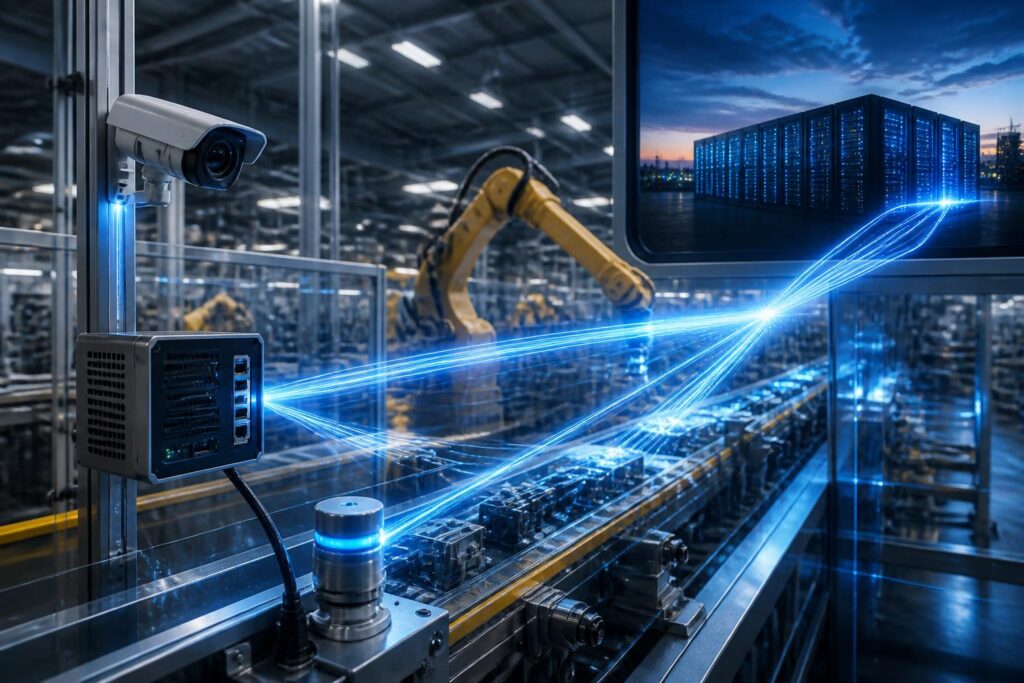
From Centralized Models to Processing Data Where It Is Generated
For many years, the familiar way to operate a digital service was to send data from users’ devices to a data center or cloud platform, process it there, and then send the results back. This model suits many needs, especially when organizations want to centralize infrastructure, simplify management, and take advantage of large-scale server capacity. However, the development of smart cameras, industrial sensors, connected vehicles, and real-time applications is exposing the limitations of a completely centralized approach.
Edge computing is a model that brings part of the storage and processing capabilities closer to where data is generated. This location could be a server installed in a factory, a gateway device at a store, a telecommunications station, a control system in a building, or the endpoint device itself. Data does not necessarily have to pass through a distant data center before the system can provide a response.
Edge computing does not eliminate cloud computing. The two models often complement each other. The cloud remains suitable for long-term storage, model training, analysis of large datasets, and centralized management. Meanwhile, the edge layer handles tasks that require fast responses, stable local operation, or a reduction in the amount of data that must be transmitted over the network.
Why Does Latency Matter?
Latency is the amount of time from when an event occurs, through the sending and processing of data, to when the result returns to the system or user. For a news-reading or file-synchronization application, added latency may only be annoying. But in a production line, safety-monitoring system, or equipment-control system, a slow response can reduce efficiency and affect the ability to handle a situation.
When data has to travel through multiple points on the network to reach a remote processing center, response time depends on connection quality, geographic distance, congestion, and the responsiveness of the central system. Bringing processing closer to the data source helps shorten this journey. The goal is not always to eliminate latency completely, but to reduce unnecessary waiting in tasks with real-time requirements.
This is especially meaningful for systems that use sensors or cameras to detect events. Instead of continuously sending all raw data to the cloud, an edge device can filter, classify, or aggregate data before transmitting it. For example, a monitoring system may send only an alert and the relevant data segment when it detects signs of an anomaly, rather than transmitting every frame around the clock. This approach both shortens response times and reduces pressure on network connections.
The Components of an Edge Computing System
An edge computing system usually consists of multiple layers rather than a single standalone server. At the outermost layer are data-generating devices such as sensors, cameras, scanners, production machinery, phones, or household appliances. These devices can perform simple calculations on-site, such as filtering data, detecting abnormal thresholds, or compressing information.
Next is the gateway or edge server layer. This is where data from multiple devices is aggregated, more complex tasks are performed, and connections with the central system are coordinated. An edge server may run analytics software, a local database, authentication services, or a pre-deployed artificial intelligence model. In enterprise environments, this layer is often designed to continue operating even when its connection to the cloud is temporarily interrupted.
Above this is the cloud platform or data center, which handles tasks requiring large-scale capacity and unified management. Selected data from the edge layer can be sent back for storage, verification, model training, report generation, or software updates for deployed sites. By dividing responsibilities, organizations do not have to choose exclusively between local and centralized processing.
Applications Close to Everyday Life and Business
In manufacturing, edge computing can support production-line monitoring, quality inspection, and fault detection. On-site cameras or sensors can analyze data directly in the factory and send alerts to operators without waiting for all the data to be transferred to a remote system. When production depends on continuity, the ability to maintain certain functions while the network is experiencing problems is also a notable benefit.
In retail, edge devices can process data from points of sale, warehouses, or building-management systems. Analysis at the store can provide faster responses to equipment status, customer traffic, or operational needs. However, data that needs to be compared across multiple locations can still be synchronized with the central system for broader-scale analysis.
In transportation and urban infrastructure, controllers at intersections, parking facilities, or observation stations can process some information locally. This allows systems to respond to events as they occur without depending entirely on a single central facility. For applications related to safety, designing backup mechanisms and clearly limiting the authority to make automated decisions remains more important than simply increasing processing speed.
Edge computing also appears in offices, healthcare, agriculture, and households with many connected devices. What these applications have in common is that data is generated in many places, may contain sensitive information, or may require a rapid response. Processing some data locally helps reduce the need for continuous data transmission, but it does not mean that all data is protected by default.
The Benefits Go Beyond Speed
Reducing latency is the most noticeable advantage, but edge computing also offers several other benefits. First is bandwidth savings. When data is filtered and aggregated before being sent, the system can reduce the amount of information transmitted to the central facility. This is an important consideration in areas with limited connectivity or high data-transmission costs.
Second is greater flexibility when the network is unstable. A properly designed edge site can continue collecting data, running basic processes, and temporarily storing information while waiting for the connection to be restored. When the connection becomes available again, the data can be synchronized according to the established policy.
Third is support for the principle of data minimization. A system can send only analytical results or the necessary data fields to the cloud instead of transmitting all the original data. This approach can help organizations reduce the scope of the data they have to manage, although its practical effectiveness still depends on software design, retention policies, and the legal requirements of each field.
Challenges That Are Easily Overlooked
Moving servers and software to multiple locations also means expanding the scope that needs to be protected. A centralized data center can be controlled within a tightly managed area, while edge devices may be located in stores, factories, vehicles, or public spaces. If a device is accessed without authorization, an attacker may try to obtain data, alter software, or use the device as a stepping stone to move deeper into the internal network.
For this reason, edge computing security needs to be considered from the design stage. Devices should have authentication mechanisms, encrypted connections, least-privilege access controls, and the ability to receive secure software updates. Organizations also need to know which devices are active, which software versions are installed, and what data is stored at each site. A system cannot be effectively protected if its operators do not have a reliable asset inventory and status information.
Operations are another challenge. As the number of edge sites grows, deployment, monitoring, updating, and troubleshooting become more complex. An update may work well in a testing environment but cause problems in real-world conditions involving different hardware, temperatures, or connectivity. Organizations therefore need phased deployment processes, the ability to roll back when errors occur, and sufficiently detailed activity logging to identify the cause of problems.
Data governance cannot be overlooked either. It is necessary to determine which data is processed locally, which data is temporarily stored, which data must be sent to the central facility, and how long it is retained. These decisions should be linked to the intended use, the sensitivity of the data, and the organization’s responsibilities toward users.
Assessing the Role of Edge Computing Correctly
Edge computing is not an automatic solution to every performance or security problem. If an application does not require rapid responses, adding an edge layer may make the architecture more complex without providing commensurate benefits. Similarly, processing data locally does not guarantee greater privacy if devices lack protective mechanisms or the organization cannot control access.
Before deployment, organizations should begin by asking about their actual needs. Where is the data generated? Which tasks require an almost immediate response? Are connection interruptions frequent? Which data can be processed locally, and which data needs to be stored centrally? Who is responsible for updating the devices? These questions help determine what should be placed at the edge and what should remain in the cloud.
A cautious strategy often begins with a use case that has a clear scope, is easy to measure, and does not disrupt core operations. After the pilot phase, the organization can assess latency, bandwidth consumption, error rates, operating costs, and data-protection capabilities. Only when these factors are under control should the model be expanded to more locations or more critical processes.
Distributed Infrastructure Will Become Part of Digital Architecture
As the number of connected devices and the demand for real-time processing continue to grow, edge computing is likely to become a familiar layer in technology architectures. The value of this model does not lie in replacing the cloud, but in how it divides work appropriately among devices, edge sites, and data centers.
In the future, effective systems will not be evaluated solely by their ability to process data quickly. They will also need to operate reliably, be observable, easy to update, resource-efficient, and designed to protect data from the outset. Edge computing should therefore be viewed as an architectural and operational decision, not merely as the act of placing another server closer to users. When deployed with a clear purpose, this model helps technology respond more closely to the real world, where data is generated continuously and waiting time can sometimes determine the quality of an entire service.
