


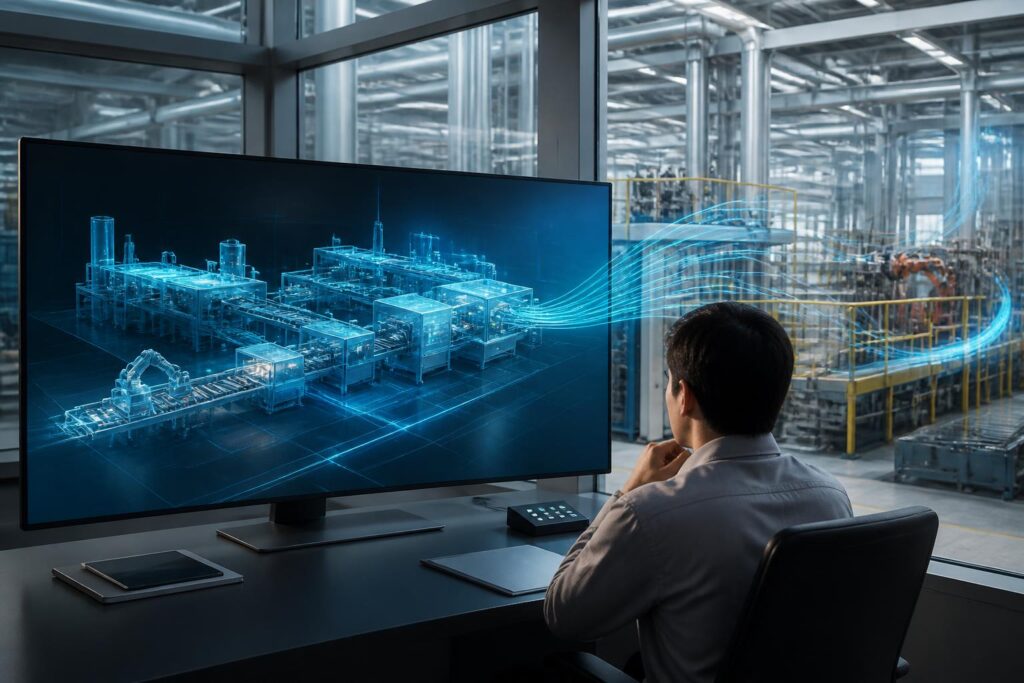
In many operational activities, important decisions are often made when information is still fragmented. A factory may want to adjust its production line, a building management unit may need to forecast maintenance needs, while an infrastructure team may have to consider the impact of a change before implementing it. If the change is tested directly, the cost can be high, and mistakes can disrupt operations. Digital twins are developed to address part of this challenge by creating digital models connected to an object, system, or process in the real world.
What is notable about digital twins is not their ability to create an attractive three-dimensional image. Their core value lies in connecting a model with operational data, thereby helping users monitor the current state, analyze developments, and test scenarios. When built for the right purpose, a digital twin becomes a testing space before people take action on a real asset. However, this is not a technology that can automatically turn data into the right answers. Model quality, data reliability, and the way people interpret results still determine much of its effectiveness.
How Is a Digital Twin Different from an Ordinary Simulation Model?
A simulation model is usually created to answer a specific group of questions. For example, engineers may simulate traffic flow in an area, a building’s energy consumption, or the temperature inside a device. This model can operate independently of the real object and use assumptions established in advance.
A digital twin may also include simulation, but it usually has an ongoing or periodic connection with the real-world object. Sensors, management software, operational logs, and data from multiple systems can be incorporated into the model to reflect the situation as it unfolds. As a result, users do not merely view a static design; they can also observe how the system changes over time.
The boundary between the two concepts is not always absolute. A simple digital model can become a component of a digital twin if it is connected to operational data and used for monitoring or decision-making. Conversely, a three-dimensional model without updated data, without the ability to reflect the state of the real object, and without support for scenario analysis may not qualify as a digital twin in the full sense of the term.
The Structure of a Digital Twin System
A digital twin implementation usually consists of multiple layers rather than a single piece of software. The first layer is the real-world object or process, such as a production line, machinery, a building, a vehicle, or an energy supply network. The next layer is the data collected from sensors, control devices, maintenance records, and related business systems.
Data must be transmitted, standardized, and linked to the correct object. If a sensor is mistakenly assigned to a different device, the model may produce a false picture even if the underlying algorithm is working correctly. Therefore, managing asset identifiers, units of measurement, recording times, and change histories is foundational, even though it does not usually produce eye-catching visuals. Yet this is what determines whether a digital twin can be trusted in operations.
Above the data layer is the analytical model. This model may describe relationships between components, detect abnormal conditions, estimate trends, or compare options. Some systems may use machine learning, but not every digital twin needs artificial intelligence. In many cases, engineering rules, physical models, and historical data are sufficient to support a specific decision. Technology should be selected according to the problem, rather than adding AI simply because it is a trend.
The final layer is the interface and action process. Users may view dashboards, maps, spatial models, or alerts. More importantly, they need to know what action an alert leads to, who is responsible for verifying it, and how the outcome is recorded after it is addressed. If the system only displays large amounts of data without connecting them to a workflow, the digital twin can easily become an expensive monitoring screen.
Fields That Can Benefit
In manufacturing, a digital twin can help businesses monitor the condition of a production line, compare performance across stages, and assess the impact of a change in layout or operating schedule. Before changing a machine’s parameters, the technical team can use the model to examine what might happen. Simulation results do not replace real-world testing, but they can narrow the scope of testing and help prepare a safer plan.
For buildings, a model can combine information about spaces, equipment, usage levels, and environmental conditions to support energy management or maintenance planning. Managers can not only determine where a device is located but also link it to technical records, repair schedules, and signs of abnormality. When a building’s function changes, the model can also help stakeholders see more clearly the relationship between spaces, equipment, and occupant activities.
In infrastructure, digital twins can be used to combine data about roads, bridges, water supply and drainage systems, or utility networks. The goal does not necessarily have to be creating a model covering everything from the outset. A project can begin with a road, a pumping station, or a group of important devices, and then expand once the data and processes have stabilized.
In design and construction, a digital twin can connect information about a facility from the design stage through construction and then operation. This helps reduce the fragmentation of records between stages. However, to achieve that benefit, the parties must agree on naming conventions, data structures, and responsibility for updates. A model that is handed over without a maintenance mechanism will quickly lose its value as the facility changes.
The Greatest Value Is the Ability to Test Before Acting
People often have to make choices under conditions of uncertainty. A digital twin does not eliminate uncertainty, but it can make it easier to observe. Users can ask questions such as: What happens if a device operates at a higher intensity, if a maintenance schedule is postponed, if usage needs change, or if a component in the system fails? Each question needs to be converted into specific assumptions, input data, and evaluation criteria.
The ability to test multiple scenarios also creates a common language among teams. Engineers, operations managers, and leaders can look at the same issue together instead of relying entirely on spreadsheets or verbal descriptions. Even so, a visual interface can create an excessive sense of certainty. A model that looks highly convincing can still be wrong if the data is incomplete or the assumptions do not fit real-world conditions.
Therefore, results from a digital twin should be treated as a basis for supporting decisions, not as automatic commands. Decisions involving safety, health, essential operations, or major costs need to be verified by qualified professionals. The system should also display the data source, the time of the latest update, and the level of confidence in the results so that users understand the limitations before taking action.
Challenges That Cannot Be Ignored
The first challenge is data quality. Data may be missing, inaccurate, inconsistent, or delayed. A system that collects too many signals without an inspection process will increase noise rather than understanding. Organizations need to determine which data is truly necessary for operational goals, which data can be stored in an aggregated form, and which data must be strictly protected.
The second challenge is the ability to connect different systems. Older equipment, different software, and inconsistent data formats can make integration labor-intensive. Not every asset needs to be connected in real time. In some cases, periodic updates may be sufficient for the intended purpose. Identifying the actual requirement helps avoid investing in infrastructure that exceeds the need.
The third challenge concerns information security and access rights. A digital twin can bring together detailed data about an organization’s assets, activities, and processes. If access controls are lax, this data may be viewed, altered, or used for improper purposes. The system needs authentication mechanisms, logging, role-based access controls, and procedures for handling situations in which the data or model is called into question.
Finally, there is the challenge involving people. Operations staff may not trust an alert if the system has frequently issued false alarms in the past. Conversely, managers may place too much trust in a chart without understanding the assumptions beneath it. A digital twin becomes a useful tool only when it is incorporated into training, feedback, and continuous improvement processes. Users need to be able to ask questions, report errors, and offer suggestions about how the system presents information.
How Should Organizations Get Started?
A practical digital twin project should begin with a specific operational problem, not with the desire to own a new platform. An organization might choose an important asset, a process that frequently incurs costs, or a bottleneck where existing data is not being used effectively. The objective should be measurable at an appropriate level, such as shortening the time needed to find information, supporting maintenance scheduling, or improving the ability to detect abnormalities.
Next, the team needs to list the data sources, check their quality, and determine who is responsible for updates. Building an initial version with a narrow scope often helps identify problems early with asset identification, access rights, and coordination processes. Once the model has demonstrated its value, the organization should consider expanding it to other assets or departments.
It is also necessary to agree from the outset which decisions the digital twin will support and which decisions it must not be used for without additional verification. This approach helps prevent excessive expectations while creating clear evaluation standards. A simple system with reliable data, users who understand how it operates, and regularly collected feedback may be more useful than a complex platform that is neglected after the demonstration stage.
Digital twins represent an important direction in the development of operational technology: moving data from a stored state into one that can be observed, tested, and discussed. A digital twin is not a perfect copy of the real world, nor does it replace human experience. The value of the technology lies in adding a structured layer of perspective that helps organizations think before acting and learn from every change.
In the future, as sensors, management software, and data infrastructure become better connected, digital twins may appear in many familiar fields. But that expansion will be sustainable only if it is accompanied by data governance, security, and accountability. This technology deserves attention not because it creates an attractive virtual world, but because it can help people make more cautious decisions in the real world.
