

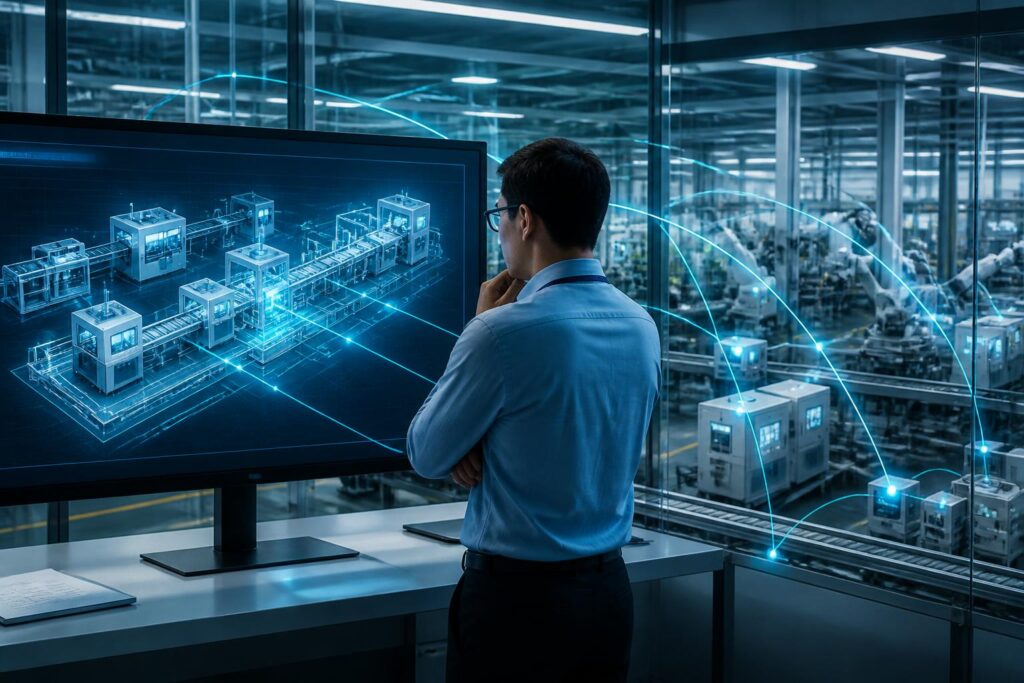
In many factories, buildings, and infrastructure systems, operational data has appeared everywhere but has yet to become a unified picture. Sensors record temperature, machinery sends operating parameters, management software stores maintenance schedules, while field staff add information through separate procedures. When these data sources are fragmented, businesses may know what each department is doing but find it difficult to see how the entire system is operating. Digital twins were developed to address that gap.
A digital twin is a digital model representing a real-world object, process, or system. The model does not merely describe shape or location; it can also receive updated data from the real object, reflect its operating state, and support analysis of different scenarios. A digital twin of a production line, for example, can link information about equipment, operating history, energy consumption, past failures, and maintenance plans. As a result, managers gain an additional space in which to observe and test changes before implementing them in the real world.
Not Every 3D Model Is a Digital Twin
This concept is often equated with 3D models, but the two are not entirely the same. A 3D model primarily describes the geometry and appearance of an object. It is useful for design, presentation, or installation instructions, but it does not necessarily know the state in which the equipment is operating. A digital twin may use a 3D model, but its core characteristic lies in the connection between the model and the data of the real object.
The degree of connectivity can also vary greatly. A model updated periodically using historical data serves a different role from a system receiving data almost continuously. A digital twin used for monitoring may only indicate the current state, while one used for analysis may also identify trends, detect signs of anomalies, or simulate the impact of a decision. Therefore, a project should not be evaluated solely by whether it has a visually appealing interface. The more important questions are whether the data accurately reflects the real object and whether the model supports a specific decision.
The Greatest Value Lies in the Loop Between Reality and Data
A digital-twin system typically creates a four-step loop. First, sensors, business software, or field staff provide data about the real object. The data is then standardized, checked, and fed into the model. The system analyzes the state, compares it with normal operating conditions, or runs scenario tests. Finally, the results are delivered to the responsible people so they can adjust real-world operations. When changes are implemented, new data returns to the system, allowing the loop to continue updating.
In maintenance, this loop can help teams shift from repairing equipment after it breaks down to monitoring signs of deterioration. A device may not have stopped operating yet but may be showing unusual fluctuations in temperature, vibration, or energy consumption. If the data is sufficiently reliable and placed in the right context, the business can schedule an inspection at a time that has less impact on production. However, a digital twin does not automatically turn every alert into a conclusion. Technical staff still need to assess the cause, environmental conditions, and importance of the equipment before taking action.
In the design and operation of buildings, a digital model can combine data about spaces, electrical systems, air conditioning, elevators, or usage flows. Managers can consider the effects of changing operating schedules, rearranging areas, or upgrading a system before implementation. For transportation and urban infrastructure, this approach can support asset monitoring, maintenance planning, and the assessment of operational scenarios. The value does not come from reproducing the world perfectly, but from helping stakeholders see the relationships among many factors that are usually managed separately.
Bad Data Makes a Model Persuasive but Unreliable
The greatest obstacle for digital twins is often not graphics or computing capacity, but data quality. Sensors may be inaccurate, older equipment may not provide data in a suitable format, and information from different departments may use inconsistent identifiers. If the input data is incomplete, delayed, or lacks context, the model may produce a highly visual image while leading to incorrect decisions.
Businesses need to determine which data is truly necessary for the chosen objective. Not every parameter needs to be collected at a high frequency. An energy-monitoring project will have different requirements from a project forecasting equipment failures. Collecting too much data can increase the costs of storing, processing, and protecting information without creating corresponding additional value. More importantly, each data element needs an owner, validation rules, and a method for handling cases in which it is missing or contradictory.
Asset identification is also foundational. If the same piece of equipment is called by multiple names across different systems, linking the data becomes difficult. Businesses need to standardize coding, status descriptions, units of measurement, and change histories. This work attracts little attention but determines the project’s ability to scale. A good digital twin is not merely the product of a technology team; it requires the participation of people who understand actual operating processes.
Start with a Specific Decision Instead of Building the Entire World
Launching a large-scale digital twin from the outset often creates many risks. An overly broad scope forces a business to integrate too many systems before the benefits have been validated. A more practical approach is to choose an asset or process with a clearly defined problem, relatively available data, and a team with direct responsibility.
A pilot project might focus on monitoring the performance of a group of devices, optimizing maintenance schedules, or analyzing energy consumption in an area. Before building the system, the implementation team should answer the following questions: Which decisions currently take a great deal of time? What data is used to make those decisions? Is the data reliable? Who will use the results? And by what criteria will success be evaluated? These questions help distinguish an operational tool from a technology demonstration.
Only after the pilot phase should the business consider expanding to other assets, locations, or processes. Expansion should retain the data rules that have proven effective while acknowledging that each environment may have its own characteristics. A model built for a production line cannot automatically be applied unchanged to a building or infrastructure system. Reusability should lie in the data architecture, connection interfaces, and governance methods, not necessarily in every detail of the model.
Access Governance Is No Less Important Than Connectivity
Digital twins bring together operational information that can affect safety, costs, and competitiveness. Therefore, connecting multiple data sources must go hand in hand with access control. Not every user needs to view all the data, and not everyone authorized to view it should be allowed to change parameters or send commands to the real-world system.
Businesses need to separate viewing, analysis, and control privileges. Important actions should be recorded so it is possible to trace who performed them, based on what information, and at what time. Connections between a digital twin and a control system must be designed cautiously, especially in environments where an incorrect change could cause disruption or create safety risks. In many cases, a digital twin should begin in a decision-support role, while the authority to automatically affect equipment should be expanded only after suitable testing and approval procedures are in place.
Security issues also go beyond protecting servers. Sensors, controllers, employee accounts, application programming interfaces, and third-party platforms can all become access points. Businesses need to know where data is collected, which systems it passes through, how long it is retained, and how it will be deleted or shared. The more broadly connected a model is, the clearer the boundaries of responsibility and data ownership need to be.
From a Demonstration Model to Long-Term Operational Capability
For a digital twin to create sustainable value, organizations need to treat it as an operational capability rather than a software project that ends on its launch date. The real object may change, sensors may be replaced, processes may be adjusted, and business goals may shift. The model therefore needs to be updated, checked, and evaluated periodically.
The user team also needs to be involved early. If the interface does not suit the way technicians or managers work, the system may be ignored even if it was built with advanced technology. People directly involved in operations often know which data is prone to error, which alerts commonly create noise, and which decisions require additional context. That experience helps make the model closer to reality than relying solely on the assumptions of the development team.
A digital twin is not a promise that a business can predict every failure or eliminate people entirely from its processes. It is a way to organize data, model states, and create an experimental environment so people can make better-informed decisions. When built around a specific need, with quality data and clear governance mechanisms, this technology can turn scattered signals into operational insight. It is also an important shift from merely observing what has happened to proactively considering what may happen next.
