


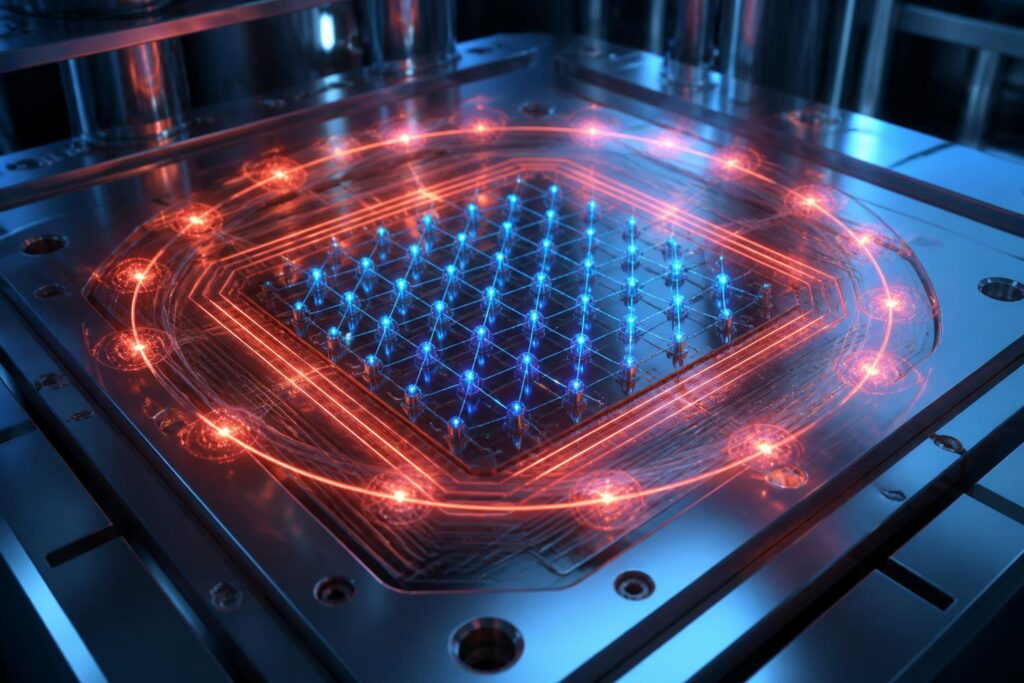
Quantum computers are often introduced through their ability to exploit superposition and quantum entanglement to process problems that are difficult for classical computers to approach. However, there is a significant gap between a short quantum circuit in a laboratory and a system capable of running large algorithms. Qubits, the information units of quantum computers, are far more sensitive to their environment than classical bits. Heat, electromagnetic fluctuations, mechanical vibrations, control errors, or imperfections in the equipment can all alter the state being used by a computation.
Therefore, the progress of quantum computers is not measured solely by the number of qubits. A system with many qubits but a high error rate can still produce unreliable results. To execute long algorithms, a machine needs a mechanism for detecting and handling errors while preserving quantum information. That is the role of quantum error correction, a field at the center of the ambition to build fault-tolerant quantum computers.
How are qubits different from classical bits when errors occur?
In a classical computer, a bit is represented by a zero or a one. If a bit is flipped by noise, the system can copy it many times, compare the copies, and choose the value that appears most often. This approach relies on the fact that a bit can be measured or copied without creating a fundamental problem for the computation.
Qubits are different. Their state can be a combination of two basis states, while simultaneously carrying information about amplitude and phase. Directly measuring a qubit usually collapses the superposition, causing the original information to no longer remain intact. Qubits also cannot be perfectly copied in the ordinary way. Therefore, a system cannot simply create many copies of the same qubit and check them as it would with classical memory.
Quantum error correction must find another path. Instead of copying the state itself, researchers distribute the information of one logical qubit across a group of physical qubits. These physical qubits collectively form a redundant representation. The system can check the relationships between them to determine where an error has occurred, without directly measuring the logical information being protected.
Physical qubits and logical qubits
A physical qubit is an element actually created and controlled by hardware, such as a superconducting circuit, a trapped ion, or another technological platform. It is directly affected by noise and usually maintains its quantum state for only a finite period of time. A logical qubit is an information unit encoded using multiple physical qubits to reduce the impact of individual errors.
This distinction explains why the reported qubit count does not always directly reflect useful computational capability. A machine may possess many physical qubits but still lack enough stable logical qubits to run long algorithms. Conversely, a system with fewer physical qubits but better error control may be a more promising foundation for practical applications.
The encoding process generally creates additional measurements, known as error-syndrome measurements. These measurements do not answer what the logical state is. They only indicate whether the expected relationships between the physical qubits are still valid. If a relationship is broken, the controller can infer that an error has occurred and apply an appropriate correction operation, or record that information for processing in software.
Error syndromes enable checking without reading the computation’s content
The subtlety of quantum error correction lies in the fact that the system must observe errors without destroying the data. Ancilla qubits are connected to data qubits through carefully designed quantum gates. After a sequence of interactions, the ancilla qubits are measured. The measurement results form a syndrome, indicating which types of errors may have occurred in which region of the quantum code.
The syndrome is neither the error itself nor the algorithm’s data. The same syndrome may be consistent with many different error possibilities, so the decoder needs to combine information from multiple measurement rounds. It generally attempts to identify the most likely error pattern based on the characteristics of the hardware and the history of the syndromes. The system can then perform a correction directly or update how the logical state is interpreted.
This creates a continuous loop between quantum hardware, measurement equipment, classical controllers, and decoding software. A fault-tolerant quantum computer is not merely a chip placed in a cold environment. It is a coordinated architecture in which quantum data must operate alongside high-speed electronics and error-monitoring algorithms.
Surface codes and the idea of an error threshold
One of the prominent approaches to quantum error correction is the surface code. In this arrangement, qubits are organized in a geometric structure on a surface and linked to checks on neighboring qubits. The code can protect information against many local errors while remaining compatible with the relatively short-range connectivity that some hardware platforms can implement.
An important related concept is the error threshold. If the error rate of basic operations is below a certain level, enlarging the code by adding more qubits can reduce the error rate of a logical qubit. If the error rate is above the threshold, adding qubits does not solve the problem and may even make the system more complex without making it more reliable.
This threshold is not a fixed number for every quantum computer. It depends on the type of code, the error model, connectivity, measurement quality, gate execution time, and the way the decoder processes data. Therefore, an important hardware result is not merely a demonstration of a quantum gate, but also proof that errors can be measured, classified, and systematically reduced as the code is scaled up.
Why does error correction require so many resources?
The greatest cost comes from the number of physical qubits required for a high-quality logical qubit. The redundancy ratio depends on the hardware’s error rate and the reliability required by the algorithm. If each physical qubit is already fairly stable, the code may achieve its goal at a moderate scale. If errors still occur frequently, the system must use a larger code, more measurement rounds, and a more powerful decoder.
In addition to data qubits, the architecture also requires ancilla qubits, connecting paths, readout equipment, controllers, and synchronization systems. Syndrome measurements must take place quickly enough to detect errors before they accumulate into a serious problem. Each additional layer also introduces new sources of error. Longer connections can reduce signal quality, more complex control circuits can create additional noise, while a slow decoder can cause error-correction information to fall behind the computation.
This is why building a quantum computer is not simply a matter of increasing the number of qubits along a straight line. Designers must balance connection density, scalability, state lifetime, gate speed, measurement accuracy, and classical processing capability. A good architecture needs to predict how these factors will interact as the system grows from a few qubits to a larger scale.
From error detection to fault-tolerant computation
Detecting errors does not mean that the machine can already run long algorithms. A fault-tolerant system must also organize logical gates so that the error-correction process does not itself create propagating errors. An error on a physical qubit, if it passes through an unsuitable sequence of operations, can affect many parts of the code. The design of logical gates must limit that propagation and ensure that the error can still be identified in subsequent checking rounds.
Some logical operations can be performed directly on the code structure, while others require more complex procedures. Special states, intermediate measurements, and techniques for switching between different forms of code can become a significant part of the computational cost. Therefore, when evaluating a quantum algorithm, one should not count only the theoretical number of gates. It is also necessary to consider the number of logical qubits, the number of error-correction rounds, and the resources required to implement each operation safely.
Software also plays an important role. A quantum compiler must translate an abstract algorithm into a sequence of operations suited to the hardware’s connectivity and error characteristics. A scheduler can arrange measurements to reduce waiting time, while the decoder needs to operate quickly and reliably enough. In the future, algorithm design may need to account for the cost of error correction from the outset rather than treating error correction as an independent layer underneath.
Criteria that should be used to evaluate progress
When reading about a new quantum system, the number of physical qubits is only one of many pieces of information to consider. Readers should pay attention to the error rate of each type of operation, measurement accuracy, state-maintenance time, and the connectivity between qubits. More importantly, it is necessary to distinguish a single high-quality measurement from the ability to operate repeatedly over many error-correction cycles.
More meaningful signs include the ability to reduce the logical error rate as the code size increases, the stability of results across multiple runs, and the degree of automation in the calibration process. A system may not yet run a commercial application but can still achieve significant progress if it demonstrates that adding resources genuinely improves the logical qubits. Conversely, a short demonstration with attractive results does not necessarily show that the machine is ready for large-scale computation.
Implications for the future of quantum computers
Quantum error correction is not an auxiliary feature added after the hardware has been completed. It affects the design of chips, cooling systems, control electronics, measurement protocols, and even algorithms. The ultimate goal is to create logical qubits that can retain information long enough to perform complex sequences of operations, while keeping the resource cost within buildable limits.
This path may not unfold around a single milestone. Near-term systems may focus on short circuits, error-mitigation techniques, and applications that exploit approximate results. Fully fault-tolerant systems will require a higher degree of integration between hardware and software, along with more rigorous verification methods. In both stages, a clear understanding of error mechanisms is essential to avoid equating a multi-qubit prototype with a useful quantum computer.
The challenge of quantum error correction also reveals that the quantum race is not only about creating exotic states. The decisive issue is maintaining, controlling, and using those states for long enough within a practical system. When researchers can transform many imperfect physical qubits into reliable logical qubits, quantum computers will move closer to solving problems that are difficult for classical computers to handle.
