


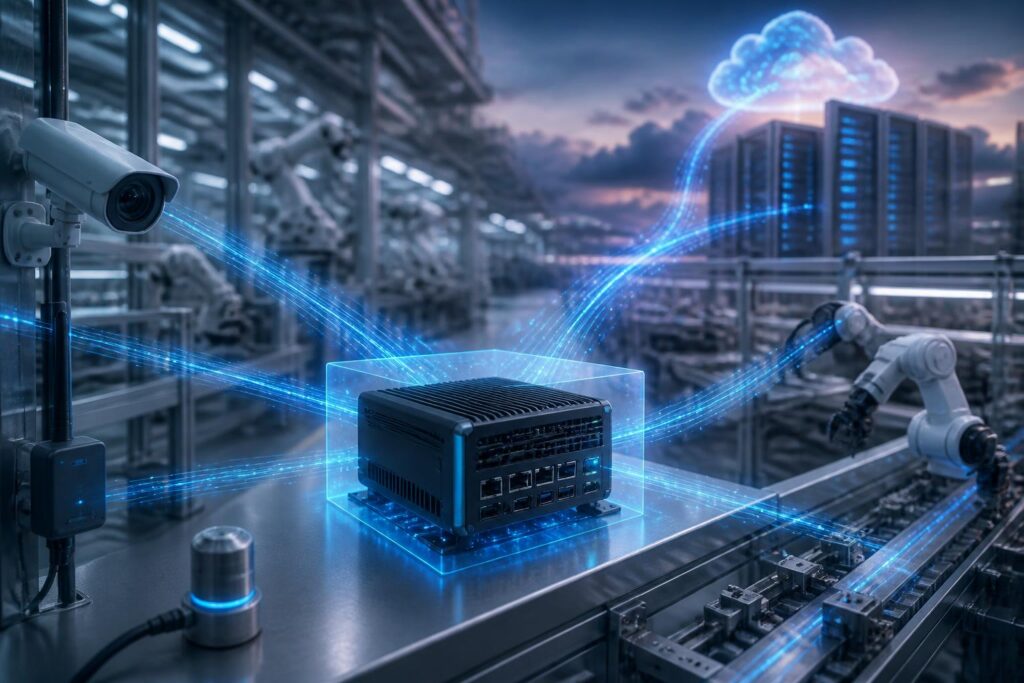
For many years, the common way to process data was to send information from end devices to a data center or cloud platform. This model is well suited to tasks that require centralized storage, synchronization across multiple locations, and access to substantial computing resources. However, as the number of connected devices has increased, data is no longer generated only by computers or phones. Cameras, factory sensors, vehicles, medical devices, and building management systems are all continuously producing information. Transmitting all that data to a distant location can increase latency, transmission costs, and risks when the connection is unstable.
Edge computing has emerged as a way to redistribute processing capabilities. Instead of sending everything to the cloud, a system can analyze, filter, or respond to some data right where it is generated or at a nearby point. The cloud still plays an important role, particularly in long-term storage, model training, and large-scale coordination. Edge computing is not a complete replacement for the cloud, but an additional layer that makes technology architectures more flexible.
Why has processing near devices become necessary?
The most apparent value of edge computing is reduced latency. In some situations, a system cannot wait for data to pass through multiple network layers, be processed on a remote server, and then have the result sent back. A production line that needs to quickly detect signs of abnormalities, a traffic control system that needs to respond based on local conditions, or a health-monitoring device that needs to issue early warnings can all benefit from processing close to the data source.
Low latency does not mean that every task must be handled entirely on the device. A camera in a controlled area can analyze images to detect a specific event and send only an alert or the necessary data to a server. This approach reduces the amount of information that must be transmitted compared with continuously uploading the entire video stream to a central facility. As a result, bandwidth is used more selectively, while the system gains the ability to keep operating when its connection to the cloud is interrupted.
Edge computing can also support privacy requirements. Sensitive data can be processed or anonymized at the source before leaving its original location. For example, an analytics system in a building may send only aggregated figures instead of transmitting all images or identifying information. However, this is an architectural capability, not an automatic guarantee. If an edge device is poorly configured, data can still be exposed at the point of collection.
How does edge computing work?
An edge computing system typically consists of multiple layers. The first layer contains data-generating devices such as sensors, cameras, meters, or controllers. The next layer may include a gateway, an industrial computer, a small server located on-site, or a specialized device capable of storage and processing. Farther away are cloud infrastructure or data centers, which handle tasks requiring significant computing power, centralized storage, and analysis across multiple sources.
In this architecture, data is classified according to its purpose and level of urgency. Signals requiring an immediate response can be processed on-site. Information valuable for long-term monitoring can be compressed or aggregated and then sent to a central system. Data that needs to be compared across multiple locations still has to be synchronized according to an appropriate schedule or set of conditions. This layered approach helps organizations avoid treating all data as having the same requirements for speed, capacity, and retention time.
The ability to operate offline is another important feature. A facility can continue performing core functions during a period of lost connectivity and then synchronize its data when the network returns. Even so, this mechanism must be carefully designed to avoid data conflicts, lost records, or the use of outdated information. The system must also clearly determine which devices are permitted to make decisions autonomously and which decisions must wait for approval from a central server.
Fields that may benefit
In manufacturing, edge computing can be combined with sensors and monitoring software to track the condition of machinery, detect deviations in processes, or support quality inspections. Analyzing data on the factory floor enables faster responses and reduces dependence on external connections. Aggregated data can then be sent to management systems to support maintenance, planning, and comparisons between production lines.
In transportation and urban environments, devices installed at intersections or on vehicles can process some information directly in the area where operations take place. This is useful when a response to a local situation is needed, while the central platform handles the broader view and trend analysis. Edge computing can also support areas with inconsistent connectivity, where continuously sending large volumes of data is impractical.
In retail and buildings, data from air-conditioning systems, access-control systems, environmental sensors, or point-of-sale devices can be analyzed directly on-site. Organizations can detect malfunctioning equipment, adjust energy use, or identify operational changes without waiting for remote processing. In healthcare, the potential benefit lies in delivering data from monitoring devices to responsible staff more quickly, but every real-world implementation must comply with strict requirements concerning safety, privacy, and professional accountability.
New costs and the management challenge
Moving servers and software closer to where data is generated does not make a system simpler. On the contrary, an organization may have to manage dozens, hundreds, or even more distributed processing points. Each point may use different hardware, operate under different environmental conditions, and have its own maintenance requirements. Software updates, device replacement, storage-capacity checks, and performance monitoring therefore become ongoing tasks.
Security is a prominent challenge. A data center is typically protected by multiple layers of physical and network controls, whereas edge devices may be located in factories, stores, traffic stations, or hard-to-access locations. If a device is compromised, an attacker may use it as an entry point into the internal network or interfere with data and operational decisions. Measures such as device authentication, data encryption, least-privilege access, secure updates, and centralized logging should be regarded as basic components from the design stage onward.
Compatibility should not be underestimated either. An edge system often has to connect with legacy devices, industry-specific protocols, and management software that has been in use for many years. If each vendor uses a separate implementation approach, an organization may become dependent on a single platform and face difficulties when expanding. An architecture with clear interfaces, unified management mechanisms, and controlled change processes can help reduce this risk.
An appropriate approach to implementation
Edge computing should not begin with buying more devices, but with identifying the problem that needs to be solved. An organization needs to know which tasks genuinely require a rapid response, which data can be processed on-site, which data must be stored centrally, and what will happen if the connection is interrupted. A small-scale trial in an environment with a clearly defined scope often provides a more accurate assessment than a plan for simultaneous deployment everywhere.
Next, a policy needs to be developed for the entire lifecycle of the devices. This policy should cover authorization, software updates, configuration backups, condition monitoring, incident response, and device retirement at the end of its useful life. Data generated at the edge also needs rules governing retention periods, access rights, and synchronization methods. If these rules are added only after the system is already operating, the cost of making adjustments will generally be higher.
People are also part of the challenge. On-site employees need to understand what the devices do, which signs indicate that the system is experiencing a problem, and when to switch to manual procedures. Information technology teams need remote-observation tools, but they should not assume that every incident can be handled without on-site support. An effective operating model usually combines automation, centralized monitoring, and clearly defined responsibilities for personnel in each location.
Edge computing in the broader technology landscape
The development of edge computing shows that digital infrastructure is moving from a model of absolute centralization toward a coordinated distributed model. Data does not necessarily have to follow a single route, and processing capabilities can be placed in multiple locations depending on the requirements of each task. This approach is particularly well suited to systems that combine physical devices, analytics software, and cloud services.
However, not every organization needs a complex edge architecture. If the volume of data is small, latency is unimportant, and connectivity is stable, centralized processing may still be the more economical choice. Edge computing delivers value only when the benefits in speed, continuity, bandwidth, or control are substantial enough to offset the cost of distributed management.
In the years ahead, the important question will not be whether to choose the cloud or edge computing, but which tasks should be placed where. The answer needs to be based on the characteristics of the data, operational requirements, security risks, and the capabilities of the team. When designed with a clear purpose, edge computing can turn a network of disconnected devices into a system that responds more quickly, uses resources more efficiently, and is more resilient to disruptions in connectivity infrastructure.
