


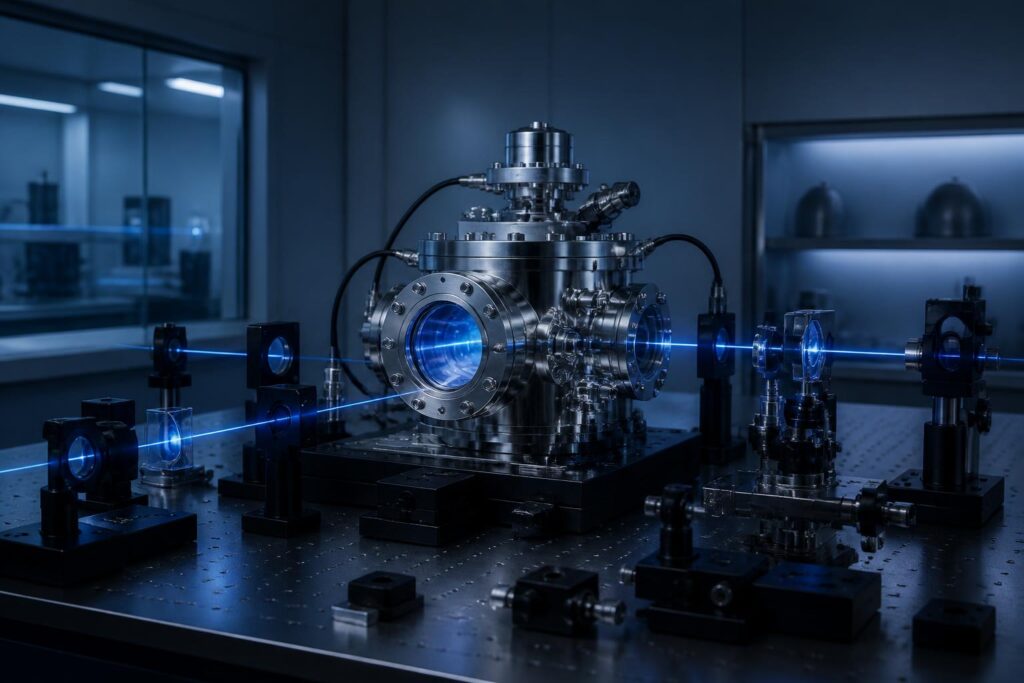
When quantum technology is mentioned, many people first think of machines capable of processing specialized problems. But quantum computers are only one part of a broader picture. Another area attracting attention is quantum sensing—that is, devices that use the properties of the microscopic world to observe and measure physical quantities.
Quantum sensors do not necessarily perform calculations like quantum computers. Their goal is to produce measurements with sensitivity, accuracy, or detection capabilities that traditional devices may find difficult to achieve under certain conditions. From determining time and position to observing magnetic fields, gravity, or extremely small movements, this technology could affect many fields. Even so, the phrase “quantum accuracy” does not mean that every sensor outperforms conventional devices in every situation. Its practical value also depends on the design, operating environment, calibration method, and how the data are used.
How Do Quantum Sensors Work?
At a basic level, a quantum sensor takes advantage of the behavior of physical systems such as atoms, ions, photons, or defects in materials. These systems can exist in specific energy, spin, or polarization states. When affected by an external quantity, their states change in ways that can be observed and converted into measurement information.
A general example is the atomic clock. This device uses the frequency of transitions between the energy levels of atoms as a time standard. Because the characteristics of those transitions are much more stable than many sources of mechanical oscillation, atomic clocks can provide an extremely accurate time standard. On this foundation, positioning systems, telecommunications network synchronization, and many scientific activities can coordinate more effectively.
In some other types of sensors, researchers track changes in the phase of matter waves or light. Acceleration, rotational speed, and gravitational fields can alter the state or path of a quantum system. Reading out these very small changes makes it possible to infer the quantity being measured. Phenomena such as superposition and interference are often exploited to increase sensitivity, but they also make devices more vulnerable to vibration, temperature, electromagnetic noise, and unwanted disturbances.
Notable Categories of Sensors
Quantum clocks are the easiest category to visualize because they turn a microscopic phenomenon into a time standard. In addition to their role in positioning and telecommunications systems, precise time is important for physics experiments, measurement networks, and applications that require multiple devices at different locations to be synchronized. However, highly accurate clocks often require strict control of temperature, radiation, magnetic fields, and mechanical vibration.
Quantum magnetic sensors measure variations in magnetic fields. Some platforms based on atoms or special structures in materials can detect extremely small changes. They can support geological research, materials surveying, observation of brain activity, or the testing of electrical systems. In healthcare, the idea of using magnetic sensors to record biological signals often comes with very high requirements for eliminating noise and ensuring the safety of the person being measured. Therefore, theoretical sensitivity alone is not enough to turn a device into a clinical tool.
Quantum accelerometers and gravimeters are designed to measure motion or changes in gravitational fields. Gravity data can reflect differences in the distribution of matter underground. In principle, this creates opportunities for geological surveying, monitoring underground structures, supporting mapping, or studying natural processes without the need to drill or excavate at every location. However, interpreting the data is often not simple, because the same signal may be associated with many different structures. The more sensitive the sensor, the more important modeling and data processing become.
Sensors based on photons and light also occupy a distinct position. Optical interferometry systems can detect extremely small changes in distance or motion. Some designs exploit the quantum states of light to improve measurement capabilities, but a clear distinction must be made between ordinary optical equipment and sensors that genuinely use a quantum advantage. The mere presence of a laser or an interferometer does not make a system quantum technology in the specialized sense.
Potential Applications Extend Beyond the Laboratory
In transportation and navigation, quantum sensors could supplement systems based on satellite signals. If a vehicle can measure acceleration, rotational speed, or gravitational fields with high stability, it has additional information for estimating its position when external signals are weak or interrupted. This is an area of interest in environments such as underground locations, underwater settings, or areas with many obstructions. Nevertheless, a practical navigation system must operate reliably over long periods, rather than merely achieving good results in a tightly controlled experiment.
In geology and resource exploration, measurements of gravity or magnetic fields can help identify differences in subsurface structures. Sensor data can be combined with geological information, remote-sensing imagery, and traditional measurements. The role of quantum sensors here is not to replace every existing tool, but to add a new layer of observation. Precisely identifying a structure still requires modeling, field surveys, and error assessment.
In biomedicine, quantum sensors could help detect extremely weak electrical or magnetic signals associated with the body’s activity. These signals may provide a different perspective from structural imaging or biochemical measurements. However, the distance from a laboratory prototype to a device used routinely is considerable. The device must be easy to operate, safe, compatible with care procedures, capable of producing reproducible results, and compliant with relevant regulatory requirements.
In fundamental science, more sensitive sensors help researchers test physical predictions, observe extremely small variations, and develop measurements that are difficult to perform with conventional equipment. This is an area where the benefits of quantum sensors may emerge early, because laboratories are often willing to accept more complex systems in exchange for new data. But scientific results in an experimental environment do not automatically prove that the technology is ready for the mass market.
Why Is It Difficult to Bring Quantum Sensors into the Real World?
The first challenge is the environment. Quantum states are often sensitive to external influences. Heat, vibration, unwanted light, electrical noise, and interactions with the environment can destroy the information being measured. To limit this, a device may need a vacuum chamber, vibration-isolation systems, temperature control, or sophisticated optical and electronic components. Each layer of protection increases size, cost, and complexity.
The second challenge is the trade-off between sensitivity and usability. A very sensitive sensor that must remain fixed in a strictly controlled room is not necessarily more useful than a less sensitive sensor that can be taken into the field. Users generally need equipment that starts up quickly, consumes a reasonable amount of energy, withstands real-world conditions, and produces results that are easy to interpret. Therefore, the criterion for success is not simply the sensitivity figure in a technical document.
Calibration and error determination are also important issues. A measurement with many digits does not mean that every digit is reliable. Sensors need to be compared with reference standards, monitored for drift over time, and evaluated for the effects of operating conditions. Without proper control, a device can produce data that appear highly detailed but contain systematic errors. In applications related to safety, healthcare, or infrastructure, recognizing the limits of a measurement is even more important than promoting maximum sensitivity.
In addition, quantum sensors usually require accompanying electronics and software. Raw signals must be filtered, synchronized, modeled, and converted into meaningful information. This highlights the role of classical engineering throughout the product. A sound quantum principle still needs a reliable light source, controller, receiver, processing algorithms, and operating interface.
A Realistic View of the Future of Quantum Sensors
Quantum sensors have the potential to expand the limits of measurement, but their development will most likely proceed field by field rather than appearing as a wholesale replacement. Applications with clear demands for accuracy, operation in controlled environments, or high value per device may be deployed first. Research systems, time standards, specialized surveying, and certain industrial tools are areas better positioned to adopt more complex technology.
To evaluate a quantum-sensor product, several specific questions need to be asked: What quantity does it measure, under what conditions, how is its error determined, what maintenance does the device require, and does its benefit outweigh its cost compared with the current method? Its ability to integrate into existing processes should also be considered, rather than focusing only on claims about a laboratory record. This approach helps distinguish genuine scientific progress from overly broad expectations about quantum technology.
Ultimately, the value of quantum sensors lies in turning difficult-to-observe effects into usable data. As the technology continues to become smaller, more stable, and easier to operate, these devices may complement traditional sensors in many measurement tasks. That path requires collaboration among physics, engineering, data science, and application-specific fields. Quantum sensors are therefore not a promise to replace every device used today, but a new way to ask questions and observe the world with greater subtlety.
