


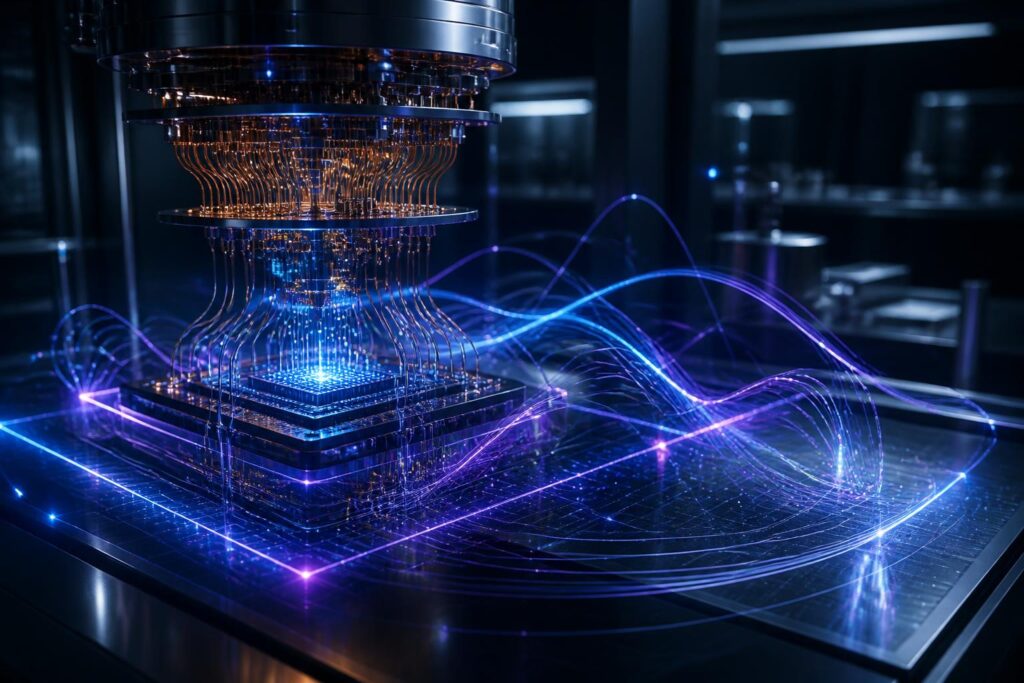
When quantum computers are mentioned, many people tend to imagine a device that can process every kind of task faster than a conventional computer. This understanding can easily create excessive expectations. A quantum computer is not simply a more powerful version of today’s personal computers or servers. It is a different computational model, based on phenomena from quantum mechanics, and it can produce a clear advantage only for problems suited to the structure of quantum algorithms.
Therefore, the important question is not “How fast are quantum computers?” but rather “How do quantum algorithms transform a problem?” Hardware provides qubits, quantum gates, and the ability to perform measurements. The algorithm determines how those components are used to turn an input problem into a verifiable result. Understanding this relationship helps distinguish the scientific potential of quantum computing from commercial claims that still need to be proven.
How Are Quantum Algorithms Different from Conventional Programs?
In classical computers, data is represented primarily by bits with a value of 0 or 1. Logical operations act on these bits through a defined sequence of steps. Quantum computers use qubits. A qubit can be prepared in a combined state of 0 and 1, but this does not mean that users can read an unlimited number of results simultaneously after measurement. When measured, the system returns only one specific result, according to the probabilities determined by the quantum state.
The important point lies in controlling probability amplitudes before measurement. Quantum algorithms are designed to increase the likelihood of desired answers appearing and reduce the likelihood of undesired answers appearing. Quantum interference plays a central role in this process. If the computational branches are arranged appropriately, they can reinforce one another in regions containing useful results and partially cancel one another in regions containing unhelpful results.
Quantum entanglement is also frequently mentioned when describing systems with multiple qubits. It is a special form of correlation between qubits in which the state of the entire system cannot always be described as a simple sum of the individual qubits. However, merely saying that an algorithm uses superposition or quantum entanglement is not enough to prove an advantage. The advantage must come from the entire process: preparing the data, executing the quantum circuit, measuring the results, and processing the output with a classical computer.
Three Commonly Discussed Groups of Algorithms
Algorithms for Simulating Quantum Systems
One of the most natural applications of quantum computers is simulating systems that already follow the laws of quantum mechanics. When a molecule or material is described using classical methods, the number of states that need to be considered can increase very rapidly as the system becomes more complex. Quantum computers are expected to be able to represent certain structures of quantum systems more directly, thereby supporting research into quantum chemistry, materials, and microscopic processes.
This does not mean that quantum machines will immediately replace all existing simulation software. Classical methods remain very important, especially for small systems or problems for which effective approximation techniques already exist. Quantum machines may serve as a supplementary tool, particularly when researchers need to examine states that become difficult to simulate entirely with classical resources.
Search Algorithms
Another group focuses on finding a suitable element within a space of possibilities. In an unstructured search model, quantum algorithms can reduce the number of queries required compared with the usual method of trying possibilities one by one. This is an improvement in the order of growth, not a fixed speed multiplier for every application.
To apply this idea to a real-world product, developers still have to build a mechanism for checking whether a candidate satisfies the required conditions. If checking is too costly, or if the initial data must be transferred into the quantum system in a complicated way, the theoretical benefit may be reduced. Therefore, a search algorithm that looks good on paper does not automatically become a good solution for a database or enterprise software.
Algorithms for Linear Algebra and Data Processing
Many areas of modern computing rely on linear algebra, including systems of equations, the analysis of data structures, and machine-learning models. Some quantum algorithms have been proposed for matrix-related tasks under certain conditions. However, these conditions can be very stringent. Data usually has to be encoded into a quantum state, output may be collected only in the form of probabilities or indirect measurements, and reading an entire large vector is generally not a free operation.
This is why caution is needed when connecting quantum algorithms with artificial intelligence. A machine-learning model may contain many matrix operations, but the mere presence of matrices does not mean that a quantum computer will provide an advantage. Efficiency also depends on the type of data, how the data is represented, the required precision, the number of circuit runs, and the cost of combining classical processors with quantum processors.
Optimization: Significant Potential but Also Many Conditions
Optimization is often viewed as an appealing area for quantum computing because many real-world problems have a rapidly growing number of possible solutions. Scheduling, resource allocation, network design, and portfolio selection can all be described using variables and objective functions. Some quantum methods attempt to encode the objective function into the energy of a system and then guide the system toward states corresponding to good solutions.
The problem is that most real-world optimization problems also contain many constraints, uncertain data, and conflicting objectives. A mathematically valuable solution may not be feasible when applied to a specific transportation schedule, production process, or budget. In addition, quantum methods for optimization still need to be compared fairly with classical algorithms that have been developed over many decades. In many cases, an approximate method running on a conventional computer may be faster, more stable, and easier to deploy.
Therefore, the appropriate question is not whether quantum computing can “solve optimization.” The specific problem, data size, evaluation criteria, and total system cost must be identified. An algorithm is worth serious attention only when it produces solution quality or processing speed sufficient to offset the operating costs of the new hardware.
Why Is Quantum Advantage Difficult to Prove?
To prove that a quantum algorithm is useful, at least three levels must be distinguished. The first is theoretical advantage, meaning that the algorithm has better asymptotic performance in a particular computational model. The second is the ability to execute it on hardware with a suitable number of qubits, level of accuracy, and runtime. The third is application benefit, meaning that the entire process creates more value than a classical solution under the same conditions.
The gap between these three levels can be very large. Long quantum circuits are easily affected by noise. State preparation and data readout can create significant costs. Measurement results often need to be repeated many times to estimate a quantity with the desired level of confidence. Meanwhile, a classical computer may handle preprocessing, control, post-processing, and even the simulation of part of the quantum circuit. If only the runtime of the quantum circuit is measured while the remaining steps are ignored, the comparison will not fully reflect practical efficiency.
Benchmarks, or standard tests, also need to be designed carefully. A test created to suit a particular architecture may produce impressive results without representing users’ actual workloads. A reliable comparison should clearly disclose the data, hardware conditions, solution-quality criteria, and all tasks performed outside the quantum processor.
How Should Businesses View Quantum Algorithms?
For businesses, the first step is not to buy quantum equipment but to classify the problems they currently have. Processes involving the optimization of many possibilities, materials simulation, or specialized mathematical models may be worth investigating. By contrast, office tasks, storage, routine data queries, and common management software do not yet have a clear reason to be moved to quantum computers.
Businesses should also build evaluation capabilities rather than chase terminology. A pilot team can begin by describing the problem, identifying the input data, setting success criteria, and comparing the results with the best classical method the organization can access. This approach helps prevent a technical demonstration from being equated with business value.
While the technology is still developing, training personnel may be more valuable than rushing to invest in hardware. Engineers need to understand both quantum programming and classical optimization methods, because real-world systems will likely combine the two types of machines. The ability to ask the right questions, verify results, and recognize the limitations of an algorithm will determine the quality of an application no less than the device itself.
The Outlook Lies in Combination
Quantum computers will not make every calculation faster simply by replacing current processors. Their value, if proven, will come from algorithms that correctly exploit the characteristics of quantum systems to solve a specific class of problems. Quantum-system simulation, search, linear algebra, and optimization all open up avenues for research, but each comes with its own conditions, limitations, and evaluation methods.
A cautious perspective does not mean denying the technology’s potential. On the contrary, caution helps identify where quantum computers can make a substantive contribution instead of turning every claim about speed into a vague general expectation. As hardware improves, algorithms are refined, and comparison methods become more rigorous, the answer regarding practical benefits will gradually become clearer. In the meantime, understanding the nature of algorithms remains the best foundation for following this field with a clear and balanced perspective.
