


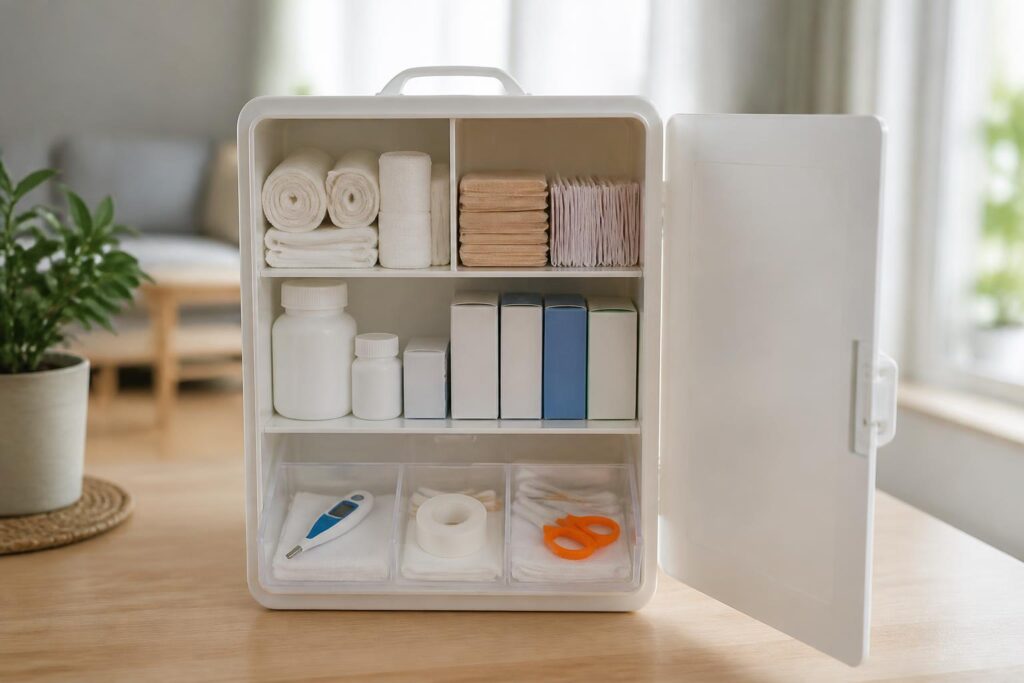
Why Does a Home Medicine Cabinet Need to Be Organized Separately?
A home medicine cabinet often starts with a few familiar items, such as a thermometer, gauze, wound-cleaning solution, or some over-the-counter medicines. Over time, the number of items may increase with each restocking trip, while items that have been used up, expired, or are no longer clearly identifiable in purpose remain in place. If everything is kept together in one drawer, finding what is needed will take time, and the risk of picking up the wrong product will also be higher.
A well-organized medicine cabinet does not mean that a family has to stockpile large quantities of medicine. More importantly, the goal is to know what is available, what each item is for, which things require professional advice, and which should be discarded. This arrangement is especially useful in small but time-sensitive situations, such as treating a minor scratch, dealing with an ordinary ache, or taking someone’s temperature to monitor their health.
Choose a Storage Location Before Sorting
The location of the medicine cabinet directly affects product quality and the safety of the entire family. Choose a dry, clean place away from direct sunlight and not frequently exposed to changes in temperature or humidity. The bathroom is usually not a suitable choice because steam can alter the storage environment. Areas near the kitchen should also be considered carefully because of heat and cooking fumes.
The medicine cabinet should be placed where adults can access it quickly but young children cannot easily open it themselves. If there are older adults in the household, the location and arrangement should also take into account their ability to read labels, open containers, and reach the items. Medicines that must be stored according to specific instructions on the packaging should be kept under the conditions required by the manufacturer, rather than being placed together in one compartment simply for convenience.
If a locked box or cabinet is used, the person in charge should agree with the other adults in the household on how to open it and where to keep the key. Locking the cabinet should not prevent someone who needs assistance from accessing it in a necessary situation. The important thing is to balance quick access for the responsible adult with preventing children from using the contents on their own.
Sort by Purpose and Level of Necessity
After choosing a location, take out all the items for inspection instead of hurriedly organizing them a portion at a time. They can be divided into clear groups: first-aid supplies, health-monitoring tools, topical products, and medicines used according to professional instructions. Each group should have its own box or compartment so that users do not have to search through multiple packages with similar shapes.
The first-aid group may include gauze, medical tape, suitable cleaning products, and other necessary items that the family commonly uses. The health-monitoring group may contain a thermometer or other tools that household members are using as instructed. For topical products, keep them in their original packaging and place them separately from oral medicines to reduce the chance of taking the wrong product.
Medicines being used by prescription or as part of an individual treatment plan should not be mixed with products intended for general household use. Each person should have a separate area or box, along with clear identifying information. This helps limit the risk of one family member accidentally taking someone else’s medicine, especially when the medicines have similar packaging.
Check Labels, Expiration Dates, and Packaging Condition
When reviewing the medicine cabinet, check the product name, intended use, storage instructions, and expiration date on each package. If a label has faded, torn, or no longer makes it possible to identify the product, it should not be kept simply because it seems wasteful to discard it. A medicine that can no longer be clearly identified may cause difficulties when its instructions need to be checked or discussed with a healthcare professional.
Do not combine leftover pills in a single container, even if they look similar in color. The original packaging usually contains important information about the name, strength, storage requirements, and expiration date. Removing medicine from its packaging and mixing it together can prevent users from accurately identifying each type.
Products that have expired, changed color, become misshapen, developed an unusual smell, or have damaged packaging should be separated for disposal. Do not arbitrarily pour medicines down the sink or toilet, or throw them away carelessly with other waste. The family can ask a pharmacy, healthcare facility, or appropriate local disposal service about how to accept and dispose of medicines that are no longer in use.
Keep Instructions in an Easy-to-Find Place
A medicine cabinet should not only keep products organized but also ensure that the accompanying information is not lost. Instructions for use, prescriptions, or notes from a doctor should be kept with the corresponding product. They can be placed in a separate document pouch if they are not to be stored in the medicine compartment. For people undergoing long-term treatment, information about when to take the medicine and important precautions should be written in an easy-to-read format.
However, family notes should not be treated as a substitute for professional instructions. When it is unclear whether a product is suitable, especially when the user is a child, an older adult, a pregnant woman, or someone with an underlying medical condition, consult a doctor or pharmacist. Having used a product before does not mean that it will always be appropriate every time afterward.
It is also advisable to record necessary information, such as known allergies or medicines currently being taken, when taking a family member for medical care. This helps make communication with healthcare professionals more complete. Sensitive personal information should be stored discreetly and made accessible only to responsible individuals.
Habits That Can Easily Create Safety Risks
A common mistake is keeping medicine from an old treatment with the thought that it might be used for similar symptoms in the future. Similar symptoms can result from different causes, and medicine prescribed for one person is not necessarily suitable for someone else. Therefore, a home medicine cabinet should not become a place to stockpile medicines based on hearsay or personal experience.
Another mistake is leaving medicines in a handbag, vehicle trunk, or place with changing temperatures for a long time without checking them again. Some people also remove pills from their blister packs in advance for convenience, but this causes the identifying information to be lost and may affect their ability to be stored properly. If doses need to be divided according to instructions, use a suitable device while still keeping the product’s packaging and information.
Sharing personal-use tools should also be avoided. Items such as measuring cups or tools provided with a product should be washed, dried, and used for their intended purpose. Do not use an ordinary eating spoon to estimate a dose, because its size and capacity may not be consistent.
Set Up a Simple Inspection Schedule
The family does not need to wait until someone becomes ill before checking the medicine cabinet. Choose a fixed time each month or every few months to review expiration dates, packaging condition, and the quantity of essential items. After each use, return the product to the correct compartment instead of temporarily placing it somewhere else. This small habit makes the next inspection faster and reduces the chance of items becoming scattered.
A short list placed outside the cabinet can record the groups of items currently available, products that are running low, and items for which additional professional advice is needed. The list does not need to include too many details, but it should be updated whenever something changes. If several people in the household use the cabinet, designate one person to be responsible for regular inspections while also showing the others how to take out and put away the items.
When adding a new product, place the product with the nearer expiration date in an easily accessible position at the front, and put the newer product behind it if the packaging conditions allow. Even so, this approach should not be applied mechanically if the storage instructions or the shape of the packaging make the arrangement less safe. The purpose of rotating stock is to reduce the chance of items being forgotten, not to encourage the use of a product before its condition has been clearly determined.
A Tidy Medicine Cabinet Is Part of a Health-Care Routine
Organizing a medicine cabinet does not replace medical examination, diagnosis, or treatment. The value of a well-organized medicine cabinet lies in its ability to support basic needs in an orderly way while helping the family recognize when to stop managing the situation on its own and seek help from a healthcare professional. If symptoms persist, develop unusually, or affect someone who requires special monitoring, do not rely solely on what is available in the cabinet.
A safe medicine cabinet is usually not the one with the most products, but the one with clearly identified contents, intact packaging, easily checked information, and a suitable storage location. Start by removing items that can no longer be identified, grouping essential supplies, and agreeing on rules for use within the household. When maintained regularly, this approach helps reduce confusion, save time, and create a more cautious health-care routine.
