


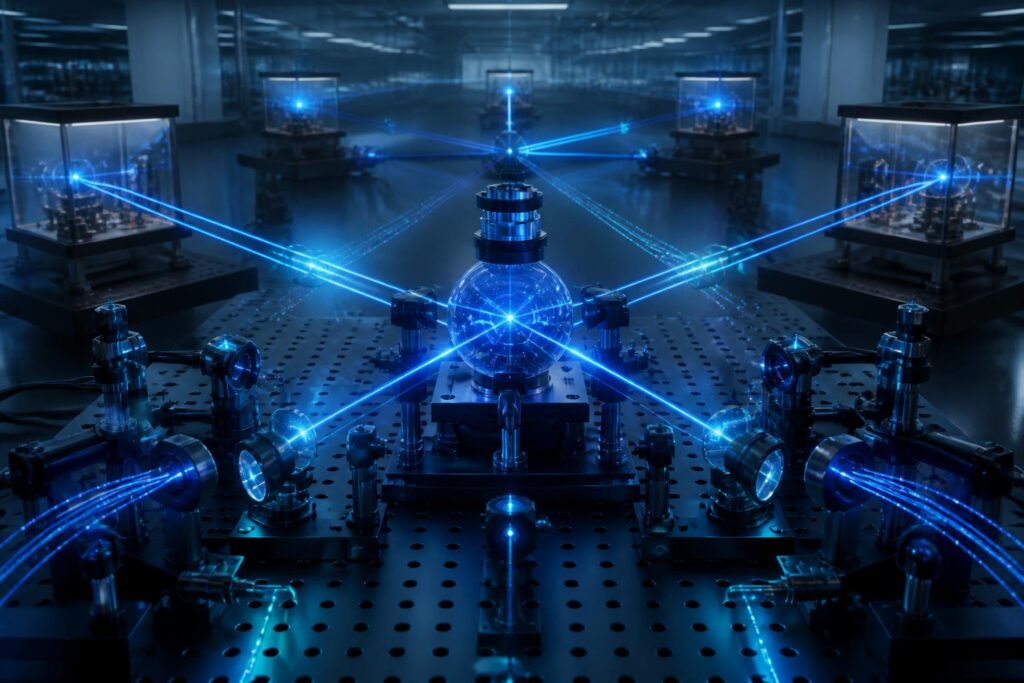
When they hear about the quantum internet, many people easily imagine a faster, more powerful version of the Internet they use every day. That picture is not entirely accurate. Quantum networks are not primarily being created to load web pages faster, transmit larger files, or replace the entire telecommunications infrastructure in use today. Their goal is to connect devices capable of processing quantum states, thereby opening up forms of communication, synchronization, and coordination that classical networks cannot perform in the same way.
The challenge lies in the fact that quantum information is extremely fragile. A quantum state can be altered by the environment, by noise along the transmission path, or even by an inappropriate measurement operation. Traditional telecommunications networks, meanwhile, rely on amplifying and copying signals to compensate for loss. With quantum information, arbitrarily copying an unknown state is impossible. Therefore, building a quantum network is not simply a matter of replacing fiber-optic cables with a new type of cable. It is a problem of redesigning how network nodes create, preserve, forward, and verify information.
How Is the Quantum Internet Different from Today’s Internet?
In a classical network, a bit can have a value of either 0 or 1. When a signal weakens, an intermediate device can read the bit, regenerate it, and send it onward. This process suits communication systems that need to maintain stable data over long distances. A qubit, the unit of quantum information, can exist in a combined state of multiple possibilities before it is measured. This characteristic allows quantum systems to exploit effects that do not appear in ordinary binary logic, but it also makes transmitting qubits much more difficult.
Quantum networks are therefore likely to operate alongside classical networks rather than immediately replace them. Classical channels will still be necessary for exchanging control information, sending measurement results, synchronizing devices, and confirming the status of the transmission process. Quantum channels will be responsible for transporting or distributing quantum states. The two types of channels complement each other, much like the transmission infrastructure and coordination system in a complex network.
One frequently mentioned application is quantum key distribution. In this model, two parties can generate a key for encryption by exploiting the properties of quantum measurement. If interference alters the state along the transmission path, abnormal signs may appear in the test data. However, quantum key distribution is only one specific application and is not synonymous with the entire quantum internet. A complete network could also be used to connect quantum computers, synchronize sensors, or carry out coordination protocols between distant devices.
What Role Does Quantum Entanglement Play?
Quantum entanglement is one of the important foundations of quantum networks. When two systems are prepared in an entangled state, their measurement results can exhibit a special correlation, even after the two systems have been taken far apart. This does not mean that users can send an instantaneous message beyond all physical limits. To complete a protocol, classical information still generally has to be exchanged between the parties.
The value of entanglement lies in its ability to create a shared resource for quantum operations. Two devices in different locations can use an entangled pair to perform state-transfer protocols, check integrity, or coordinate computations. One conceptual example is quantum teleportation. The name can be misleading because it does not transport matter from one place to another. Instead, the quantum state of one system can be recreated at another location by using an entangled pair together with some classical information. The original state is no longer preserved at the sending location, so the process does not create an arbitrary copy of the qubit.
For a useful network, creating entanglement once is not enough. The nodes must distribute, preserve, and test entangled pairs of acceptable quality. The greater the distance, the more loss in the optical fiber and interaction with the environment reduce the ability to maintain the necessary state. This is why a quantum-network architecture needs more layers of intermediate equipment than a simple point-to-point transmission line.
Quantum Repeaters Are Not the Same as Signal Amplifiers
In a classical network, a repeater receives a weakened signal, restores its original form, and retransmits it. This approach cannot be applied directly to an unknown qubit, because measurement can destroy quantum information and copying an arbitrary quantum state is impossible. Quantum repeaters are proposed to solve the problem in a different way: divide the route into short segments, create entanglement over each segment, and then connect the segments through suitable procedures.
An important operation in this idea is entanglement swapping. If the middle node shares entangled pairs with the two nodes on either side, a coordinated measurement can help the two more distant end nodes form an entangled correlation. This process is not signal amplification in the traditional sense. It requires intermediate nodes capable of creating the necessary state, performing precise measurements, storing the results, and exchanging control information with other nodes.
In practice, quantum repeaters must also cope with the requirement to store qubits for a sufficiently long period. Network segments do not always complete the creation of entanglement at the same time. If quantum memory loses its state too quickly, segments prepared in advance may become useless before they can be connected. Therefore, quantum memory must not only hold qubits, but also operate in coordination with photon sources, measurement devices, control protocols, and the transmission schedule across the entire network.
Photons, Optical Fiber, and Physical Limitations
Photons are often considered natural candidates for carrying quantum information over transmission lines because they can travel through optical fiber and interact less with the environment than some other physical systems. Nevertheless, photons transmitted through optical fiber still experience loss. As distance increases, the number of photons that reach the receiver decreases, while detecting a single photon requires sensitive equipment and suitable testing procedures.
The transmission path is not the only source of difficulty. The source must create quantum states with stable characteristics; the receiver must distinguish signals from noise; and the nodes must synchronize time with extreme precision. Temperature, vibration, material impurities, and component instability can all affect connection quality. A quantum network will therefore be a combination of optics, materials, control electronics, software, and information theory.
These requirements also show why the quantum internet should not be evaluated solely by data-transmission speed. A link may transmit few classical bits and still be valuable if it distributes high-quality entangled states or supports a protocol that an ordinary network cannot provide. Important metrics may include state fidelity, memory-retention time, the rate of successful link generation, and the ability to recover when a link fails.
What Could Quantum Networks Be Used For?
In information security, quantum networks could support key-distribution mechanisms based on detecting certain forms of interference. This does not make every system automatically and absolutely secure. End devices, key-management software, identity-authentication methods, and operating procedures can still create vulnerabilities. A well-protected quantum channel connected to an untrusted device still does not solve the entire security problem.
Another application is connecting quantum computers. A single machine may be limited by its number of qubits, control capabilities, or operating conditions. If multiple systems are linked through quantum protocols, they may coordinate on certain tasks. However, this does not mean that combining many small machines will immediately create a larger, more powerful machine in a linear manner. The costs of synchronization, latency, loss, and protocol requirements can be very high.
Distributed sensing is another noteworthy direction. Devices in different locations can jointly measure a phenomenon, compare results, or maintain a common reference standard. In problems requiring high sensitivity, the ability to coordinate quantum mechanically could provide an advantage. However, that advantage is meaningful only when the devices are deployed in real-world environments, where noise, maintenance costs, and long-term stability are often no less important than the physical principle itself.
Why Is the Quantum Internet Not Yet Ready for Everyday Life?
The first barrier is reliability. A commercial network must operate stably under many different conditions, detect faults automatically, and have a way to respond when a node temporarily fails to respond. Experiments in research laboratories can demonstrate a protocol on a limited scale, but expanding it into interregional infrastructure requires many layers of engineering that cannot yet be considered fully resolved.
The next barrier is standardization. Photon sources, memories, detectors, and control systems may be built according to different principles. If equipment from multiple suppliers cannot communicate, the network will be divided into separate islands. Quantum-routing protocols are also more complex than ordinary packet routing, because the network must track entanglement resources, link quality, and the state of the memory at each node.
Cost is also a practical issue. New infrastructure may require precise optical equipment, cooling or environmental-control systems, and an operations team with interdisciplinary expertise. In the early stages, quantum networks will most likely focus on high-value use cases rather than providing mass connectivity to every user. Classical networks will continue to serve as the foundation for most digital activities.
A Realistic View of the Future of Quantum Networks
The quantum internet should be viewed as a new layer of capability that supplements existing infrastructure, not as a promise to replace the Internet after a single upgrade. The early stage of development may focus on short links, experiments between laboratories, and applications requiring key distribution or coordination between specialized devices. As sources, memories, detectors, and control software become more reliable, network nodes may be expanded region by region.
It is important to clearly distinguish what quantum networks can do from what is often exaggerated. They do not allow information to be sent faster than light, do not automatically solve every security problem, and do not turn an ordinary computer into a quantum computer. Their value lies in creating protocols based on quantum states, where new limitations and capabilities appear together.
The path from experiments to operational infrastructure will depend on coordination among fundamental physics, telecommunications engineering, cybersecurity, and standards policy. If successful, quantum networks could become a specialized connectivity layer for tasks that classical networks struggle to handle. But reaching that point will require the industry to solve problems involving transmission lines, memory, routing, testing, and operations with the same patience required to build any critical technological infrastructure.
