


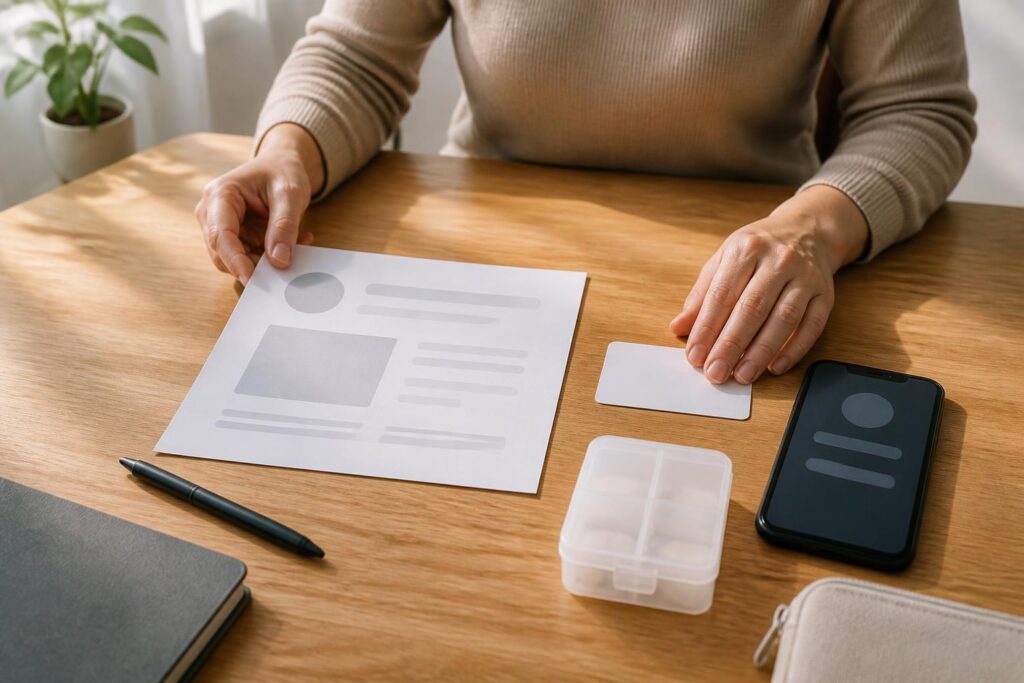
In unexpected situations such as fainting, accidents, hospitalization, or temporarily losing the ability to communicate, what confuses the people around you is not only how the situation unfolds. They may also not know whom to call, what medications you are taking, whether you have allergies or underlying conditions that need attention, where important documents are, or what your wishes are. Information that seems familiar to you is not always readily available on your phone or in the memories of your loved ones.
A well-organized personal emergency information profile cannot prevent an incident from occurring, but it can reduce the time spent searching and limit unnecessary guesswork. This is not a complicated dossier or a special technology system. Essentially, it is a collection of minimal, easily accessible information that is updated regularly, so people you trust can provide support when you are unable to make decisions or explain things yourself.
What Is an Emergency Information Profile?
An emergency information profile is a summary of the data needed for communication, assistance, and initial handling in an unusual situation. The profile may exist in paper form, as a protected electronic file, as emergency information on a mobile device, or as a combination of several formats. What matters is not the format, but whether the information can be found at the right time and understood without having to guess what it means.
This profile does not replace medical records, legal documents, doctors’ instructions, or decisions by competent authorities. It should also not contain all of your private information. A good profile includes only data that is truly useful in an emergency, while limiting access to protect your private life.
Groups of Information to Include
Identification and Contact Information
The first section should help the person providing assistance identify who you are and contact the appropriate person. It may include your commonly used full name, date of birth if you consider it necessary, the phone numbers of one or two emergency contacts, and their relationships to you. If you live alone, you may also include your home address or brief instructions on how to access it, but the complete version should be shared only with people you trust.
You should speak in advance with the person chosen as your emergency contact. They need to know that their name and phone number have been included in the profile, and understand in what circumstances you want them to be called. Do not automatically assume that your closest relative is always the person who can respond most quickly. Someone who lives near you, regularly answers the phone, and is calm enough to handle information may sometimes be more suitable.
Health Conditions Requiring Attention
Briefly record information that could directly affect the assistance provided, such as important underlying conditions, medication or food allergies, conditions currently under treatment, medical devices you use, and limitations that should be respected. If you have a medication list, it should include the medication name, time of use, and purpose in an easy-to-understand form. Avoid adding your own comments about dosages or changing professional instructions simply to make the profile shorter.
Health information often changes over time. A medication may be discontinued, replaced, or adjusted; a new allergy may develop; or a condition that previously required attention may no longer be relevant. Therefore, the profile should include the date it was most recently updated. This timeline helps readers understand how reliable the information is and reminds you to review it when necessary.
Information About Needs and Support Requirements
Not every need is reflected in a medical condition. Some people need glasses for reading, hearing aids for communication, mobility assistance, simple language, or a few quiet minutes before responding. People with young children, dependents, pets, or family members who need regular support should also clearly state who can take over those responsibilities if they have to leave home or be hospitalized.
This section should focus on what others need to know in order to respond appropriately, rather than providing a lengthy description of your personal circumstances. For example, a brief guide to communicating effectively may be more useful than a paragraph explaining numerous terms. If you have specific needs when receiving information or making decisions, express them in concrete sentences and avoid overly general wording that leaves readers unsure what to do.
Designing a Profile for Practical Use
Emergency information is valuable only if it can be found quickly. Therefore, the profile should have a summary page at the front containing your name, contact person, allergies or important warnings, underlying conditions requiring attention, and where to find the detailed information. The remaining sections can be presented on subsequent pages or in a separate file with restricted access.
Use clear headings, short sentences, and a consistent layout. Phone numbers should be checked by making a test call at an appropriate time. Medication and medical condition names should be written accurately according to the information currently available, avoiding nicknames that only family members understand. If the profile is on paper, the text should be large enough, have good contrast, and not be obscured by plastic covering or a difficult-to-read colored folder.
You can prepare multiple versions with different levels of detail. A summary kept in your wallet or with your personal belongings can be used when quick identification is needed. A more complete version should be stored in a safe place that your emergency contact knows how to access. If you use a phone, learn about the device’s function for displaying emergency information on the lock screen and include only data that you are comfortable allowing others to see there.
Balancing Accessibility and Privacy
Preparing a profile does not mean making your entire private life public. Identification document numbers, passwords, bank unlock codes, authentication codes, account information, or copies of sensitive documents should not appear in a version that can be viewed easily. If a piece of information is not necessary for initial assistance, consider removing it or storing it in a separately protected area.
For an electronic profile, determine who is authorized to access it, how they will access it, and what they should do if the device or account encounters a problem. Do not send files containing sensitive data through inappropriate channels simply because of immediate convenience. If you use an online storage service, check the sharing settings and avoid leaving a link set so that anyone with the link can view it.
Paper profiles also need protection. A copy kept at home should be in a place that family members can find but that strangers cannot easily access. If you carry a summary with you, consider the risk of losing it and record only what is truly necessary. Sharing the profile should be based on consent and trust, and should not become a habit of sending it to too many people.
A Simple Process for Creating a Profile
The first step is to list the situations you want to prepare for. Someone who lives alone may prioritize contact information and instructions for accessing their home. Someone who travels frequently for work may need a summary that is easy to carry. Someone undergoing long-term treatment should focus on their medication list, the healthcare facility monitoring them, and the person who can communicate on their behalf when needed.
Next, choose a contact person and ask whether they are willing to take on this role. Agree on the preferred method of communication, the time period in which they can respond, and a backup person if they do not answer. This is a practical discussion, not a formal ritual. If both sides understand their roles, the likelihood that the profile will be used correctly is higher.
Then, collect information from reliable sources, such as current prescriptions, appointment slips, personal notes, and conversations with people who are caring for you. Do not fill it out from memory if you can verify the information. After completing it, read the profile as someone who knows nothing about your circumstances. Any sentences that are unclear, phone numbers missing the recipient’s name, or instructions that require guesswork should be rewritten.
Finally, test it in a hypothetical situation. Ask a family member to find the summary, identify whom to call, and explain how they understand the key information. This test often reveals issues that the person who created the profile did not notice, such as a file with a confusing name, a paper copy stored somewhere no one knows about, or a phone number that has changed.
Update It on a Set Schedule
The profile should not be created once and then forgotten. A regular review schedule can be tied to easy-to-remember occasions such as the beginning of the year, your birthday, after each course of treatment, or after moving. In addition to scheduled reviews, any important change in medication, phone number, residence, dependents, or emergency contact is a reason to update it immediately.
When replacing an old version, retrieve or destroy the previous copy to prevent two versions from existing at the same time. For electronic files, use a name with a clearly stated update date, but do not include sensitive data in the file name. People who have been granted access should also be notified if the information has changed or if their role is no longer appropriate.
Preparation Is a Way of Caring for One Another
Talking about emergency situations can make many people uncomfortable because it brings up uncertainty and the possibility of losing autonomy. Even so, preparing a concise profile is not pessimistic. It is a way to turn important matters into usable information, rather than leaving family members and those providing assistance to guess under stressful circumstances.
A good profile does not need to be elaborate, nor does it need to contain every detail of your life. It needs to be accurate, easy to read, appropriate to your circumstances, and adequately protected. By taking time to speak with your contact person, recheck the data, and practice how to access it, you are creating a practical support for yourself and for those who may have to act on your behalf. In a life full of changes, clarity prepared in advance is sometimes the most valuable form of support.
