


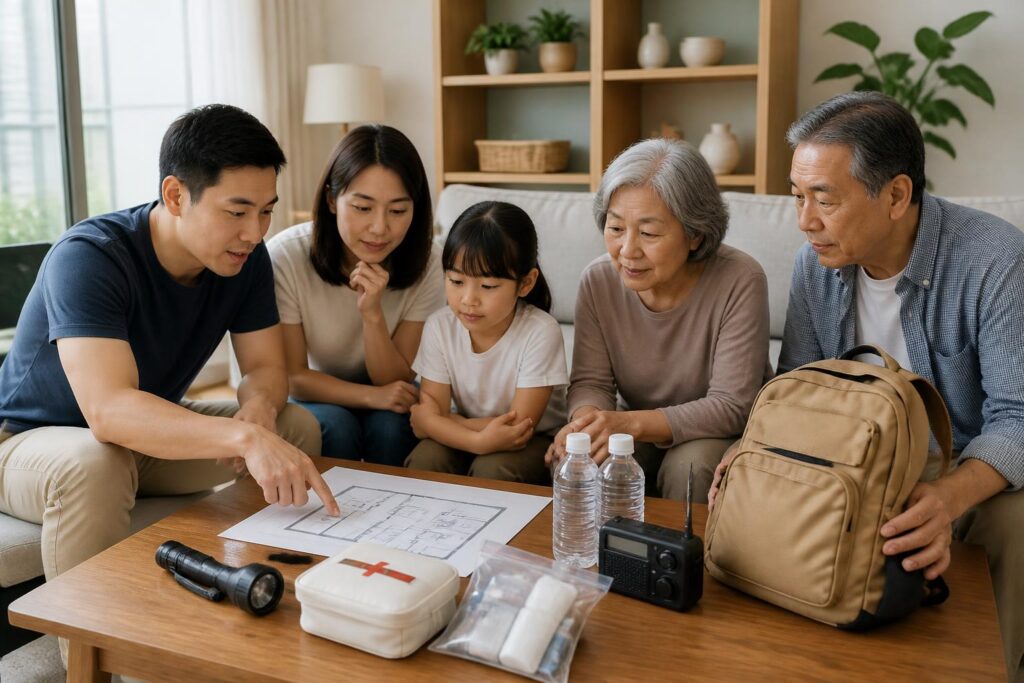
In everyday life, most families only think about emergency situations after something has already happened. Heavy rain causing flooding, a prolonged power outage, a small fire, an accident at home, or a family member suddenly needing to be hospitalized can all disrupt daily routines. When people are worried and lack information, they are more likely to act hastily, forget important tasks, or rely entirely on outside assistance.
Preparing in advance does not mean living in fear. It is a way to turn spontaneous reactions into a simple process that every family member can understand and follow. A good plan does not need a long list, expensive equipment, or overly remote assumptions. It should suit the place where the family lives, the number of people in the household, their health conditions, mobility capabilities, and the risks commonly encountered in the local area.
Start with the Risks That Are Most Likely to Occur
The first step is to sit down with the family and identify the situations that should be prioritized. There is no need to make plans for every imaginable scenario, because an overly long list will be difficult to remember and maintain. Instead, consider the living environment and actual daily routines. A home in a low-lying area may need to focus on flooding; a family in a high-rise building needs to pay attention to emergency exits and power outages; and a household with young children, older adults, or someone who needs regular medication will have specific requirements.
Risks can be divided into three groups to make discussion easier. The first group consists of incidents inside the home, such as fires, water leaks, power outages, or household accidents. The second group consists of situations arising from the surrounding environment, such as storms, flooding, landslides, or transportation disruptions. The third group concerns health and communication, such as someone being injured, getting separated while traveling, or being unable to make phone calls as usual.
For each situation, the family only needs to answer four questions: What signs indicate that action is needed? What is the first thing to do? Who is primarily responsible? And where will everyone meet? Asking these questions helps the plan focus on actions rather than general descriptions. For example, instead of writing “fire prevention,” the family can agree that when smoke or an unusual burning smell is detected, the person nearest the area will raise the alarm, everyone will leave the house by the designated route, and help will be called only after reaching a safe location.
Establish Ways to Communicate When Things Are Disrupted
Communication is often overlooked in family plans. Many people assume that making a phone call will be enough, but during an incident, a phone may run out of battery, the network may become congested, or family members may not be able to answer immediately. Therefore, families should agree on several alternative ways to communicate and record the information both electronically and on paper.
Everyone should know the phone numbers of important family members, the home address, the contact information of a relative outside the local area, and the agreed meeting locations. An outside contact can help relay messages if household members cannot call one another. There should be at least two meeting-point options: one near home for use in a minor incident and another safer location in case the surrounding area is affected.
For children, older adults, or people who have difficulty communicating, the plan should not be explained only verbally. Write the information in an easy-to-read format, using short sentences, and place it somewhere visible. Children should know the name of the person who can pick them up, a safe location, and how to seek help from a trusted adult. People who take regular medication should have a record of their medications, schedules, and the information others may need in order to assist them.
The family should also agree on principles for checking information. During an emergency, rumors or unverified content can cause people to move around unnecessarily. Share information only from authorities, building management, schools, or other reliable sources appropriate to the situation. If there is no certain information yet, prioritize keeping communication brief and reporting each person’s location and safety status.
Prepare a Sufficient Set of Essential Supplies
An emergency supply kit does not necessarily have to be a large bag that is put away and forgotten. What matters is that essential items are easy to access, everyone knows where they are, and they are checked regularly. The kit should be placed somewhere dry and easy to reach, without heavy objects blocking it. If the family lives in a multi-story home, it may be worth considering keeping basic supplies in suitable locations rather than storing everything in one place.
Basic supplies typically include drinking water, some nonperishable food, a flashlight, spare batteries, a first-aid kit, masks, a whistle, personal hygiene items, and a small amount of cash. A phone and portable charger are also useful, but they should not be treated as the only solution because devices may run out of power or break down. A multipurpose knife, strong adhesive tape, ties, gloves, and garbage bags can help with many small tasks while dealing with an incident.
Families with young children need to consider formula, diapers, suitable food, and a familiar object that can help the child feel less frightened. Older adults may need glasses, mobility aids, or a record of their health information. People who keep pets should prepare food, water, a leash, and a plan for getting the animals out of the house. These specific needs should not be addressed at the last minute, because when an incident occurs, stores and delivery services may not operate normally.
Food and medication should be checked for expiration dates. Batteries, flashlights, and portable chargers should be tested regularly. Important documents can be stored as copies in a secure location, while ensuring that the family knows how to access them when needed. Sensitive personal information should not be shared publicly merely for the sake of convenient storage.
Draw an Evacuation Map and Assign Responsibilities Clearly
Many families know where the main door is but have never examined alternative exits. Draw a simple map of the home, marking entrances and exits, stairways, the location of fire extinguishers if available, water valves, electrical breakers, and the outdoor assembly point. The map does not need to look attractive, but it must be easy to understand and accurately reflect the current situation. If the furniture changes, the paths should also be checked again.
The evacuation plan should emphasize the principle of not going back to retrieve belongings after leaving a dangerous area. Everyone should know how to move to a safe place without relying on elevators if the building loses power or there is smoke. However, dangerous tasks such as extinguishing a fire, turning off the electricity, or opening a valve should only be handled by someone who knows how to do so, and only when doing it does not put that person at greater risk.
Assigning responsibilities helps prevent a situation in which everyone waits for someone else to act. One person may be responsible for calling for help, another for checking on household members, and someone who can move easily may assist children or older adults. Assignments need to be flexible because the person given a task may not be present. Therefore, each task should have a backup person, and every member who is old enough should know the basic steps.
Practice So the Plan Becomes Natural
A plan that exists only on paper is quickly forgotten. Families should set aside time to practice at a reasonable level, beginning by following the evacuation route, locating the necessary supplies, and practicing a call to report their location. There is no need to turn a practice session into a stressful activity. The goal is to identify inconveniences, such as keys being stored too securely, pathways being blocked, children not knowing whom to call, or an older adult having difficulty moving along part of a staircase.
After each practice session, ask every member what was easy to remember, what caused confusion, and what needs to be changed. Children should also participate in an age-appropriate way, avoiding overly frightening images that could alarm them. Adults should explain that practice is meant to help everyone stay calm and know how to help one another, not because the family is expecting something bad to happen.
The plan needs to be updated when the family moves, gains a new member, changes jobs, experiences a change in health status, or purchases new equipment. At a minimum, communication information, medications, batteries, and perishable supplies should be reviewed according to a fixed schedule. Brief but regular updates are more valuable than preparing a great deal once and then neglecting it for a long time.
Prepare to Stay Calm and Support One Another
Emergency response is not only about material supplies. The family members’ mental state directly affects their ability to make decisions. When an incident occurs, adults should try to speak briefly, assign specific tasks, and avoid blaming others. If there are children, reassure them with clear statements, let them know what the adults are doing, and guide them toward a simple action such as staying near the person in charge or holding hands.
Families should also pay attention to people around them, especially neighbors who live alone, older adults, or people with limited mobility. It may not always be possible to help the entire area, but knowing who needs assistance and agreeing on how to report information can create a practical safety network. This coordination should respect privacy boundaries; do not enter someone else’s home or move another person without first assessing the situation.
The purpose of a plan is not to control every unexpected event. No list can guarantee the complete elimination of risk. The value of preparation lies in giving the family something to rely on when information is limited, time is short, and emotions are unsettled. A well-organized set of supplies, an easy-to-understand map, a few recorded phone numbers, and rules that everyone remembers together can make a significant difference.
The family can begin right away with a short conversation this week. Choose the three most realistic situations, identify the meeting locations, check the exits, and review each person’s special needs. Then write the plan in simple language, place it somewhere accessible, and adjust it over time. Being well prepared does not make life more burdensome; on the contrary, it helps everyone be more proactive and know how to protect one another when something unusual happens.
