


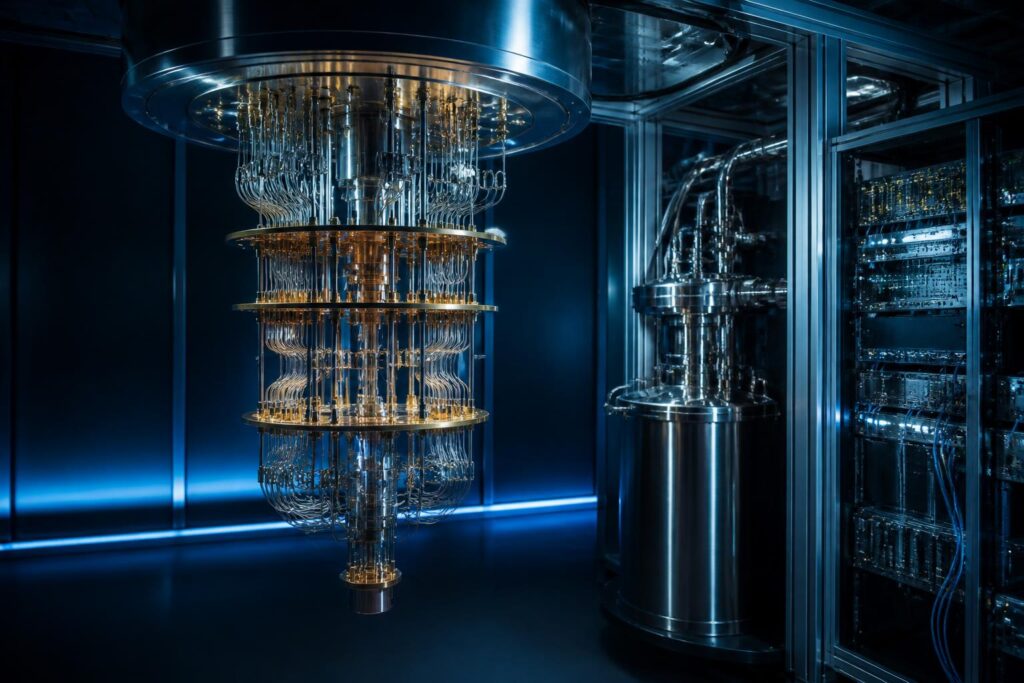
Quantum computing is not a faster version of an ordinary computer
Quantum computing often appears in discussions about future technology alongside images of machines that can solve every problem faster than today’s computers. This description is easy to understand, but it does not accurately reflect the nature of the technology. Quantum computers are not designed to replace personal computers, servers, or phones for familiar tasks. Their value lies in their ability to exploit the laws of quantum mechanics to process certain types of problems that traditional methods find difficult.
The important point is that this technology is still under development. Quantum hardware is sensitive to its environment, prone to errors, and requires complex operating systems. Therefore, rather than viewing quantum computing as a finished product, it is better to see it as a new computing platform being built step by step, from hardware and software to methods for verifying results.
How is a qubit different from a bit?
Traditional computers store and process information using bits. Each bit can be in one of two basic states, usually represented by 0 or 1. From these simple states, logic circuits perform calculations, comparisons, data storage, and data transmission.
The unit of information in a quantum computer is the qubit. A qubit can also be measured as being in the state 0 or 1, but before measurement, it can exist in a quantum state that is a combination of both possibilities. This phenomenon is commonly called superposition. However, it should not be understood simply as meaning that one qubit is two bits operating in parallel in the usual way. When a measurement is performed, the system produces only one specific result, while the ability to exploit superposition depends on how the algorithm and measurement are designed.
Another characteristic is quantum entanglement, in which the states of qubits can be related to one another in a way that cannot be described by treating each qubit as a completely independent unit. This connection helps quantum algorithms organize and transform the probabilities of many possible outcomes. Superposition and quantum entanglement do not automatically make every calculation faster. They become useful only when combined with an appropriate algorithm.
Why is building a quantum computer difficult?
Qubits can be created using many different physical methods, such as superconducting circuits, ions held in traps, neutral atoms, or other systems. Each approach has its own advantages and challenges. Some systems require extremely low temperatures, while others need laser-control equipment or structures that protect qubits from external interference.
A major difficulty is that qubits are highly sensitive. Heat, vibration, electromagnetic radiation, and unwanted interactions with the environment can all cause the quantum state to deteriorate. This phenomenon causes information to become corrupted before the algorithm is completed. Meanwhile, measuring a qubit can also change its state, making the checking process unlike reading data from the memory of an ordinary computer.
To address this, researchers are developing quantum error-correction techniques. The basic idea is to distribute the information of one logical qubit across multiple physical qubits, then detect and handle some errors without directly destroying the information being protected. This approach requires substantial resources, precise control circuits, and the ability to coordinate hardware with software. Therefore, the number of announced qubits is not the only measure of a system’s capabilities. Stability, gate quality, connectivity, and error rates are just as important.
What kinds of problems could benefit?
Quantum computing is expected to help simulate natural systems that are inherently quantum in nature, such as molecular structures and interactions between particles. If sufficient accuracy and scale can be achieved, such simulations could help researchers study new materials, chemical reactions, or the mechanisms of certain industrial processes. However, the path from simulation capabilities in a laboratory to a stable commercial application is still a long one.
Another direction is optimization. Many activities in everyday life and production involve selecting the best option from a very large number of possibilities, ranging from scheduling and resource allocation to network design. Some quantum algorithms are being studied to solve problems of this kind. Even so, not every optimization problem is suitable for a quantum computer, and any practical advantage needs to be demonstrated through fair comparisons with efficient classical algorithms.
This technology is also frequently mentioned in the field of cryptography. In theory, some quantum algorithms could alter the security level of widely used encryption methods if quantum computers become sufficiently large and stable. This does not mean that current systems will immediately become insecure. The practical concern is that data collected and stored today could be decrypted at some point in the future if protection methods are not upgraded. For this reason, many organizations are taking an interest in post-quantum cryptography, meaning methods designed to withstand threats from both traditional computers and quantum computers.
Quantum computers will work alongside classical computers
In the near future, the most realistic model is unlikely to be a standalone quantum computer handling everything. Classical computers will still perform most tasks, such as coordinating data, controlling equipment, preprocessing inputs, and analyzing results. The quantum processor will participate only in special parts of a process where it can provide an appropriate advantage.
This hybrid model creates new requirements for software. Programmers will need not only to write code using sequential instructions, but also to understand how to represent quantum states, design circuits, reduce the effects of errors, and interpret probabilistic results. A quantum program often does not return a single answer after one run. It may need to be run repeatedly to observe the distribution of results and then combined with a classical computing process.
Simulation tools on traditional computers help students and developers become familiar with these concepts without yet needing access to specialized hardware. However, simulation also faces limits as the number of qubits increases because the state space grows very rapidly. This is why the quantum computing ecosystem needs to develop hardware, programming languages, algorithm libraries, cloud services, and performance-evaluation methods at the same time.
Avoiding excessive expectations of an immediate revolution
Claims about quantum computing sometimes overlook the conditions required for a quantum advantage to become an economic benefit. An algorithm with a theoretical advantage will not necessarily produce a better product in a real-world environment. Operating costs, data-transfer times, accuracy, scalability, and ease of use can all change the outcome of a comparison.
Users also need to distinguish between a quantum computer producing a result that is difficult for a classical computer to simulate and that result being useful to a business or a particular field. A calculation may demonstrate the capabilities of hardware without necessarily solving a problem of value in everyday life. For the technology to move closer to widespread application, research teams need to demonstrate not only that a system can operate, but also that it produces reliable, repeatable results at a reasonable cost.
Implications for businesses and users
While waiting for the hardware to mature, businesses can still prepare by identifying data and processes related to cryptography, simulation, or optimization. Auditing the systems currently in use, monitoring the possibility of transitioning to new cryptographic standards, and training personnel with foundational knowledge will be more practical than chasing unqualified promotional claims.
For ordinary users, the most noticeable impact may not come from a quantum computer sitting in the home, but from indirect changes in information security, materials, pharmaceuticals, or optimization services. Users do not need to memorize every technical term, but they should understand that this technology is neither magic nor an accelerated version of every existing piece of software.
A journey that requires patience
Quantum computing is noteworthy because it introduces a different way of thinking about information and computation. The technology shows that computing power does not depend solely on speeding up traditional hardware; it can also come from exploiting different laws of physics. Even so, the gap between principles, prototypes, and reliable products remains very large.
The most clear-eyed view is to regard quantum computing as a field still taking shape. It has clear potential for certain problems, but must overcome many challenges involving stability, error correction, programming, and cost. As these conditions are gradually addressed, quantum computers may become specialized components of computing infrastructure, operating in parallel with classical computers rather than replacing them entirely.
