


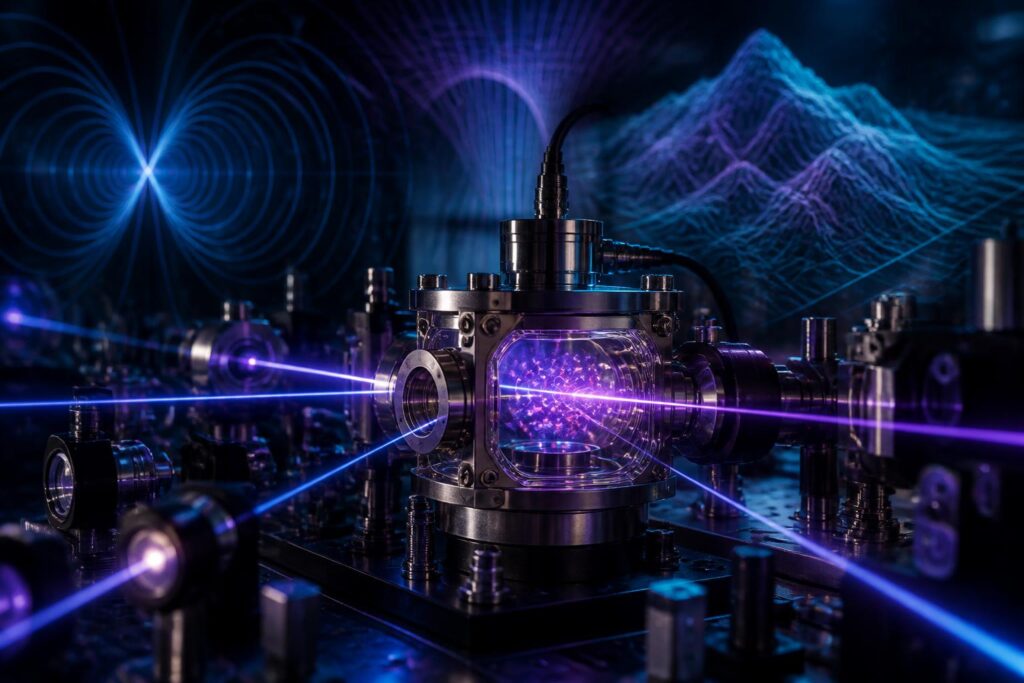
When quantum technology is mentioned, many people first think of computers capable of processing problems beyond the reach of traditional computers. However, quantum computers are not the only application of quantum physics. Another area receiving significant attention is quantum sensing, meaning devices that exploit the properties of quantum systems to measure physical quantities with very high sensitivity and precision.
What is noteworthy about quantum sensors is that this technology does not necessarily have to wait until large-scale quantum computers are perfected. In some cases, quantum principles have already been used in atomic clocks, magnetic resonance imaging equipment, and many modern measurement systems. A new generation of sensors is expanding these principles into positioning, geological surveying, healthcare, defense, climate research, and infrastructure operations.
How Are Quantum Sensors Different from Conventional Sensors?
Every sensor has the task of converting a phenomenon in the physical world into a signal that can be read and analyzed. Temperature sensors measure changes in temperature, accelerometers track motion, and magnetic sensors detect variations in magnetic fields. The differences lie in the materials, design, and signal-processing methods.
Quantum sensors use the quantum states or transitions of atoms, ions, photons, electrons, or other special material systems as the basis for measurement. These systems can respond very sensitively to time, electromagnetic fields, acceleration, gravity, or other environmental factors. When the quantity being measured changes, the quantum state also changes accordingly. The device records that change through light, frequency, phase, or a corresponding physical signal.
It should not be understood that quantum sensors are always absolutely accurate or always better than every classical device. Theoretical sensitivity can be reduced by noise, temperature, vibration, calibration errors, and the limitations of the signal-readout system. Therefore, the advantage of quantum sensors becomes practically valuable only when the entire device is designed to protect the state being measured and maintain performance in the environment where it is used.
Three Principles Behind the Measurement Advantage
Some quantum sensors rely on the stability of energy levels in atoms. Because these levels follow highly consistent physical laws, they can be used as standards for measuring time or frequency. Atomic clocks are a familiar example: instead of relying on mechanical oscillations like traditional clocks, these devices monitor an energy transition in an atom to maintain a stable timekeeping rhythm.
The second principle involves quantum interference. When a quantum system can follow multiple states or multiple paths of evolution, those states can reinforce or cancel one another. The interference pattern changes when the system is affected by acceleration, gravity, or some field. By observing this change, the device can infer the quantity being measured.
The third principle is the ability to exploit quantum states that are sensitive to the environment. A very weak magnetic field can change the spin direction of a particle or affect an energy state. With an appropriate design, this small change can be converted into a signal clear enough to analyze. This sensitivity opens up applications that conventional sensors may struggle to meet, although it also makes quantum sensors more vulnerable to noise.
Important Categories of Sensors
Time and Frequency Sensors
Accurate time measurement is the foundation of many modern systems. Telecommunications networks, satellite positioning, data synchronization, and electronic transactions all require devices that maintain consistent time. Atomic clocks provide a time standard based on the properties of atoms, thereby creating the foundation for synchronization on a large scale.
In the future, more compact atomic clocks could be integrated into systems that cannot rely entirely on external positioning signals. This would be significant for vehicles operating in environments where signals are obstructed, infrastructure networks requiring independent synchronization, or scientific instruments that must maintain stable measurements over long periods.
Acceleration and Gravity Sensors
Quantum inertial sensors can track acceleration by observing changes in an ultracold atomic system or a similar quantum system as it undergoes motion. If made smaller and more robust, this type of sensor could support positioning without requiring continuous satellite signals. This is a noteworthy direction for ships, aircraft, underground vehicles, and equipment operating in areas where signals are interrupted.
Gravity sensors, by contrast, exploit very small variations in the gravitational field. Because the density of underground materials is not uniform, the gravitational field can also vary from one location to another. Highly sensitive equipment may help map geological structures, survey groundwater layers, monitor tunnels, or assess changes in an area. However, gravity data generally needs to be combined with geology, maps, and other surveying methods to avoid overinterpretation.
Magnetic Field Sensors
Quantum magnetic sensors can detect very small variations in magnetic fields. In healthcare, magnetic fields generated by the body’s electrical activity can provide additional information for research on the brain or heart, although the measurement system must be isolated from environmental magnetic interference. In geology and resource surveying, magnetic-field data can help identify differences between types of rock or underground structures.
Some devices use controlled defects in crystal materials to measure magnetic fields on a small scale. The advantage of this approach is that the sensors can operate near room temperature and have the potential to be miniaturized. Nevertheless, practical performance depends on material quality, optical design, readout circuitry, and signal-processing methods.
From the Laboratory to Real-World Applications
The distance between a sound measurement principle and a product that can be widely deployed remains substantial. Quantum devices often require stable lasers, vacuum chambers, vibration-isolation systems, precision controllers, or controlled thermal environments. These requirements increase their size, cost, and operational complexity.
For this reason, commercialization efforts often focus on simplifying the system. Developers must reduce the number of components, automate calibration, make the equipment resistant to vibration and temperature changes, and build software that turns raw signals into information that is easy to use. A sensor is truly useful only when operators can install, maintain, and interpret its results without becoming experts in quantum mechanics.
The ability to work together with conventional sensors is also highly important. Quantum sensors can provide an accurate reference point, while traditional sensors handle continuous monitoring at a lower cost. The two types of data are fused using algorithms to produce stable results. This approach is more practical than replacing an entire existing system with a quantum device from the outset.
Applications in Different Fields
In healthcare, quantum sensors may help detect weak biological signals without placing measuring materials inside the body. Such measurements could support research into neural activity, cardiac function, or other physiological processes. However, medical devices must meet strict requirements for safety, repeatability, noise reduction, and clinical interpretation. High sensitivity alone is not enough to turn a research system into a diagnostic tool.
In transportation and maritime operations, quantum sensors could support positioning when satellite signals are weak or unavailable. In construction, gravity and magnetic-field surveys could help detect underground anomalies before excavation or drilling. In the energy sector, more precise measurement data could support pipeline monitoring, geological surveying, and infrastructure monitoring. In Earth science, widely distributed sensor networks could provide data on movement, the geomagnetic field, or changes in gravity over time.
These applications do not mean that every quantum device will quickly appear on the mass market. Many ideas still require long-term testing to determine their economic benefits, reliability, and ability to integrate into existing processes. A technology may measure well in a laboratory but still fail to create value if deployment costs exceed the benefits obtained.
Challenges That Need to Be Addressed
The first challenge is noise. The more sensitive a quantum state is, the more easily it can be affected by heat, vibration, unwanted light, and external electromagnetic fields. Designers must find a balance between sensitivity and the ability to operate stably. A device that is too sensitive but cannot distinguish the signal being measured from environmental noise will not produce reliable results.
The second challenge is size and energy consumption. Some systems require bulky optical or vacuum equipment, while field applications often demand devices that are small, durable, and energy-efficient. Miniaturization is not simply a matter of fitting large components into a smaller box. It can alter the thermal behavior, vibrations, optical paths, and calibration methods of the entire system.
The third challenge concerns human resources and standards. Quantum sensors lie at the intersection of physics, electrical engineering, optics, data science, and application-specific fields. Consequently, product development requires teams capable of coordinating across multiple areas of expertise. At the same time, the market needs common evaluation methods to compare sensitivity, stability, latency, and operating costs between quantum devices and existing solutions.
The Prospects for Quantum Measurement Technology
Quantum sensors could become one of the paths through which quantum technology enters everyday life earlier than general-purpose quantum computers. The reason is that many sensors do not need to perform complex quantum computations on a large scale. They focus on maintaining, controlling, and reading a quantum state suited to the measurement task.
Even so, expectations should be accompanied by caution. Not every problem requires extremely high sensitivity, and not every measurable signal can be converted into a useful decision. The value of quantum sensors will depend on the entire chain, from the question that needs to be answered, to the way data is collected, the analytical model, and the action process that follows the measurement.
In the coming years, an important direction of development may be hybrid devices that combine quantum sensors with conventional optical, mechanical, and electronic sensors. As the technology is packaged more effectively, calibrated more automatically, and made simpler to operate, it will have a better chance of leaving the laboratory and becoming part of positioning, surveying, healthcare, and infrastructure-monitoring systems.
Quantum sensors do not turn every measurement into a perfect measurement. What they promise is a new approach to signals that are too weak, changes that are too small, or environments in which conventional methods face limitations. If the technical and economic barriers are overcome, the ability to observe more precisely could become an important advantage in many industries, even when end users cannot directly see the quantum component inside the device.
