


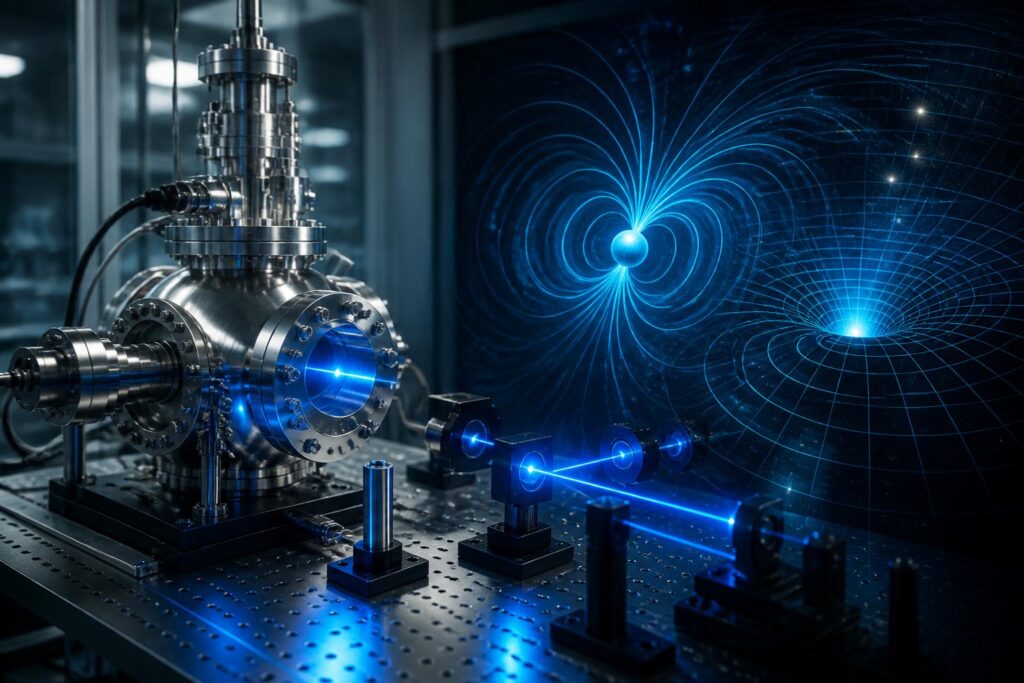
When quantum technology is mentioned, most attention tends to focus on quantum computers and their ability to process problems that conventional computers struggle to handle. However, another branch with far-reaching practical significance is quantum sensing. Rather than using qubits for computation, quantum sensors exploit the states and phenomena of the microscopic world to measure physical quantities with very high sensitivity.
The quantities being measured may include time, acceleration, rotation, magnetic fields, electric fields, or gravity. These quantities are already measured by many types of devices in everyday life and industry, but quantum sensors open up a different approach: using the behavior of atoms, photons, or controlled quantum systems to detect extremely small changes in the environment. The value of the technology does not lie in some promotional “quantum” figure, but in its ability to improve accuracy, stability, or the measurement method in specific contexts.
How Do Quantum Sensors Work?
Conventional sensors typically convert a physical influence into an electrical, optical, or mechanical signal. For example, an accelerometer may rely on the displacement of a small structure inside the device. Quantum sensors also require a similar conversion process, but their sensitive element may be the state of an atom, ion, photon, or a special material system.
Three ideas commonly appear in quantum-sensing systems: superposition, interference, and the controlled evolution of quantum states. A quantum system can be prepared in a state associated with multiple possibilities and then subjected to the influence of a force field, magnetic field, or motion. When the components of this state combine, they produce an interference signal. Very small changes in the environment can alter the phase or shape of the signal, allowing the quantity being measured to be inferred.
Not all quantum sensors operate according to the same design. Some systems use cold atoms and laser beams to control the motion of atoms. Others rely on the spins of particles or defects in materials. There are also devices that use photons and optical effects. What they have in common is that the quantum state is used as a sensitive “ruler,” while electronics and software handle control, signal readout, calibration, and interpretation of the results.
Quantities That Can Be Measured
Time is a prominent area. Atomic clocks have become the foundation of many positioning, telecommunications, and network-synchronization systems. In essence, atomic clocks rely on the stable frequency of transitions between atomic states to maintain a time standard. As state-control and readout technologies improve, time-measurement systems can achieve greater stability, supporting applications that require many devices to operate in sync.
Acceleration and rotation are also important categories of quantities. Inertial sensors based on quantum effects can support positioning in environments where satellite signals are weak or unavailable. Ships, aircraft, autonomous vehicles, and surveying equipment all need to know where they are and how they are moving. In situations where it is impossible to rely continuously on an external positioning system, highly stable inertial sensors can help maintain position estimates for longer periods. Even so, practical effectiveness still depends on the size, cost, update rate, and interference resistance of the entire system.
Measuring magnetic fields is another direction. Magnetic fields can provide information about electric currents, material structures, biological activity, or geological characteristics. Quantum magnetic sensors may be studied for underground surveying, nondestructive testing, and the measurement of extremely weak magnetic signals. In biomedicine, detecting magnetic signals from the body could provide additional information for diagnostic methods, but turning that potential into a clinical tool requires validation procedures, safety assurance, and the ability to operate reliably in real-world environments.
Gravity is another quantity that can be exploited. The distribution of matter underground affects the gravitational field in very small ways. If these variations can be measured with suitable sensitivity, surveyors may find additional clues about geological structures, groundwater resources, or cavities. However, gravity data generally need to be combined with geological models and other surveying methods. A more sensitive sensor does not automatically turn a measurement into a certain conclusion if the data are affected by terrain, vibration, or environmental conditions.
Why Do Quantum Sensors Matter in Their Own Right?
The strength of quantum sensors often lies in their ability to detect small changes and provide measurement standards based on highly stable physical properties. In some applications, sensors do not need to rely entirely on external reference signals. This can be useful when signals are obstructed, disrupted, or when supporting infrastructure cannot be deployed.
However, sensitivity must be distinguished from accuracy. Sensitivity indicates how small a change a device can detect, while accuracy concerns how close the result is to the true value. A highly sensitive sensor that is strongly affected by temperature, vibration, or electromagnetic interference does not necessarily produce reliable results. Therefore, evaluating quantum sensors requires considering stability, calibration capability, measurement time, durability, energy consumption, and ease of integration at the same time.
This is also why quantum sensors are not simply a “better” version of every traditional sensor. In many consumer devices, conventional sensors still have clear advantages in cost, size, power consumption, and ease of manufacture. Quantum sensors create an advantage only when measurement requirements are sufficiently demanding or when traditional methods face fundamental limitations in a particular environment.
The Gap Between the Laboratory and the Product
Taking a quantum sensor out of the laboratory is a complex engineering challenge. Many systems require stable lasers, vacuum chambers, vibration-isolation mechanisms, temperature control, or low-noise electronics. Each additional component increases size, cost, and maintenance requirements. A device that achieves impressive results under tightly controlled conditions may not necessarily perform the same way in a moving vehicle, outdoors, or at a construction site.
Data processing is just as important as the quantum element itself. Measurement signals are often mixed with noise and may be affected by multiple factors at the same time. The system needs to model noise sources, detect deviations from normal operation, and combine data from multiple sensors. In some applications, the most effective approach is not to replace all existing sensors with quantum sensors, but to use the quantum system as a reference standard or combine it with conventional sensors in a hybrid architecture.
Mass-manufacturing capability also determines the speed of adoption. A device may work well but be difficult to turn into a mass-market product if it requires manual assembly, individual calibration for each unit, or hard-to-source components. Developers therefore have to balance quantum performance with industrial requirements such as reliability, repairability, communication standards, operational safety, and life-cycle cost.
Impacts on Economic Sectors and Research
In transportation and aviation, more accurate inertial sensors could support positioning, navigation, and motion monitoring. In energy, measuring magnetic fields and other physical parameters could help monitor equipment, detect anomalies, or survey resources. In construction and infrastructure, sophisticated measurements could support the monitoring of deformation, vibration, and changes in the ground. In basic research, quantum sensors help observe small effects that conventional equipment would struggle to distinguish from noise.
These applications should not be viewed as a promise that all current measurement systems will soon be replaced. Technology typically develops one niche at a time, beginning with problems where the value of accurate measurement is sufficient to offset deployment costs. A specialized surveying system may be able to accept equipment that is more complex than a smartphone, whereas a consumer product demands entirely different criteria.
Quantum sensors also create demands for skilled personnel. Engineers need to understand quantum physics, optics, electronics, control systems, software, and manufacturing engineering at the same time. If attention is focused only on the quantum element while system design is neglected, a product may achieve strong test results but struggle to meet operational needs. Conversely, if it is treated merely as an ordinary measuring device, developers may overlook the distinctive limitations and opportunities of quantum states.
The Need for Realistic Expectations of the Technology
Quantum sensing is an example of how quantum technology is not limited to quantum computers. It can create value by measuring, standardizing, and observing the world, even while large-scale quantum computing systems continue to face many challenges. But potential does not mean immediate commercialization. Each application needs to be assessed according to its specific measurement requirements, deployment environment, and total operating cost.
In the coming years, notable progress may come from miniaturizing devices, reducing the need for supporting infrastructure, improving resistance to interference, and combining quantum sensors with existing data-analysis platforms. As these systems become easier to deploy, they may complement rather than necessarily eliminate traditional measurement technologies.
The core value of quantum sensing lies in transforming the subtle properties of the microscopic world into usable information in the real world. Achieving this requires more than an appealing physical principle. It requires good design, rigorous validation procedures, and a sufficiently clear problem to demonstrate that the new measurement truly makes a difference.
