


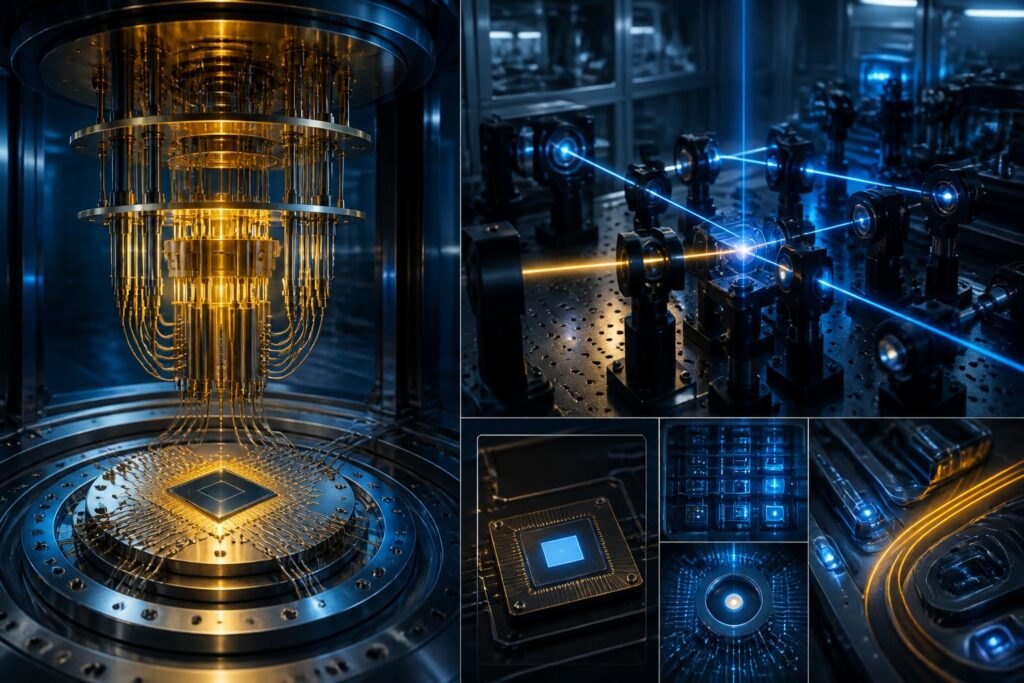
When people talk about quantum computers, they often imagine a machine capable of processing problems that conventional computers struggle with. However, behind that concept lies a more fundamental question: what kind of hardware will quantum computers be built from? Unlike classical computers, where transistors have become the dominant foundation, the quantum field still has many different approaches coexisting.
The basic unit of a quantum computer is the qubit. Qubits can be created from many different physical systems, as long as the system can represent quantum states, interact with other qubits, and be measured with sufficiently high reliability. These requirements may sound simple, but in practice they are extremely demanding. A qubit must be isolated from external noise to preserve its quantum state, while still remaining connected to control equipment in order to perform computations.
Therefore, the industry race is not just about who has more qubits. It is also a race involving qubit quality, connectivity, control speed, scalability, and suitability for future error-correction systems. Each hardware architecture addresses these issues in a different way.
A qubit is not a single type of component
In classical computers, a bit is usually represented by two voltage or current states. A qubit also has two basis states, but it can additionally exist in a superposition of those two states. When multiple qubits interact, they can form special quantum connections, opening up a way of processing information that differs from traditional binary logic.
To turn this idea into a practical computer, research teams must control many factors at the same time. They need to initialize qubits in defined states, act on them with precise control operations, create interactions between qubits, and read the results after a computation. Every stage can introduce deviations. A qubit can lose its state because of heat, vibrations, electromagnetic noise, or unintended interactions with the environment.
The concept of a “physical qubit” must also be distinguished from that of a “logical qubit.” A physical qubit is a specific quantum system in a device, while a logical qubit is an information unit protected by multiple physical qubits and error-detection and error-correction methods. Therefore, an architecture with a large number of physical qubits does not necessarily provide useful computing power if those qubits are difficult to control or have high error rates.
Superconducting circuits: high speed and stringent cooling requirements
Superconducting circuits are among the most widely known development paths. In this architecture, qubits are created from superconducting electrical circuits with special components that function as an artificial quantum system. The circuits are usually fabricated on solid materials and controlled using microwave signals.
A notable advantage of superconducting circuits is their relatively high computational speed. The qubits can also be fabricated using processes similar to microfabrication techniques, allowing laboratories to draw on extensive experience from the electronics industry. Placing many qubits on the same chip is technically feasible, although scaling to a large size still presents many challenges.
In return, superconducting circuits must operate in an extremely cold environment to reduce thermal noise and maintain their quantum properties. The cooling system is not simply a single cabinet. It includes multiple temperature stages, wiring, filters, and measurement equipment, all of which must be arranged so that signals can enter and leave without introducing too much noise into the qubit region.
As the number of qubits increases, connectivity and control also become more complex. Each qubit needs to be acted upon and read out, but the number of control lines cannot increase indefinitely within a restricted cooling space. This is driving research into integrated control circuits, efficient coupling methods, and chip designs that reduce noise.
Trapped ions: stable qubits but sophisticated control requirements
In trapped-ion architectures, ions are held in space by electromagnetic fields. The quantum state of an ion can be used to represent a qubit, while lasers control the ions and create interactions between them. Because the ions have the same physical nature and are well isolated from many sources of noise, these systems can achieve high accuracy in certain operations.
One appealing feature of trapped ions is that qubits within the same chain can interact in flexible ways. Researchers are not necessarily limited to connecting only neighboring qubits, as in some types of chips. This can reduce the number of intermediate steps required for certain quantum circuits.
However, the speed of laser-based control is often a factor that must be considered. Positioning, stabilizing, and adjusting multiple laser beams at the same time requires a complex optical system. When seeking to increase the number of ions, research teams must address issues involving spatial arrangement, ion movement, vibration control, and connections between multiple trapping regions.
Trapped-ion architecture illustrates a typical trade-off in quantum computing. A system may prioritize coherence time and accuracy, but have to accept slower operations or greater complexity in its control equipment. No single criterion is sufficient to evaluate an entire platform.
Neutral atoms and flexible arrangement capabilities
Neutral atoms are another approach, in which atoms are held and arranged using laser light. The state of an atom can serve as a qubit, while special excited states are used to create interactions between atoms at suitable distances.
This architecture is attracting interest because atoms of the same type are naturally uniform. Using light to move or arrange atoms also creates the possibility of changing the system’s configuration according to the needs of an algorithm. A qubit network does not necessarily have to be completely constrained by fixed positions on a chip.
The challenge with neutral atoms lies in controlling many atoms simultaneously using precise optical systems. The light used to trap, cool, arrange, and control the atoms must be stable in frequency, intensity, and direction. Even a small deviation during this process can affect the result of a computation.
The ability to change the geometry of a qubit network may be useful for different algorithms, but it also creates additional requirements for control software and operational scheduling. The system must not only know which operation to perform, but also decide when to move or reconfigure the qubits.
Photons and the challenge of scaling up light-based systems
Photons, the quantum particles of light, have several properties suited to carrying information. Photons interact only weakly with the environment under many transmission conditions and can travel through optical components. For this reason, optical quantum computers are often seen as an approach with natural potential for connecting to optical networks.
In an optical system, quantum information can be encoded in properties such as a photon’s path, polarization, or time of arrival. Beam splitters, interferometers, and single-photon detectors are used to perform and measure the necessary operations.
The difficulty is that photons do not easily interact with one another. In many other platforms, interactions between qubits can arise directly through fields or material structures. With photons, creating a useful interaction often requires optical components, materials, or special measurement mechanisms. The system must also contend with losses: some photons may not be generated, may fail to travel along the correct path, or may not be detected.
As a result, optical quantum computers often have to rely on methods that combine multiple photon sources, optical circuits, and measurements. The ability to operate at less demanding temperatures than some other architectures is an advantage, but it does not automatically solve the scaling problem. The number of components, the stability of optical paths, and detection efficiency remain decisive factors.
Spin qubits and the use of semiconductor materials
Some research groups are seeking to store quantum information in the spin of electrons or nuclei, often in connection with extremely small semiconductor structures. Spin can be envisioned as a quantum property with two basis states, although this description should not be understood too literally as a sphere physically rotating in the classical sense.
A potential advantage of this approach is that it can draw on the knowledge and processes of the semiconductor industry. If spin qubits can be fabricated, controlled, and connected using techniques compatible with chip manufacturing, this platform could benefit from the existing electronics ecosystem.
However, the small size also makes measurement and control more sensitive. Researchers must precisely control the material environment, the positions of the structures, and the signals acting on the spins. Connecting many qubits without increasing noise or creating uncontrolled errors is an important challenge.
Spin qubits clearly illustrate that a promising architecture is not judged only by the state of its prototype. To become a useful computer, the system also needs stable fabrication processes, suitable control equipment, and a way to integrate large numbers of components without reducing qubit quality.
What criteria determine whether an architecture is promising?
Comparing qubit architectures using a single number often leads to incomplete conclusions. The number of qubits is an attention-grabbing figure, but it needs to be considered alongside error rates, coherence time, operation speed, and connectivity. A system with fewer qubits but more accurate operations and more effective connections may be more useful than a system with many qubits that are difficult to control.
Scalability must also be considered at multiple levels. At the physical level, manufacturers need to fabricate additional uniform qubits. At the control level, they must provide signals for a large number of qubits while still limiting noise. At the system level, cooling equipment, lasers, electronics, software, and methods for reading results must operate in sync.
The software ecosystem is another criterion. An architecture has practical value only when developers can describe circuits, compile algorithms, map operations onto physical connections, and assess errors. Different hardware characteristics lead to different ways of optimizing programs. Therefore, the development of quantum computers is a process involving coordination among materials, control engineering, computer architecture, and software.
The race may lead to multiple types of quantum computers
The possibility that multiple architectures will coexist is not a sign that the field lacks direction. On the contrary, each type of qubit may be suited to a different objective. One platform may prioritize operation speed, another may emphasize accuracy, while another may take advantage of strengths in transmission or semiconductor manufacturing.
In the future, quantum computers may also not be built according to a model of a single machine containing every component. Qubit modules could be linked together, while control systems and measurement equipment are designed in multiple layers. In that case, the problem of connecting modules would be no less important than improving each individual qubit.
What is more certain is that the quantum computing industry cannot yet be evaluated solely through short-term demonstrations or lists of specifications. The important questions are how reliably a platform can perform useful computations, how it can be scaled, and what its operating costs will be. Answering those questions will require time, experimentation, and cooperation across multiple fields.
Today’s qubit architectures are therefore not merely competing hardware choices. They are different ways of addressing the same fundamental problem: how to turn fragile quantum effects into a computing system that can be controlled, verified, and scaled. Understanding both the advantages and the limitations of each approach will help people assess progress in quantum computing more soberly, rather than simply chasing qubit counts or claims about speed.
