


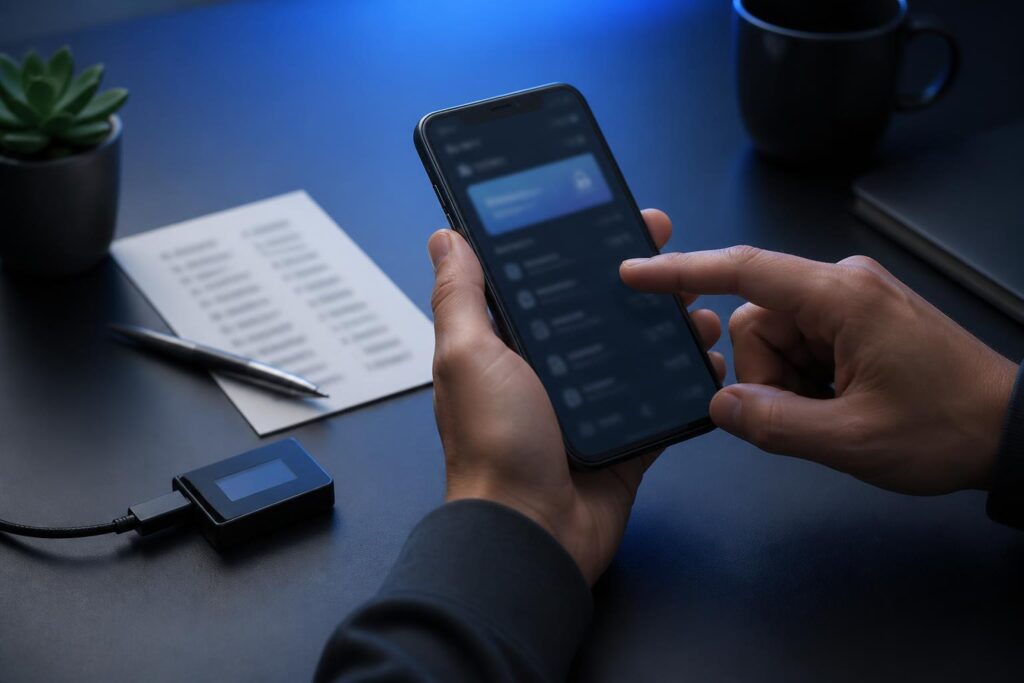
In the cryptocurrency ecosystem, control over assets does not depend solely on the balance displayed in an application. The more important question is who holds the authority to sign transactions transferring those assets. When funds are held on an exchange or with a custodial service, users typically log in with an account and submit withdrawal requests through the platform. When using a self-custodial wallet, users directly control the private keys and assume responsibility for protecting the tools that enable access to their assets.
This difference means that choosing a wallet is not simply a matter of selecting an application with an easy-to-use interface. It is a choice concerning the model of responsibility, level of convenience, recoverability, and approach to risk management. Self-custody can reduce dependence on intermediaries, but it does not create an automatic layer of protection. If the recovery phrase is lost, the private key is exposed, or the user mistakenly signs a dangerous transaction, there may be no support department capable of reversing what happened.
How Are Custodial and Self-Custodial Wallets Different?
In a custodial model, the service provider holds or manages the keys used to conduct transactions on behalf of customers. Users can see the balance in their account and submit withdrawal requests, but technical control over the assets lies within the provider’s system. This model is often convenient for beginners because account recovery may rely on a password, identity verification, or the platform’s support procedures. In return, users must accept risks related to the account, operational systems, withdrawal policies, and the possibility of service disruptions.
Self-custodial wallets operate according to a different principle. A wallet does not necessarily directly contain cryptocurrency as an object stored inside a phone. Assets are recorded on the blockchain network, while the wallet stores and uses cryptographic information to prove control over an address. Users can create, sign, and broadcast transactions without an exchange standing between them and the network. However, this autonomy comes with security obligations. There is no universal recovery email for the entire network, nor is there a helpline that can confirm ownership based solely on someone’s statement.
The two models do not always completely exclude each other. A person may keep the portion of their assets that they trade frequently on a custodial service while using a self-custodial wallet for funds requiring long-term control. The appropriate allocation depends on goals, experience, trading frequency, and the ability to protect information. What matters is clearly understanding where the assets are in terms of control, rather than relying only on the application’s name.
Private Keys and Recovery Phrases
A private key is cryptographic information that allows the creation of a signature confirming a transaction from the corresponding address. In principle, anyone with the ability to use the private key can request that assets be transferred out of the address, provided the transaction complies with the network’s rules. Therefore, a private key is not an ordinary password. It should not be sent to support staff, entered into unfamiliar forms, or stored in online chats.
Many modern wallets use a recovery phrase consisting of a sequence of words generated when the wallet is set up. This phrase can help recreate the keys and addresses belonging to the same wallet on a compatible device or software. A recovery phrase is not an authentication code to be shared when requested, nor is it information that can be arbitrarily replaced. If a website asks you to enter your recovery phrase to receive a reward, synchronize an account, or resolve an error, that is a sign to stop and check carefully.
A recovery phrase should be treated as the original backup of access rights. Saving a screenshot, writing it in a cloud note-taking application, or sending it by email all create additional points where it could be exposed. Printing it on paper can avoid certain online risks, but it is vulnerable to water, fire, fading ink, and being seen by others. A more durable material may be considered, but no method eliminates physical risks entirely. The storage method should suit the actual circumstances and should be tested before significant assets are held in the wallet.
Setting Up a Safer Wallet from the First Step
The wallet-creation process should begin on a trusted device, with an updated operating system and software obtained from an official source. Users need to carefully check the application name, developer, and access method, because counterfeit applications may have interfaces very similar to those of genuine products. A wallet should not be created while screen sharing is active, while numerous software programs from unclear sources are installed, or while connected to an untrusted public network without a clear understanding of the risks.
After the wallet generates a recovery phrase, users should record it in the correct order and check every word. The record should be stored in a private place, with the number of people who know about it limited, and should not be kept together with the device regularly used for transactions. If there are multiple copies, each one must be protected equally. A copy kept in an unlocked drawer can become a weak point even if the other copy is stored very carefully.
Testing recovery on another device is a useful step before transferring a large amount of money. However, the test should also be carried out in a safe environment, without entering the phrase into an online tool and without using a compromised device. After recovery, users should check the receiving address and access capability before putting the wallet into regular use. The purpose of this step is to confirm that the backup can actually be used, not to create numerous copies indiscriminately.
Do Hardware Wallets Eliminate All Risks?
Hardware wallets are designed to keep private keys relatively separate from a computer or phone while carrying out transaction signing on a dedicated device. This model can reduce the risk of keys being directly stolen by certain types of malware on the host computer, but it does not make users immune to scams. If a user enters the recovery phrase into a fake website, photographs the phrase, or confirms a transaction without reading it carefully, the hardware wallet still cannot protect against that decision.
The screen of the signing device should be checked against the information displayed in the application. The receiving address, network, and asset type must match the purpose of the transaction. A transaction may be technically validly signed and still transfer assets to a destination the user did not intend. Security is not only about preventing bad actors from obtaining the key; it is also about being able to recognize what is being authorized.
Users should also be cautious when updating software and recovering a device. Perform updates only through trustworthy channels, read warnings carefully, and do not follow instructions that require providing the recovery phrase. If a device is lost, the fact that someone else finds it does not necessarily mean they can access the assets if the protective measures were set up correctly. Conversely, losing the recovery phrase can be more serious than losing the device, because the phrase is the component that enables control to be recreated.
Common Mistakes When Using Wallets
A common mistake is treating every link that requests a wallet connection as a routine procedure. Decentralized applications may ask users to sign many different types of messages or transactions. Connecting a wallet does not mean that assets have already been transferred, but an authorization request or transaction may enable assets to be used within a certain scope. Users should read the content, check the domain name, and consider revoking permissions that are no longer needed instead of approving them out of habit.
Another mistake is sending assets on the wrong network or using the wrong address. An address may appear valid but does not guarantee that the assets will be handled correctly if the network, token format, or receiving service is incompatible. Before a large transaction, a small test transaction should be made if conditions permit, followed by confirmation that the recipient received it and a recheck of the fee. Blockchain transactions are often difficult to reverse, so a few minutes of checking may be more valuable than dealing with the consequences.
Keeping all assets in a single wallet also creates concentration risk. Separating wallets by purpose, such as a wallet for frequent transactions and one for long-term storage, can help limit losses when one wallet interacts with an untrustworthy application. This approach increases management requirements and is not suitable if the user cannot remember or protect multiple pieces of information. The important principle is that the separation must be simple enough to maintain over the long term, rather than creating a complicated system that is easy to forget.
A Sustainable Security Habit Framework
Effective wallet security does not depend on a single product but is built through repeated habits. Users should set unique passwords for related accounts, enable multi-factor authentication when a service supports it, update their devices, check login notifications, and maintain a backup communication channel. These measures do not replace protecting the recovery phrase, but they help reduce the risk that an auxiliary account will be taken over and then used for fraud.
Before each transaction, it may be helpful to ask four questions: What application am I interacting with, which address will the assets go to, what permissions am I granting, and what is the plan for dealing with a problem? For unusual transactions, stop rather than give in to pressure from urgent notices, promises of profits, or someone claiming to be a support employee. No one needs a recovery phrase to verify an ordinary wallet error.
For assets of significant value, an inheritance plan is also part of self-custody. If only the user knows how to access the assets, they may become unusable if something happens to that person. Conversely, giving the entire phrase to someone else without a control mechanism increases the risk of exposure. An appropriate plan must balance access when needed with the principle that no single individual or location should hold all the information.
Self-custody of digital assets is not a competition to see who can use the more complicated tool. Its core value lies in users understanding what they are controlling, accepting the responsibilities involved, and building a process clear enough not to depend on momentary memory. When the recovery phrase is protected, transactions are checked, and access rights are reasonably separated, a wallet becomes a tool for controlling assets rather than an incomprehensible point of risk. Nevertheless, every storage or transaction decision still needs to be considered according to personal circumstances, level of understanding, and ability to withstand losses.
