


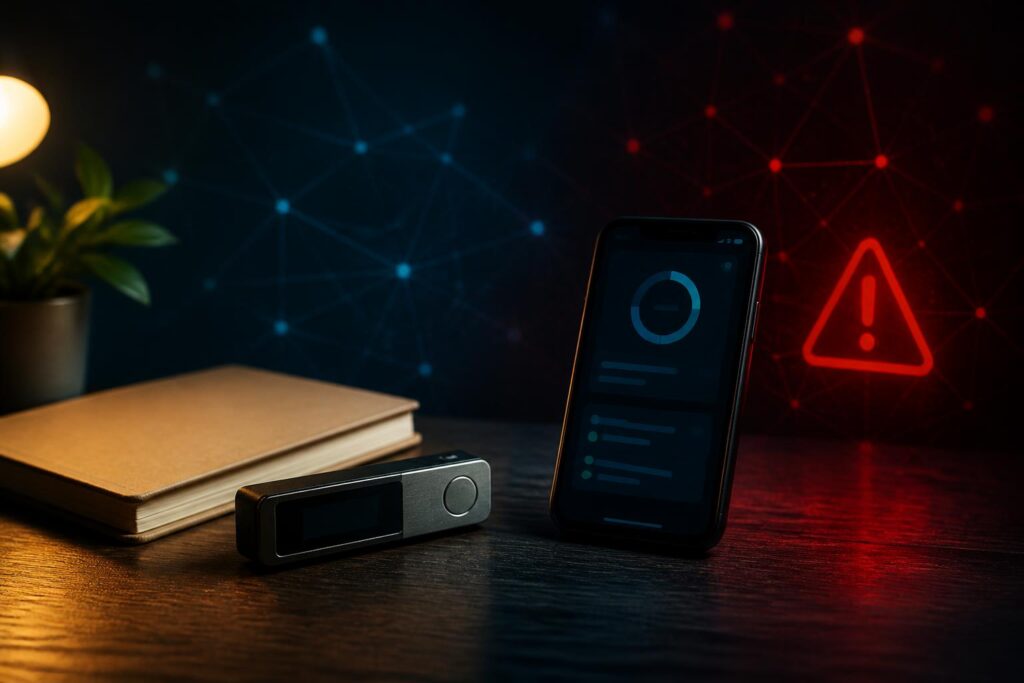
Within the blockchain ecosystem, the phrase “not your keys, not your assets” is often used to describe the difference between holding assets on an intermediary platform and managing them independently with a personal wallet. This wording is not absolute advice for every user, but it reflects an important principle: control over assets on a blockchain is tied to the ability to control the corresponding private keys.
Self-custody can give users greater control over accessing and signing transactions. However, it also removes some of the support mechanisms provided by intermediaries. If users lose recovery information, mistakenly sign a transaction, or expose their private keys, there may be no customer service department capable of reversing what happened. Therefore, understanding how wallets are structured and establishing safe usage procedures is no less important than choosing which assets to hold.
What Do Blockchain Wallets Actually Store?
Saying that “the money is in the wallet” makes the conversation easier to understand, but technically, assets on a blockchain are recorded in the state of the network. A wallet does not store coins in a physical sense. It manages cryptographic information that allows users to prove control over an address and sign requests to change the state of the network.
An address can generally be shared to receive assets. By contrast, a private key must be kept secret because it can be used to create transaction signatures. A valid transaction is usually checked by the network based on the signature and other protocol conditions. Therefore, someone does not necessarily need to know the identity of an address owner to transfer assets out if they have obtained the private key or the corresponding signing method.
A digital wallet may provide an interface for viewing balances, creating addresses, connecting to decentralized applications, and confirming transactions. That interface is not the blockchain itself. Users can switch to another software application or device compatible with the same recovery information without changing data already recorded on the network. However, entering secret information into another application always requires careful consideration, because untrustworthy software may expose the data.
How Are Private Keys and Recovery Phrases Different?
A private key is a cryptographic value associated with the signing authority of an address or account on a specific network. A recovery phrase, also called a seed phrase or mnemonic phrase, is generally a sequence of words created to be easier for people to record than a long string of characters. From this phrase, wallet software can generate multiple keys and addresses according to specific rules.
These two concepts are related, but they should not be used interchangeably in every situation. A recovery phrase can open multiple accounts or addresses belonging to the same wallet structure, while a private key may represent only one specific key. Users should also note that entering the same phrase into different applications does not necessarily always display the same list of accounts if the network settings, key derivation paths, or wallet types are different.
Recovery information must be treated as highly confidential data. It should not be captured in a screenshot, sent by email, stored in an online note-taking application, or entered into a website simply because the site requests “wallet verification.” A legitimate support representative does not need users to provide their recovery phrase to check a balance or guide them through ordinary procedures. Anyone requesting this phrase may be trying to take control of the wallet.
Hot Wallets, Cold Wallets, and the Trade-Off in Convenience
A hot wallet is a wallet used on a device that is frequently connected to the internet, such as a phone or browser. Its advantages are convenience for monitoring balances, connecting to applications, and making transactions quickly. In exchange, hot wallets are exposed to multiple layers of risk, including malware-infected devices, compromised browsers, fake extensions, or users accidentally visiting the wrong website.
Cold wallets generally separate the processes of storing and signing transactions from internet-connected devices more strictly. Some specialized devices display transaction information for users to review before confirming. However, a cold wallet does not automatically make every activity safe. Users can still sign the wrong transaction, approve an excessively broad access permission, or be tricked into entering their recovery phrase into a fake device.
There is no single wallet model that suits everyone. People who frequently interact with blockchain applications may need one wallet for everyday use and a separate storage method for long-term assets. This division does not eliminate risk, but it helps limit the amount of assets that could be affected if the wallet used for frequent interactions encounters a problem.
Frequently Overlooked Issues When Signing Transactions
Many asset losses do not begin with an exposed recovery phrase, but with users signing a dangerous request without understanding its contents. When connecting a wallet to an application, users may be asked to grant a smart contract permission to use a type of asset. This permission may serve a legitimate activity, but it may also be designed too broadly or embedded in a fake interface.
Before confirming, users should check the website domain, the source of the link leading to the application, the network being used, the recipient address, the type of asset, and the details of the requested permission. The fact that a website has a professional interface or appears in search results should not be treated as proof of trustworthiness. Scammers can create pages that closely resemble real services, use urgent notifications, or promise rewards to pressure users into acting hastily.
For asset-transfer transactions, visually checking an address may not be sufficient if the character string is long and difficult to distinguish. When conditions permit, users can make a small test transaction while checking the address at multiple steps. Users should also be cautious about copying addresses from transaction history or from a compromised device, because the address displayed in the clipboard may not be the one originally intended.
Establishing Protective Procedures Instead of Relying Only on Memory
Wallet security should not depend on a vague promise to “be more careful.” A clear procedure helps reduce mistakes caused by haste and makes it possible to investigate when something goes wrong. The first step is to define the purpose of each wallet: a wallet for everyday transactions, a wallet for testing applications, or a wallet for long-term storage. Each purpose may require a different degree of separation and a different risk limit.
Next, users need to create backups of their recovery phrase using an offline method and safely verify that the phrase can be read back. A backup should not be kept somewhere easily seen, easily damaged by fire, or located in only one place. Even so, creating multiple backups increases the number of places where the information could be exposed. Therefore, users need to balance recoverability with the ability to control access.
Recovery information should not be protected by sharing it casually with multiple people. For assets of significant value, users may explore arrangements that require multiple parties or multiple devices to participate in confirmation, if supported by the software and network being used. Such models can reduce dependence on a single key, but they also require technical understanding and a clear recovery plan. A complex structure that the owner cannot operate remains a risk.
Plans for Asset Recovery and Transfer
Losing a phone or having a computer fail does not necessarily mean losing assets if the user still has the appropriate recovery information. Conversely, having a recovery phrase but not remembering the wallet type, network, account, or original setup can make the recovery process difficult. Therefore, in addition to protecting confidential data, users should record the necessary instructions for identifying the wallet structure without revealing the key to unauthorized people.
This plan is particularly important when assets need to be transferred to family members or heirs. Leaving only a phrase in a safe or storage box may not be enough if no one knows which device, application, and procedures are needed to use it. However, the instructions should not contain more information than necessary or be stored somewhere that would allow another person to immediately take control. Each family needs to consider the recipient’s legal circumstances, level of trustworthiness, and technical ability.
Recognizing the Limits of Self-Custody
Self-custody of digital assets provides autonomy, but it is not a competition to see who can handle everything alone. Some users may be better suited to custodial services, exchanges, or a hybrid model if they prioritize support, account-recovery procedures, and convenience. When using an intermediary, the risks shift to issues such as account security, terms of service, the ability to withdraw assets, and verification procedures.
What matters is clearly distinguishing who has been given control and which risks are being accepted. Users should not send assets to a service simply because it calls itself a “wallet,” nor should they self-custody all their assets before understanding how to protect keys and verify transactions. The complexity of the tools should match the user’s actual ability to operate them, not merely their desire for control.
Blockchain can provide a system for recording and authenticating transactions, but it cannot automatically correct decisions that users have signed incorrectly. Wallet security is therefore a combination of knowledge about keys, checking habits, trustworthy devices, and a recovery plan. When users understand that public addresses, private keys, recovery phrases, and contract permissions serve different roles, they can avoid many common misunderstandings.
Safe self-custody does not begin with installing as many applications as possible or buying expensive devices. It begins by determining which assets need protection, which transactions genuinely need to be signed, which information must never be shared, and what will happen if the current device can no longer be used. A simple procedure followed consistently is often more valuable than complex measures that users cannot verify and maintain.
