


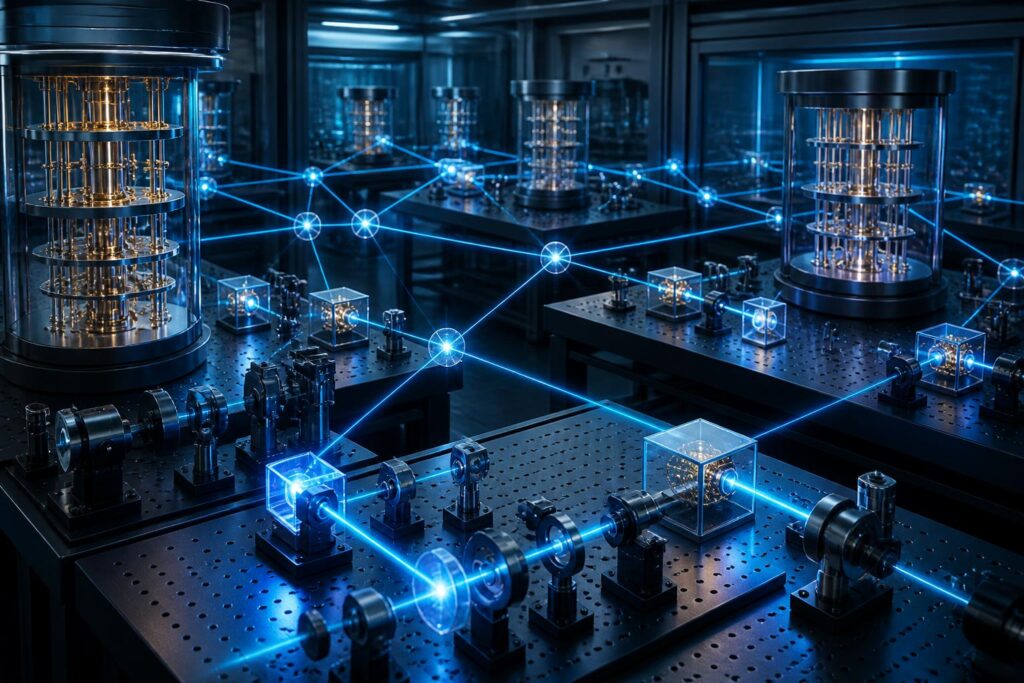
When it comes to quantum computers, most attention is usually focused on the number of qubits, error-correction capabilities, or the problems that classical computers struggle to handle. However, another equally important question is gradually emerging: how can quantum computers be connected to one another? If each system operates independently in a single laboratory, its capabilities will be limited by the size and conditions of that system itself. Quantum networks are being studied to address part of this challenge.
A quantum network can be understood as infrastructure that allows quantum devices to exchange or share quantum states. This concept is not simply about sending data from one computer to another over a faster connection. It relies on phenomena such as superposition and quantum entanglement, while also requiring ways of creating, transmitting, storing, and measuring information that are very different from those used in conventional computer networks.
How Are Quantum Networks Different from Today’s Internet?
The classical Internet represents data using bits, with each bit able to take a value of either 0 or 1. Information is copied, amplified, stored in memory, and transmitted through multiple routing devices. These mechanisms create a resilient infrastructure that can detect errors and resend data when necessary.
In a quantum system, information can be encoded using qubits. A qubit can exist in a superposition of 0 and 1 before it is measured. When measured, the result is a specific state, so observing it is not simply like reading a bit in a classical computer. More importantly, quantum states are highly sensitive to their environment. Heat, vibrations, electromagnetic interference, or unintended interactions can all alter the state before the information is used.
This characteristic means that a quantum network cannot rely solely on copying a signal many times. In the classical world, an amplifier can receive a weak signal, regenerate it, and transmit it onward. For an unknown quantum state, the no-cloning theorem shows that it is impossible to create a perfect copy in the same way. Therefore, extending transmission distances requires specialized methods, including the idea of intermediate quantum nodes.
What Role Does Quantum Entanglement Play?
Quantum entanglement is a special relationship between quantum systems. When two qubits are prepared in an entangled state, their measurement results can display strong correlations, even when the two qubits have been taken to different locations. This does not mean that a message can be sent instantaneously across any distance. Entanglement does not by itself replace a classical communication channel, nor does it allow arbitrary information to be transmitted faster than light.
The value of entanglement lies in its ability to create correlations that classical networks cannot provide. In some protocols, it can support the distribution of secure keys, the transmission of quantum states through specialized procedures, or the linking of quantum processors. Each application requires an accompanying classical channel to exchange control information and compare results.
For this reason, a practical quantum network will not consist only of transmission links for photons or qubits. It will also need a classical network to synchronize devices, manage connection sessions, confirm measurements, and handle tasks that are not quantum in nature. These two layers of infrastructure can complement each other rather than exist separately.
Components Needed in a Quantum Network
A basic quantum network requires quantum nodes, transmission channels, and control equipment. A quantum node may be a processor, a memory device, or equipment capable of creating and preserving qubits. The transmission channel is responsible for carrying quantum states between nodes. In many designs, light and particles carrying optical information are considered important media, but the choice of specific technology depends on the distance, environment, and requirements of the system.
Quantum memory also plays an important role. A state created at one point in time may need to wait until the device at the other end is ready. Without a sufficiently stable place to store it, the state will degrade before the connection process is complete. Memory must therefore balance storage time, state fidelity, read-and-write speed, and compatibility with the transmission channel.
In addition, the network needs signal-detection devices, controllers, and coordination software. These components must operate with appropriate latency because a quantum state cannot be processed like an ordinary data packet. A small discrepancy in the timing of transmission, reception, or measurement can reduce the quality of the link.
Why Is Scaling a Quantum Network So Difficult?
The first challenge is quantum degradation. When a qubit interacts with its environment, quantum information can lose its coherence. This phenomenon is commonly called quantum decoherence and is one of the reasons transmitting a state over long distances is so difficult. A longer cable does not merely increase the distance; it also raises the requirements for the performance of the source, receiver, memory, and noise-control capabilities.
The second challenge is the reliability of operations. A network with many nodes must repeatedly create, distribute, store, and verify quantum states. If each step has only a certain probability of success, overall efficiency can decline rapidly as the number of steps increases. The system must also distinguish between errors caused by equipment and errors arising during transmission in order to decide whether to try again or switch to another route.
The third challenge concerns distance and infrastructure. A connection that works well in a laboratory may not necessarily be suitable for an urban network or a link between distant regions. A practical system must contend with temperature conditions, vibrations, transmission losses, and maintenance requirements. Deploying a quantum network is therefore not merely a matter of chip design; it also involves optics, telecommunications, control systems, materials, and operating standards.
Finally, there is the issue of compatibility. Different laboratories or providers may use different hardware platforms and control methods. Without common protocols, individual devices will struggle to form an open network. Standardizing node identification, connection management, link-quality assessment, and access permissions will become increasingly important as the technology moves beyond the experimental stage.
Potential Applications
One commonly mentioned application is communication capable of detecting interference. In some quantum key distribution protocols, measuring or interfering with the transmitted state can alter characteristics that the recipient uses for verification. This does not make every system automatically secure, because security also depends on the equipment, protocol, implementation, and operating procedures. Nevertheless, quantum networks may provide a method of detecting interference that differs from the mechanisms used to protect data classically.
A second application is connecting multiple quantum processors. A single computer may be limited by its number of qubits, control architecture, or physical conditions. If processors can share states reliably, they could jointly participate in a larger task. This is an ambitious goal, because combining multiple systems does not automatically create a more powerful computer. The link must be of sufficient quality, operations must be synchronized, and the software must know how to divide the work among the nodes.
Quantum networks could also support scientific experiments that require measurements to be compared or coordinated across multiple locations. When measuring devices are linked through quantum states, researchers gain an additional tool for investigating correlations and testing physical models. In sensing, a multi-node network could help combine data from different locations, although its practical benefits would depend closely on the stability of the system.
Not an Immediate Replacement for the Internet
A common misconception is that quantum networks will replace the entire Internet as it exists today. A more realistic scenario is for the two types of networks to coexist and handle different tasks. The classical Internet will remain necessary for transmitting content, controlling devices, storing data, and providing everyday services. Quantum infrastructure could be added where there is a need to distribute quantum states, create specialized secure links, or connect dedicated processors.
This also means that ordinary users may not notice a quantum network in the same way they notice a broadband connection or mobile network. Many functions will take place at the infrastructure layer, between data centers, laboratories, research facilities, or specialized systems. The value of a network does not necessarily lie in every device having its own qubit, but in its ability to provide quantum resources in the right place and at the right time.
From Research to Practical Infrastructure
For quantum networks to become usable technology, developers must address multiple layers of challenges simultaneously. Hardware must reduce errors and increase stability. Transmission channels must maintain quality over suitable distances. Software needs to automatically detect link conditions, allocate resources, and respond when a node is temporarily unavailable. In addition, evaluation methods must be standardized so that different systems can be compared.
This process will most likely take place gradually. Small-scale connections can be used to test protocols and equipment. Nodes can then be expanded within a facility or region before larger networks are considered. A phased approach helps break the technical problem into measurable parts, rather than assuming that a complete quantum Internet can be built immediately.
Quantum networks should therefore be viewed as a long-term direction for the development of computing and communications infrastructure. They are not faster versions of the Internet, nor are they a solution that replaces every classical system. They are a new layer of technology that takes advantage of the distinctive properties of the quantum world to create types of connections that traditional networks struggle to provide. Their success will depend not only on creating good qubits, but also on the ability to turn those fragile states into stable, verifiable services that can operate in the real world.
