


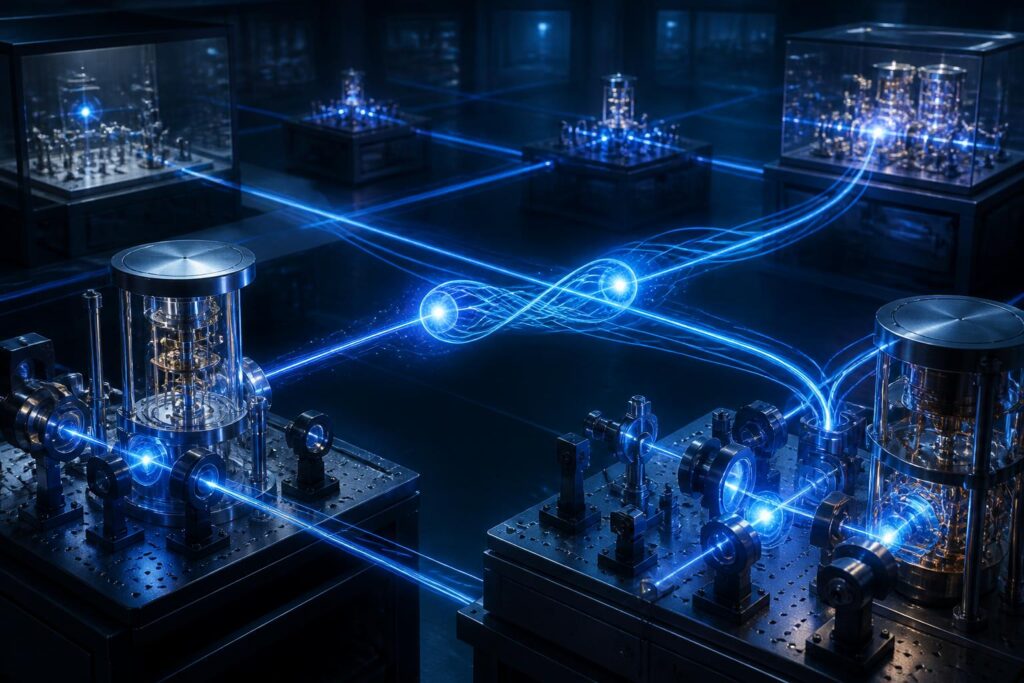
When quantum computers are mentioned, most attention tends to focus on their processors and their ability to solve particular problems. However, another area of development that is no less significant is quantum networking. If quantum computers are intended to process information using quantum states, quantum networks aim to connect such systems while also transmitting or sharing quantum states between different locations.
A quantum network is not a faster version of the Internet, nor is it a way to replace the entire network infrastructure in use today. It is a new technological layer based on phenomena such as superposition and quantum entanglement. In a future that still depends on many technical breakthroughs, this network could support more secure communication, connect quantum computers, and create distributed sensor systems with exceptional sensitivity. To properly understand that potential, it is necessary to examine how quantum networks work as well as the limitations that prevent them from soon becoming widespread infrastructure.
How Do Quantum Networks Transmit Information?
In traditional networks, information is encoded into bits and transmitted through copper cables, optical fibers, or radio waves. Each bit can take one of two basic values. Quantum networks use qubits, meaning units of information that can be prepared in different quantum states. A qubit is commonly implemented using photons, ions, atoms, electrons, or other physical systems, depending on the device’s purpose.
The important point is that a quantum network does not merely send a sequence of qubits from one place to another. It must also preserve the fragile characteristics of quantum states throughout the processes of creation, transmission, storage, and measurement. A measurement can change the state being observed. Environmental noise, transmission losses, and imperfections in the equipment can also destroy quantum information.
Quantum entanglement is a central component of many quantum network architectures. Two systems are said to be entangled when their states have a special quantum relationship, even after they have been taken to different locations. This relationship does not allow information to be transmitted faster than light, but it can be used in protocols that conventional networks do not provide. To exploit quantum entanglement over long distances, a system must create, distribute, verify, and maintain entangled pairs with a high degree of reliability.
Why Can’t We Simply Upgrade the Existing Internet?
Today’s Internet is built to copy, amplify, store, and route data flexibly. When a signal weakens, network equipment can read the signal, regenerate it, and forward it to the next segment. This approach is highly effective for classical data, but it cannot be applied unchanged to quantum information.
It is impossible to arbitrarily copy an unknown quantum state in order to create multiple identical copies. This is a fundamental limitation commonly known as the no-cloning theorem. Therefore, an intermediate node in a quantum network cannot operate like a conventional amplifier. The system must find other ways to extend the distance, such as distributing entanglement across separate segments and using intermediate nodes to link those segments together.
Such intermediate nodes are often described using the concept of a quantum repeater. They do not simply receive a signal and transmit it again. They need quantum memory, the ability to perform appropriate operations, and error-handling mechanisms. In practice, maintaining a stable quantum state for long enough to coordinate multiple segments is one of the greatest challenges of this network architecture.
Three Functional Layers of a Quantum Network
A complete quantum network requires many components to work together. At the physical layer, the system must have sources that generate quantum states, transmission paths, and detection equipment. Photons are often of interest for transmission because they can travel through optical media, but generating suitable photons, controlling them, and detecting them with high precision still requires specialized equipment.
At the intermediate layer, the network needs nodes capable of storing or processing quantum states. Quantum memory must preserve information for long enough for other parts of the network to complete their tasks. This is difficult because many quantum systems remain stable only under tightly controlled environmental conditions.
At the control layer, the network needs protocols to synchronize sources, confirm events, manage resources, and coordinate classical information with quantum information. This shows that quantum networks do not eliminate traditional networks. On the contrary, classical channels remain necessary for exchanging control information, publicly sharing certain measurement results, or confirming the status of the entanglement-distribution process.
Where Are the Nearest Applications?
The application mentioned most often is quantum key distribution. In this model, parties can use quantum states to create keys for encryption. If a third party attempts to interfere with the measurement process, that interference may change the states and produce abnormal signs in the test data.
However, quantum key distribution does not mean that every form of communication immediately becomes absolutely secure. The security of the entire system also depends on the protocol design, equipment quality, protection of the endpoints, and operating procedures. A good quantum connection cannot compensate for a compromised server or a misconfigured endpoint. Therefore, this technology should be regarded as one component of a multilayered security architecture, not the sole solution to every risk.
In the long term, quantum networks could connect quantum computers in different locations. Instead of requiring a single system to process an entire problem on one device, quantum resources could be coordinated within a distributed architecture. This idea opens up the possibility of expanding processing capabilities, but it still depends on transmitting states with sufficiently high reliability and synchronizing devices with very different characteristics.
Another direction is distributed quantum sensing. Multiple sensors placed in different locations could coordinate data to observe time, physical fields, or environmental changes. The potential benefit would not necessarily come from transmitting quantum information to end users, but from the ability to maintain relationships between the sensors and perform measurements in a new way.
Major Obstacles Before Quantum Networks Can Scale
The first obstacle is loss. When photons travel through optical fiber or free space, part of the signal may be lost. With ordinary data, a network can detect and resend a packet. With a quantum state, resending is not straightforward because the system cannot arbitrarily copy the original state. The greater the distance, the stricter the requirements for sources, memory, repeaters, and detection equipment become.
The second obstacle is the time for which a state can be maintained. A quantum memory can lose coherence through interactions with the environment. If the storage time is shorter than the time needed to establish a connection between nodes, the entire process will struggle to achieve efficiency. Developers must balance operational speed, stability, integration capacity, and operating conditions.
The third obstacle is error correction. Noise is a familiar problem in every hardware system, but quantum error correction is more complex because the state being protected cannot be copied directly. Information must be encoded into larger structures and multiple checks must be performed while still avoiding the loss of useful states. This increases the requirements for hardware, the number of devices, and control capabilities.
There is also the issue of standardization. A future network may include multiple hardware platforms and transmission methods. If devices do not share consistent ways to describe states, authenticate nodes, manage resources, and handle errors, large-scale connectivity will be very difficult. Technical standards are therefore no less important than advances in the laboratory.
How Will Quantum Networks Change the Internet?
The more plausible scenario is not that the current Internet disappears to make way for a single quantum network. The two types of networks may coexist and take on different roles. Classical networks will remain suitable for most everyday activities, such as viewing content, sending email, storing files, and accessing services. Quantum networks may be deployed in places that require key distribution, connections between quantum devices, or specialized measurements.
This also means that ordinary users may not directly notice when a quantum network is operating. Like many layers of today’s infrastructure, this technology may sit behind data centers, research organizations, financial systems, or facilities with high security requirements. Its value will be assessed through reliability, operating costs, and its ability to address a specific need, not merely through the image of an advanced technology.
Therefore, caution is necessary in response to claims that quantum networks will soon replace the Internet or automatically eliminate every risk of eavesdropping. The technology still faces questions regarding scale, cost, maintenance, and practical effectiveness. Experimental prototypes may demonstrate an individual function, but building a sustainable, interoperable, and easy-to-manage network is a much larger challenge.
A New Infrastructure Requires a New Way of Thinking
Quantum networks are noteworthy not only because they use phenomena that are difficult to observe in everyday life, but also because they force the technology industry to rethink the concept of communication. Quantum data cannot be treated like ordinary packets. Every step, from source generation and transmission to storage and measurement, is associated with its own physical limitations.
In the future, progress in quantum networking may come from combining more stable hardware, more efficient protocols, and practical integration with classical networks. Success will not be determined by a single device, but by the ability to make many components work together reliably over long periods.
Therefore, quantum networking should be viewed as an expansion of computing and communications infrastructure, not as a slogan about a next-generation Internet. It may create capabilities that today’s networks do not provide, but it will deliver value only when physical limitations are transformed into systems that can operate in the real world. The distance from quantum principles to a useful network is still long, but the process of narrowing that distance will shape an important part of the technological future.
