


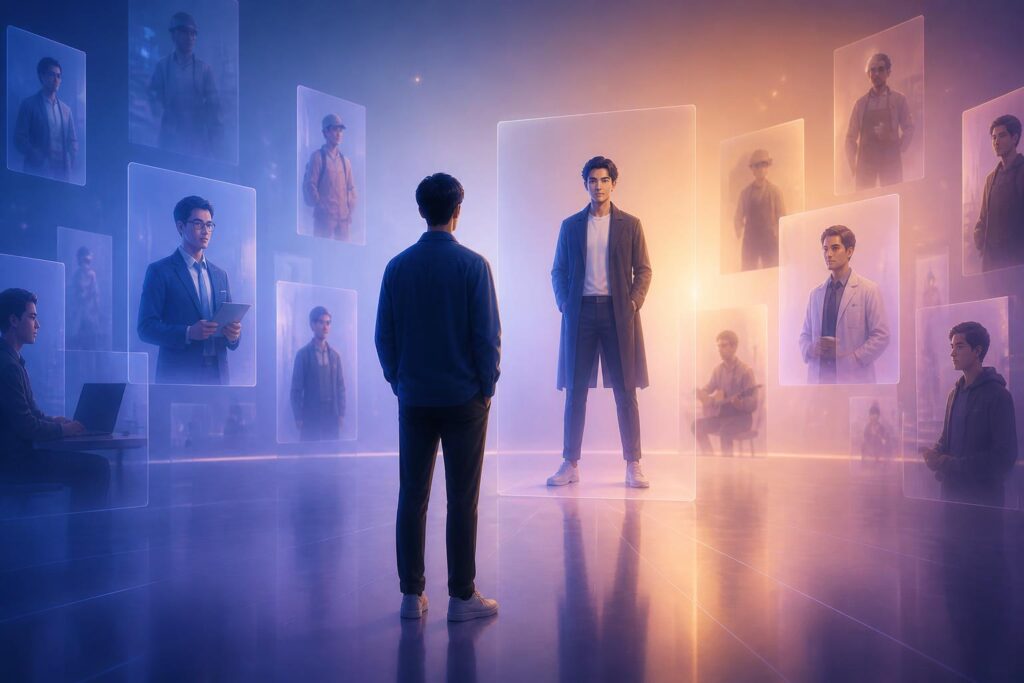
In highly interactive digital spaces, people rarely appear entirely under their real names and with their real faces. A virtual character, an avatar, a chosen voice, or a style of movement can stand between users and the community. At first, avatars are often seen as decorative shells for accounts. Users choose hair color, clothing, facial features, or accessories to make their characters distinctive. But as conversations, community activities, work, and entertainment increasingly take place in digital environments, avatars gradually take on a larger role: they become signals that help others recognize and remember an individual and form impressions of them.
This shift makes avatars worth viewing as part of identity, even though they cannot be equated with the whole person in real life. Someone may create multiple avatars for different purposes, or use a single avatar over an extended period to maintain a sense of continuity. Both choices show that identity in the virtual world is not a fixed object assigned by the system. It is the result of an ongoing process of choice, expression, and repeated interaction.
Avatars Are More Than a Means of Identification
In face-to-face communication, people rely on many signals at once to recognize the person in front of them: facial features, voice, gestures, clothing, the way they move, and the surrounding context. In virtual environments, these signals are often recreated or simplified. An avatar therefore becomes a focal point of presence. It indicates that a user is present, how they want to be perceived, and what role they are taking on in the space.
A serious-looking avatar can help a user create a sense of professionalism in an online meeting. A colorful character may be suited to an entertainment space or a creative community. Some people choose an image close to their real appearance to maintain a sense of familiarity; others intentionally create a completely different character in order to experiment with self-expression. Neither choice is automatically right or wrong. The meaning of an avatar depends on the context, purpose, and expectations of the person using it.
What matters is that an avatar does not operate in a vacuum. Its value is created through the way the user acts. An eye-catching image may attract initial attention, but trust is usually built through communication, the ability to keep promises, attitudes toward the community, and consistency across appearances. Thus, virtual identity does not exist only in what can be seen. It also includes a history of interactions and the meanings that others attach to the avatar.
The Right to Experiment with a Different Version of Oneself
A clear advantage of avatars is that they create a necessary distance between an individual and the image presented to the outside world. This distance can help users feel less constrained by characteristics that others commonly focus on in face-to-face life. Age, appearance, disability, voice, or clothing style are no longer the only factors determining how a person appears in a digital space.
When given the ability to choose an avatar, users can experiment with a new way of communicating, join communities they were previously hesitant to enter, or express interests that are not yet easy to reveal. For some people, an avatar is a creative tool. For others, it may be a form of psychological protection that allows them to observe and become familiar with a setting before deciding how open to be. Trying out a different expressive identity does not necessarily amount to deception. In many cases, it is a way for people to learn about themselves through different roles and images.
However, this sense of freedom is meaningful only when users are able to control how their avatars appear. If a platform imposes a small number of choices, forces users to use preset features, or links avatars to evaluation systems, the ability to express oneself is restricted. A diverse virtual world needs more than a wide range of decorative items. It must allow people to choose the degree of realism, fiction, and privacy that suits each situation.
The Distance Between the Avatar and the Real Person
An avatar can express part of a person, but it can never contain that person in their entirety. This is an important point to remember when evaluating others in digital environments. A minimally designed character does not show that its owner lacks personality. An elaborate avatar does not prove that the user has a richer life. What appears on the screen is only the layer of information chosen for presentation.
Conversely, this distance can also create ambiguity. Someone may construct a highly convincing image but act in ways that differ greatly from it. In communities where users do not know one another offline, an avatar is often the starting point for trust. In such cases, visual cues can easily be treated as evidence of character or ability, even though they are not sufficient to support a firm conclusion.
A prudent approach is to separate an initial impression from a long-term assessment. Users can respect the way an avatar was created without automatically believing that all the information associated with it is accurate. Platforms should also avoid designing interfaces that cause users to confuse a fictional character, a verified account, and a legal identity. These three concepts may coexist in the same space, but they do not have the same meaning.
When an Avatar Is Carried Across Multiple Spaces
An avatar’s meaning changes significantly when it is no longer limited to a single application. Users may want to bring the same character, name, or identifying style into different games, communities, and services. This continuity helps create a sense of stability. Others can recognize an individual more easily, while the avatar’s owner does not have to start over every time they enter a new environment.
But continuity also creates its own risks. When the same avatar appears in multiple places, activities that were previously separate may become linked. An account used for entertainment may be connected to an account serving educational or professional purposes. Users may not realize that an identifying choice that seems harmless is reducing their ability to keep different parts of their digital lives separate.
Therefore, consistency is not always the goal to pursue. There are times when a person needs multiple avatars to maintain boundaries between roles. A character for friends, an image for work, and an anonymous account in a discussion community may all belong to the same individual while serving different needs. The right to maintain unconnected layers of identity is no less important than the right to take a single avatar everywhere.
The Responsibilities of Platforms and Communities
If avatars increasingly function as identities, the way platforms manage them will directly affect users’ autonomy. Platforms need to clearly state what users own, what they can transfer, and what they may lose if an account is locked or a service changes. A virtual outfit, display name, or character design may carry great significance for a user, but the rights to use and move these components between spaces should not automatically be assumed to be the same.
Design must also take into account people who do not want, or are unable, to appear in ways that closely resemble real life. Using a real face, real voice, or personal information should not become an implicit condition for full participation. Identity verification may be necessary in certain contexts, but verifying identity with a system does not mean that one’s identity must be disclosed to the entire community.
User communities also share responsibility. A distinctive avatar should not become a reason for ridicule, exclusion, or hasty assumptions. Harassment targeting an avatar can still cause real harm because its ultimate target is the person controlling the avatar. Conversely, users need to understand that choosing a character does not grant them immunity from all rules of communication. Freedom of expression and responsibility for one’s behavior must coexist.
Designing a Virtual Identity Deliberately
Rather than choosing an avatar solely according to trends or the options suggested by a platform, users can begin with a simple question: What purpose do I want this image to serve? If the goal is long-term connection, recognizability and consistency may be important. If the goal is creative experimentation, change and fiction may be more suitable. If privacy is needed, users should consider an avatar that does not reveal characteristics that could be linked to their offline lives.
It is also worth reconsidering how an avatar is used in each community. An image that suits a group of friends may not be appropriate in an educational or professional setting. Users can prepare different forms of self-presentation without viewing this as artificial. People already adjust their speech, clothing, and attitudes according to context; an avatar is simply a new form of that process of adjustment.
The final thing to protect is the ability to change. No one should be trapped forever in a particular image simply because the community has grown accustomed to it. Preferences, opinions, and circumstances can change, bringing with them the need to change an avatar. A healthy digital ecosystem should allow users to refresh their image without being seen as betraying their former identity, while also providing enough information so that significant changes do not cause confusion in relationships that require trust.
Identity Does Not Reside Entirely in a Single Image
Avatars are becoming a language of presence in the virtual world. They help people be recognized, remembered, and sometimes freer in how they express themselves. But an avatar is only the starting point of an identity, not the whole identity. Its lasting meaning is shaped by behavior, relationships, and the control users have over their own image.
Viewing avatars in this way helps avoid two extremes. One is treating them as meaningless decorations; the other is regarding them as complete evidence of the person behind them. A more balanced view acknowledges the social weight of an avatar while preserving room for privacy, change, and experimentation. When users have the right to decide how they appear, to separate roles when necessary, and to take responsibility for how they act, the virtual world will not merely recreate identity but also expand people’s ability to understand and build their own identities.
