


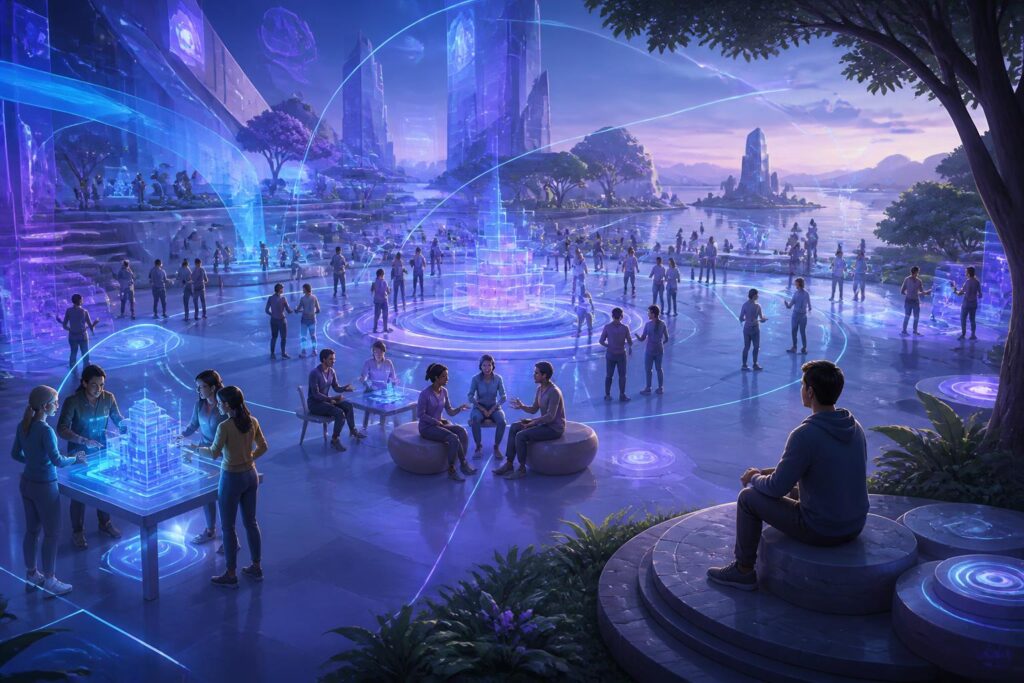
The virtual world is often imagined through readily visible images: avatars, three-dimensional spaces, remote gatherings, or items that can be bought and sold in digital environments. However, behind those images lies a resource that is rarely named but plays a decisive role: human presence. A person who logs in, chats, builds a space, organizes an event, or simply spends time observing is contributing to making the virtual world vibrant.
That presence is not entirely free. It requires time, attention, emotional energy, and sometimes creative labor as well. Platforms may view user activity as a signal for improving products, sustaining communities, or generating revenue. Content creators and community managers also rely on other people’s participation to build their work. Therefore, the important question is not only how virtual worlds are designed, but also how the value generated by human presence is distributed.
Presence Is More Than Login Time
In ordinary online environments, users can read an article, send a message, or watch a video without needing to create the feeling that they are truly in the same space as other people. Virtual worlds, especially environments that use avatars and live audio, aim to create a feeling closer to real life. Participants can turn their heads to look around, move, express emotions, work together, or react in real time.
These features make presence more substantial. Users provide not only data about what they have clicked, but also reveal how they interact, whom they stand near, which groups they join, when they leave a conversation, and how they respond to the atmosphere of a space. Some signals may help a platform operate better, but they can also create a feeling of being watched if users do not know what data is being recorded and what it is being used for.
Time is not the only measure of value, either. One person may spend many hours building a community area, guiding newcomers, or organizing an educational activity. Someone else may appear for only a few minutes but bring an idea, a meaningful conversation, or a valuable connection. If contributions are assessed solely by the number of minutes spent online, a platform may overlook the invisible forms of labor that sustain the quality of a community.
Who Creates Value in Virtual Spaces?
A virtual world is not created solely by software development teams. Designers build the architecture and tools, but users are the ones who fill the space with stories, conventions, and relationships. Event organizers create reasons for the community to return. Administrators handle disputes, explain rules, and support new members. People who create models, sounds, clothing, or interactive experiences make the environment more diverse.
Many of these jobs are difficult to see if attention is focused only on the final product. A friendly chat space may be the result of many hours of preparation, testing, and handling unexpected situations. A safe community does not appear naturally; it requires reporting mechanisms, moderators, behavioral guidelines, and coordination among many members. When platforms benefit from high levels of activity, acknowledging the contributions of those who sustain that activity becomes an important issue.
This does not mean that every interaction must be converted into money. Some people participate for enjoyment, friendship, learning, or the desire to contribute to the community. But voluntariness should not be understood to mean having no value. Someone who voluntarily guides newcomers is still providing time and ability. An artist who shares work for free still has the right to know how that work is being used. The boundary between voluntary contribution and exploited labor needs to be clarified through platform design as well as transparent agreements.
When Attention Becomes the Goal
In many digital products, the level of engagement is used to evaluate success. This measure can be useful, but if it becomes the sole objective, it can easily encourage designs that keep users around longer instead of helping them achieve their original purpose. A virtual space may continually offer notifications, rewards, invitations, or new activities to prevent users from leaving. Participants then no longer have complete control over deciding how long they want to remain present.
The problem is not that every invitation to interact is bad. A timely notification can help users avoid missing a meeting or find their friends. But responsible design needs to distinguish between convenience and coercive retention. Users should have an easy way to turn off notifications, review privacy settings, leave a space, or pause activity without being pressured. The ability to leave is no less important than the ability to participate.
For children and people who are easily drawn into continuously interactive environments, this question is even more sensitive. An engaging virtual world can support learning, creativity, and connection, but it can also blur the boundary between rest and consuming content. Rather than merely advising users to control themselves, platforms need to provide tools that allow them to see their usage history, set limits, and understand what is happening within their accounts.
The Boundary Between Experience and Data
To create a sense of presence, virtual worlds often need to collect more types of information than an ordinary website. The data may relate to movement, voice, devices, relationships, or how users interact with a space. Not all collected data is necessary for every feature. Therefore, a reasonable principle is that platforms must clearly explain the purpose of collection, limit the scope of use, and allow users to make meaningful choices.
Privacy notices, if presented only as long and difficult-to-understand passages, will not help users make substantive decisions. Choices should appear at the right time, in language that is easy to understand, and remain adjustable afterward. Users also need to know what happens to their data when they close their account, move to another platform, or leave a community.
Virtual spaces also raise questions about recordings of conversations and shared activities. A gathering may be recorded for safety purposes, but recording or storage needs to be accompanied by appropriate notice. If users cannot know whether they are in a space where audio or video is being recorded, the sense of presence can turn into a feeling of being monitored. The community’s trust depends greatly on this clarity.
Designing So People Can Be Present in Their Own Way
A good virtual world should not force everyone to express their presence in the same way. Some people prefer communicating by voice, while others want to use text, gestures, or simply observe. Some need a quiet space, while others seek crowded activities. If only one type of interaction is prioritized, a platform will unintentionally exclude people with different needs.
Flexible design can begin with basic choices: adjusting the volume for each person, turning off disturbing effects, changing the way things are displayed, controlling invitations, and creating private areas. These tools serve not only accessibility but also help all users maintain control. A person can participate in a community without having to keep their microphone on, appear before a crowd, or share a great deal of personal information.
Platforms also need to acknowledge that absence has value. Users may leave a meeting to rest, not respond immediately, or choose not to join every activity taking place. If a system continually treats silence as a sign of disconnection and tries to pull users back in, it will turn digital life into a competition over readiness and availability. The right not to appear is, in many cases, part of the right to self-determination.
Distributing Value More Fairly
As virtual worlds develop, economic questions will become increasingly connected to questions about presence. Who owns spaces built by communities? Who decides how a work is distributed? Do administrators receive support when they handle ongoing tasks? Can users transfer their reputation, work, or relationships to another environment? There is no single answer for every platform, but asking these questions early helps prevent users’ contributions from being treated as an unlimited resource.
Fairness also needs to be considered from the perspective of ordinary users, not only those who generate direct revenue. A sustainable community depends on many people participating to different degrees. If a platform prioritizes only those with greater ability to pay, those who participate frequently, or those who create large amounts of content, everyone else may gradually be pushed out. The social value of a space lies not only in transactions, but also in the sense of belonging, opportunities to learn, and chances to meet others that it creates.
In the future, platforms may compete not only through graphics or new devices, but also through how they treat people’s time and attention. A platform that allows users to understand their data, control the pace of their participation, and recognize their own contributions will have a better chance of building long-term trust. By contrast, an environment focused solely on maximizing time spent online may quickly exhaust the enthusiasm it seeks to sustain.
Meaningful Presence Instead of Constant Presence
Virtual worlds do not necessarily have to compete with real life by demanding that people spend more and more time in them. The value of a digital environment may lie in helping make a meeting more accessible, supporting a group in creating together, or opening up a form of expression that physical space cannot easily accommodate. To achieve this, presence needs to be viewed as a deliberate choice, not a continuous obligation.
When designing products, establishing rules, and distributing benefits, platforms should see users as individuals with time, emotions, and the power to decide, rather than merely as sources of activity. Participants, too, need to ask what they are receiving, what data they are sharing, and which contributions have not been recognized. A virtual world worth living in is not a place where everyone is always online, but one where people can appear in ways that suit them, create value, and leave while retaining control over themselves.
