


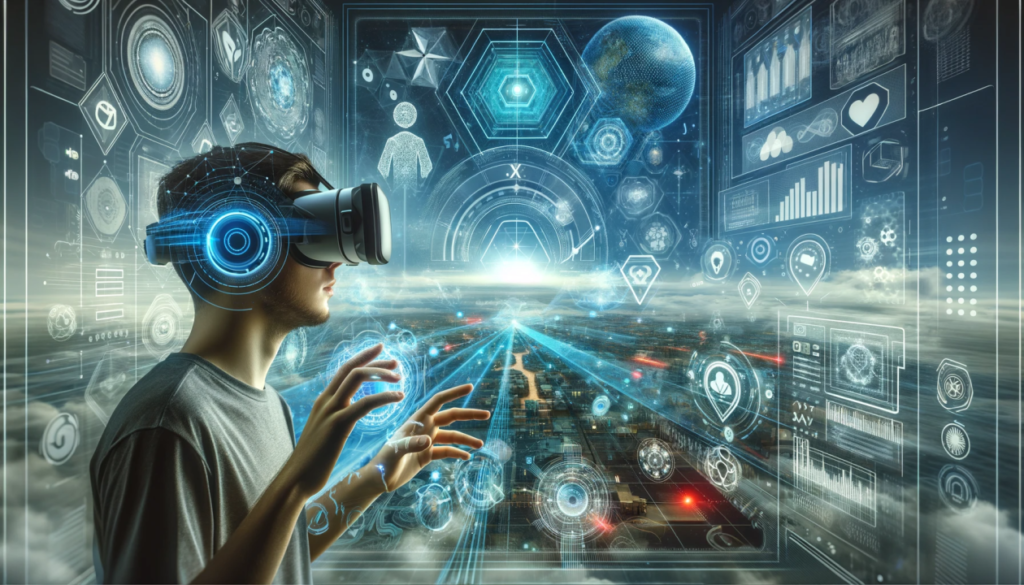
For many years, extended reality (XR) was often seen as a futuristic concept, largely confined to tech labs or the entertainment industry. However, recent developments suggest that XR is no longer a distant vision of the future. Instead, it is gradually becoming part of everyday life, from manufacturing and education to healthcare and commerce.
XR, which includes virtual reality (VR), augmented reality (AR), and mixed reality (MR), is being strongly driven by major technology players such as Apple, Meta, and Microsoft. What truly matters, however, is not just technological advancement, but the real-world value that XR can deliver.
XR Is No Longer Just for Entertainment
The launch of Apple Vision Pro marked a significant turning point in how the market perceives XR. Rather than being positioned as a mere entertainment device, Vision Pro is introduced as a “spatial computer,” offering a fundamentally new way for humans to interact with digital information.
Still, according to many experts, the key factor lies not in the hardware itself, but in the surrounding ecosystem of applications. Tim Bajarin, an analyst at Creative Strategies, argues that XR will only truly take off when it solves concrete problems in work and daily life, rather than simply delivering impressive visual experiences.
In practice, many businesses have already begun using XR for employee training, production simulations, and remote maintenance support. These applications help reduce costs, improve accuracy, and minimize risks—benefits that traditional technologies often struggle to achieve.
From Potential to Reality Across Industries
In healthcare, XR is assisting surgeons with highly detailed 3D visualizations, improving precision and reducing the likelihood of errors. According to PwC, VR-based training can be up to four times faster than traditional methods while boosting learner confidence.
In education, XR enables immersive learning experiences, allowing students to interact directly with knowledge instead of passively consuming it. Universities in the United States and Europe have already implemented XR classrooms where students can explore human anatomy or simulate complex experiments.
In industry, Microsoft HoloLens is being used to support engineers with real-time visual guidance, significantly reducing troubleshooting time.
In Vietnam, XR is still at an early stage, but there are encouraging signs. Some real estate companies have started using AR to offer virtual property tours, while edtech startups are experimenting with VR for skills training.
The Biggest Barriers: Cost and Content
Despite its strong potential, XR still faces significant challenges. The cost of hardware remains high, especially for premium devices like Vision Pro, making widespread adoption difficult.
Content is another major bottleneck. Unlike smartphones or the internet, XR requires purpose-built experiences. Developing XR content is resource-intensive and demands multidisciplinary expertise, ranging from programming and design to user psychology.
Mark Zuckerberg, CEO of Meta, has stated that “metaverse and XR will take years to fully develop,” emphasizing that this is a long-term evolution rather than an overnight breakthrough.
Expert Perspective: XR Will Become “Invisible”
Many technology experts believe that the future of XR does not lie in forcing users to wear headsets all day, but in integrating seamlessly into everyday life.
Benedict Evans, an independent technology analyst, suggests that XR will evolve in a way similar to cloud computing today: users may not even realize they are using it, yet it will be embedded in nearly every activity.
This implies that XR could gradually become a new interface layer, potentially replacing traditional screens, but in a more subtle and unobtrusive way.
Where Does Vietnam Stand in the XR Race?
Compared to larger markets, Vietnam still lags behind in terms of infrastructure and ecosystem development for XR. However, this also presents an opportunity to leapfrog if the country focuses on high-demand sectors such as education, manufacturing, and tourism.
Local experts suggest that instead of competing in hardware, Vietnamese companies should prioritize content and practical solutions. XR only becomes valuable when it addresses real problems faced by businesses and users.
XR Is Not a Passing Trend
Overall, XR is not just another hype cycle like many technologies that briefly surged and faded. It represents a natural evolution of digital interfaces, from keyboards to touchscreens—and potentially toward fully immersive 3D environments.
That said, XR adoption will not progress evenly. Industries with clear, immediate use cases will move faster, while mass consumer adoption may take more time.
What is clear is that XR is gradually transitioning from experimentation to real-world application. And when that transition fully unfolds, it will reshape how people work, learn, and interact with the digital world—perhaps profoundly, yet quietly.
