


In the early years of blockchain, transparency was often regarded as one of its most important advantages. Every transaction was recorded on a shared ledger, could be checked using software, and did not depend on a single authority. However, absolute transparency also creates a paradox. When the entire transaction history, balances, and connections between addresses can all be analyzed, users may lose some of the privacy they still have in traditional financial systems.
Zero-knowledge proofs emerged as a possible solution to that paradox. In principle, this technology allows one party to prove that a statement is true without revealing all the information used to prove it. On blockchain, this is not merely a technique for protecting personal data. It can also help networks process more complex tasks without having to place the entire computation on every node.
Proving Without Exposing Data
Imagine someone who wants to prove that they are eligible to use a service but does not want to make their entire personal record public. In the traditional approach, that person would often have to send copies of documents or provide more information than necessary. With a zero-knowledge proof, the system may receive only a mathematical proof showing that the condition has been met. The verifier knows that the result is valid, but does not necessarily know all of the original data.
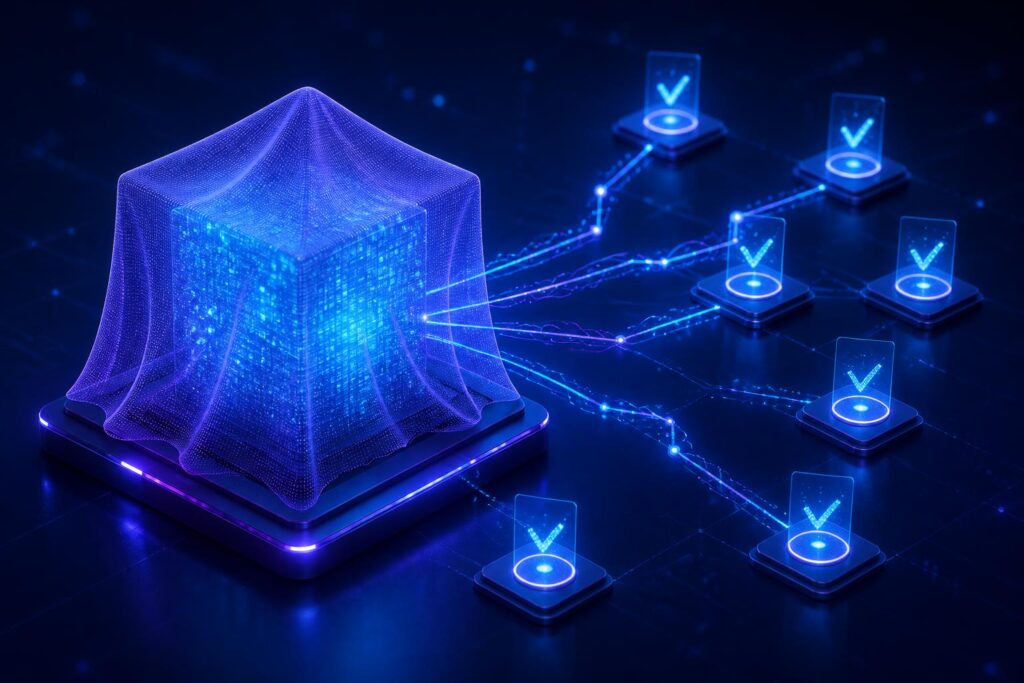
In a blockchain environment, this principle is transformed into a process involving a prover and a verifier. The prover uses private data together with an agreed-upon rule to generate a proof. The verifier checks that proof using public information. If the check succeeds, the network accepts that the statement has been proven without needing to see the input data.
It is important to note that zero-knowledge proofs do not mean that all transactions become completely anonymous. The level of privacy depends on the protocol’s design, the type of data being concealed, how addresses interact, and the ability to analyze the traces that remain. A system may protect the amount or content of a transaction while still revealing the time of activity, the frequency of interactions, or the relationships between accounts. Therefore, this should be viewed as a tool within a security architecture, not as a promise to automatically erase every trace.
Two Major Challenges: Privacy and Scalability
The first application that is often mentioned is privacy protection. Users can prove a specific condition without publicly disclosing all related information. An authentication system can verify that an account meets a requirement, a market can confirm the status of an order, and a financial application can check transaction conditions without publishing all sensitive data.
The value of this approach lies not only in protecting individuals. Businesses may also need to prove that they comply with a rule without wanting to disclose commercial data. In a supply chain, one party can prove that a shipment meets certain standards without revealing the entire contract or supplier information. In digital services, users can prove that they have access rights or valid credentials without sharing excessive identifying data.
The second application concerns scalability. Public blockchains typically require many nodes to check the state and transactions together. If every computation is performed directly on the base layer, processing and storage costs can increase rapidly. Zero-knowledge proofs allow one party to perform the heavy computation off-chain and then send a shorter proof for the network to verify. Nodes do not need to repeat the entire process, but they still have a mathematical basis for checking the result.
This design can change the role of the base layer. Rather than directly processing every operation of an application, the blockchain focuses on verifying proofs and maintaining the final state. Computation can be moved to supporting layers or systems. However, this separation is effective only when the necessary data remains accessible, the proofs can be checked, and the security assumptions are made sufficiently clear to the public.
Behind a Simple Experience Lies a Complex System
To end users, an application using zero-knowledge proofs may look like any other blockchain application. They connect a wallet, submit a request, and receive a result. But behind the interface is a complex chain of technical components. Data must be represented in a form suitable for a computational circuit or proving system. The application’s conditions must be written as rules that can be checked. The proving system then performs the necessary computation and produces an output for the network to verify.
Proof generation can require significant resources, especially when an application contains many conditions or computations. This creates trade-offs among the level of privacy, response speed, and operating costs. If proof generation is too demanding, users may have to wait a long time or depend on an external service. If the process is delegated to a third party, new questions arise: can that party see the private data, can it falsify the result, and how easily can users switch to another provider?
Verification is usually lighter than proof generation, but that does not make the design simple. The system needs to precisely determine which data is public, which data is kept private, how the state is updated, and how an invalid proof is handled. Even a single error in describing a condition can cause the proving program to prove a statement different from what the designer intended.
Trust Does Not Disappear; It Shifts to Software and Assumptions
Blockchain is often described as a technology that reduces dependence on intermediaries. With zero-knowledge proofs, that reduced dependence may occur at another layer, but it does not mean that trust disappears completely. Users still have to trust the source code, the deployment process, cryptographic libraries, and the way the system manages keys. If an initial setup step requires the creation of secret data, protecting or destroying that data becomes an important issue.
This is why projects need to disclose their security assumptions and clearly explain their threat model. A system may be secure against some parties observing data but not secure if an administrative key is exposed. A mechanism may protect transaction contents while still allowing identities to be inferred from interaction patterns. A proof may demonstrate the correctness of a computation, but it does not guarantee that the original input data was complete or truthful if the system has no way to verify the data’s source.
From a governance perspective, auditing also becomes different. Auditors must not only examine the transactions that occurred, but also inspect the proving circuit, the rules for generating proofs, and how the components are connected. This requires greater expertise and new evaluation methods. A product with a user-friendly interface does not necessarily have an architecture that is easy to verify.
Barriers Before the Technology Becomes Widespread
The first barrier is user experience. Security procedures often require users to manage keys, remember recovery information, or wait for a device to generate a proof. If these steps are too complicated, the technology will struggle to move beyond specialized users. Developers need to hide the complexity behind the interface while still avoiding the creation of a centralized service that users cannot control or replace.
The second barrier is compatibility. Each system may use a different data model, circuit language, or verification mechanism. When an application needs to connect to multiple networks, proof generation and state verification can introduce additional layers of logic. This increases development costs and expands the scope of testing. The challenge is not only to make a proof valid, but also to ensure that the proof is interpreted consistently throughout the entire system.
The third barrier concerns law and accountability. Privacy is an important value, but financial systems and digital services still have requirements for verification, risk control, and the investigation of unusual transactions. A good architecture needs to distinguish between protecting data that does not need to be made public and concealing all information in every situation. Conditional disclosure mechanisms, tiered access rights, and the ability to prove compliance may become important parts of future designs.
From a Cryptographic Tool to a Product Design Principle
The long-term value of zero-knowledge proofs will not be determined solely by the ability to produce complex proofs. It depends on whether the technology can solve real problems at a reasonable cost. A good application should begin with the questions: which data truly needs to be made public, which data only needs to be verified, and how much control should users have over access rights?
Asking these questions can help developers avoid two extremes. On one side is making all data public because transparency is assumed always to mean reliability. On the other is concealing so much information that users, operators, and oversight authorities can no longer evaluate the system. More effective design lies in disclosing exactly what is necessary, at the right time, and to the right party.
In the future, zero-knowledge proofs may become a familiar infrastructure layer of blockchain, much like digital signatures or transaction authentication mechanisms. Users may not know that they are using this technology, but they will benefit from applications that disclose less data, process information more flexibly, and have a clearer ability to prove their state. Even so, to achieve this, the blockchain industry must continue to prioritize auditability, transparent technical documentation, and user-centered design.
Blockchain once focused on creating a ledger that multiple parties could jointly trust. Zero-knowledge proofs extend that idea in a more subtle direction: not everyone needs to see all the data to confirm that a result is correct. If deployed carefully, this technology could help blockchain achieve a better balance among transparency, privacy, and efficiency—three goals that have often been considered difficult to attain at the same time.
