


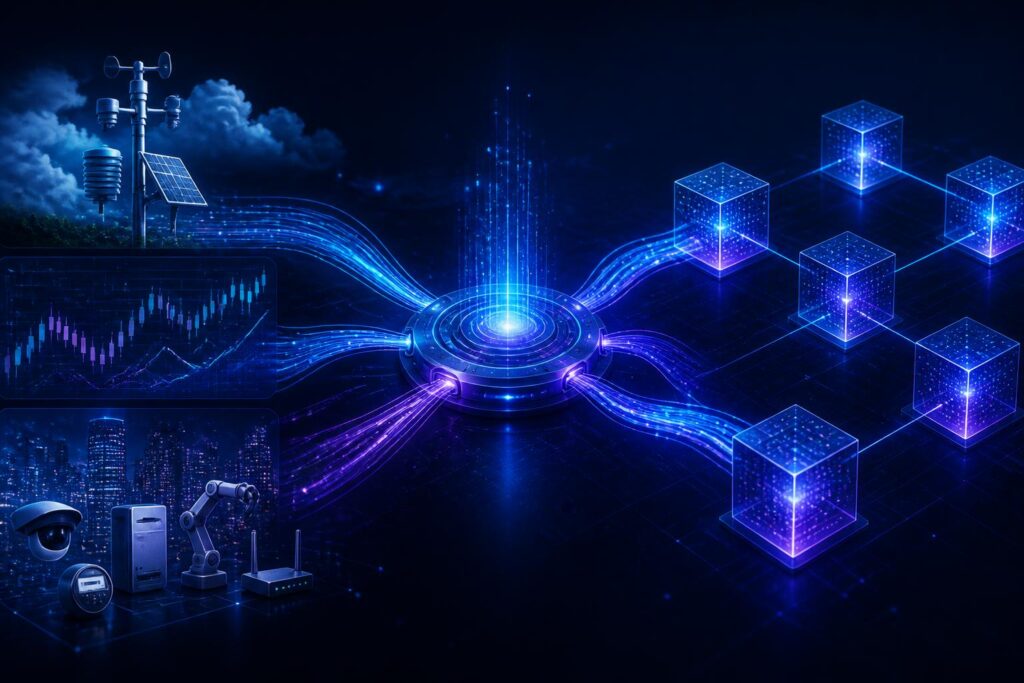
Blockchain is often described as a system capable of recording and verifying data without a single central authority. However, this capability mainly applies to information that already exists within the network. When a smart contract needs to know the price of an asset, the weather at a particular location, the result of a match, or the real-world status of a delivery, the blockchain cannot access those data sources on its own. This is the gap that blockchain oracles were created to address.
An oracle is not a new type of cryptocurrency, nor is it simply a channel that brings data from the Internet onto the blockchain. In essence, it is a mechanism for collecting, checking, transmitting, and sometimes aggregating external information so that smart contracts can use it. This mechanism plays an important role in decentralized finance, insurance, gaming, and many other applications. At the same time, it raises a fundamental question: if the input data is wrong, can a fully automated contract still produce the correct result?
What Does a Blockchain Know and Not Know?
A blockchain network can verify its own state. For example, the network can determine how many tokens an address holds, whether a transaction is valid, or whether a contract has received a payment. This information is observed and confirmed by network nodes according to shared rules.
The difficulty arises when a contract needs data that was not generated on the blockchain. A flight insurance contract may need to know whether a flight was canceled. A lending platform may need a reference price for collateral. An application that makes conditional payments may need to know whether goods have been delivered. A blockchain cannot call a website on its own or independently verify a real-world sensor. If a contract is allowed to obtain data arbitrarily from a single source, the operator of that source becomes a highly influential point of control.
An oracle is viewed as a connecting layer between the off-chain world and on-chain logic. It does not automatically make data correct. The oracle’s practical task is to design a process through which information is supplied in a verifiable manner, with manipulation limited and in a way that suits the type of application using the data.
What Steps Does an Oracle Follow?
An oracle system usually consists of multiple components. First, a smart contract submits a request or specifies the type of data it needs to receive. Data providers then obtain information from external sources, such as a market data platform, an enterprise system, or a sensor device. The data may be signed, have its format checked, compared against other sources, and transferred onto the blockchain through a transaction.
In a simple model, the contract receives data from only one source. This approach may be easy to deploy and inexpensive, but the risk depends heavily on the reliability of that source. If the source fails, is attacked, or deliberately changes the information, the contract may execute an incorrect decision.
A multi-source model seeks to reduce risk by collecting data from multiple providers and then using an aggregation method. The system may identify the median value, discard values that deviate too far, or require a certain number of parties to confirm the same information. However, multiple sources do not mean absolute safety. The sources may all depend on the same underlying data, update at the same slow pace, or be affected by an unusual market event.
Oracles can also operate using a push or pull model. In a push model, the system regularly sends new information to the blockchain. In a pull model, the contract or user requests data only when it is needed. The choice between the two depends on the required update frequency, transaction costs, and the application’s sensitivity to data fluctuations.
The Role of Oracles in Cryptocurrency Applications
In decentralized finance, price data is one of the most common use cases. A lending platform needs to know the value of collateral to determine whether a user is borrowing beyond a safe level. If the recorded price is lower than the actual price, assets may be liquidated at the wrong time. If the price is pushed too high, the system may allow users to borrow more than the assets can actually secure.
Derivative products also depend on oracles to determine reference prices, settlement times, or contract termination conditions. In these situations, a short-term discrepancy can have a major impact, especially when participants can trade based on information before the data is officially updated.
In decentralized insurance, an oracle can transmit the status of a predefined event. For example, a contract may rely on weather data or the disruption status of a service. The system does not need employees to process each claim, but this is meaningful only when the event data is clearly defined, comes from a reliable source, and is difficult to interfere with.
Oracles can also support blockchain games, supply chain management, and applications that need to interact with systems outside the network. However, complexity increases with the number of data types and participating parties. An application recording digital ownership may need to verify only a simple event, while a goods-management application must process data from multiple locations, devices, and operational procedures.
Risks That Cannot Be Ignored
The greatest risk is inaccurate input data. A smart contract may execute its code correctly and still produce an incorrect result if the information it receives was wrong from the outset. This is different from a programming error. A perfectly written program cannot automatically correct incorrect data supplied by an oracle.
The second risk is centralization. If a single organization controls the data source, server, authentication key, or update authority, the system still has a single point of failure even if the rest is built on a blockchain. Users need to consider who provides the data, who has the authority to change the configuration, and what procedures apply when the data source stops operating.
The third risk concerns latency. Asset prices, exchange rates, or the status of an event may change faster than the data can be updated on the network. During that period, some participants may trade based on new information that has not yet been reflected in the contract. If the update mechanism operates too frequently, operating costs may increase. If updates are too infrequent, the data loses its timeliness.
There is also the risk of economic manipulation. When an application holds assets of substantial value but relies on a data source that lacks liquidity or is easily influenced, a party may try to distort the data briefly in order to profit from liquidation, issuance, or settlement. Therefore, evaluating an oracle cannot be based solely on the protocol’s name or claims about decentralization.
How to Evaluate an Oracle System
Users and developers should begin by determining what data the application actually needs. Not all types of information have the same level of importance. Data used for display in an interface may tolerate a certain amount of latency, while data that determines asset liquidation requires stricter standards.
Next, it is necessary to examine the number and independence of the data providers. Multiple sources are valuable only when they do not all depend on a single data point. The aggregation mechanism should also be transparent so that users understand how the system handles abnormal values, missing data, or sources that produce different results.
The ability to respond when a problem occurs is equally important. A sound system needs a plan for situations in which the oracle stops updating, data conflicts, or the market behaves abnormally. Depending on the design, the contract may temporarily suspend a function, limit transaction sizes, or require additional confirmation. These measures do not eliminate risk, but they can reduce the impact of a single failure.
Finally, users need to distinguish between data that can be verified directly on-chain and data that depends on external statements. The blockchain can help preserve the update history after data has been entered into the network, but that history does not prove that the original data was correct. Transaction transparency therefore needs to be accompanied by transparency about the information’s origin.
Oracles Reveal the Practical Limits of Decentralization
Oracles do not eliminate the need for trust; they merely shift that need to another layer. Instead of trusting a single central authority, users may have to assess a network of data providers, incentive mechanisms, verification procedures, and governance powers. This is an important change, but it is not a transformation that makes every application completely decentralized.
In many cases, the most suitable design is not to eliminate all intermediaries, but to limit each party’s power, make operating rules public, and enable independent verification. An oracle may be considered more reliable when its data sources are diverse, update authority is controlled, changes can be traced, and the contract has safeguards against abnormal situations.
For cryptocurrency users, understanding oracles provides a clearer view of the risks behind a protocol. An application with an attractive interface, open-source code, or operation on a popular blockchain can still be affected by off-chain data. Before providing assets or using a financial product, users should find out what information the contract relies on, how the data is updated, and what happens if the oracle supplies an incorrect value.
Oracles are among the less visible forms of infrastructure, but they have a far-reaching influence on the blockchain ecosystem. They expand the capabilities of smart contracts by connecting code with events in the real world. At the same time, they serve as a reminder that blockchain automation cannot replace the quality of its input data. As applications become increasingly connected to off-chain assets and activities, the important question will not only be whether the contract runs correctly, but also what information caused the contract to make that decision.
