


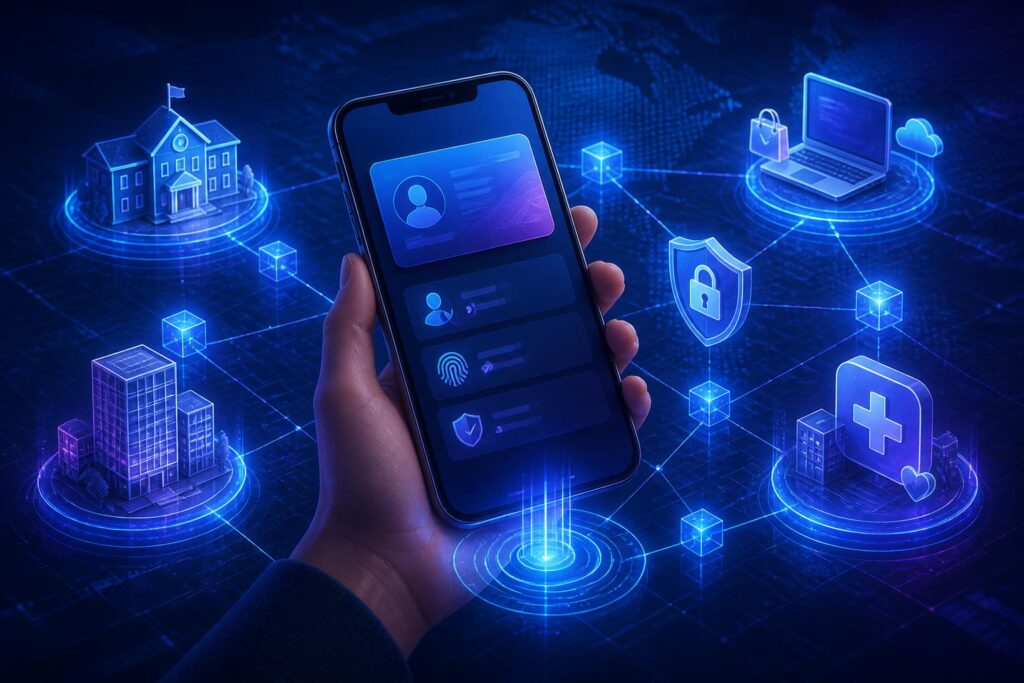
Across many online services, users are often required to provide the same types of information to multiple organizations. One platform may request a photo of an identity document, another may need a residential address, while a different service may want age or professional qualification verification. Each registration means that personal data is copied, stored, and potentially exposed to a security incident. The decentralized digital identity model, often discussed alongside blockchain, seeks to change this by giving users control over their own credentials.
This idea does not mean that all personal data will be made public on a blockchain. On the contrary, a sound design must limit the appearance of sensitive data on a public ledger. Blockchain can serve as a verification layer, helping parties confirm that information was issued by the correct organization and has not been altered. Detailed data can be kept in an identity wallet or an appropriate storage system, under the user’s control and in compliance with relevant legal requirements.
What Is Decentralized Digital Identity?
Decentralized digital identity is an approach in which an individual, organization, or device can own and use identifying information without being entirely dependent on a single central account. Users typically interact with an identity wallet to store credentials, rather than creating separate accounts and submitting their records again to every service.
In this model, three main roles can be distinguished. The subject is the person or organization that owns the identity. The issuer is an agency, business, school, or authorized organization that issues a credential. The verifier is the service that needs to confirm information before granting access. For example, a school may issue a digital graduation certificate; the user stores that certificate in a wallet; and an employer verifies its validity without necessarily having to contact the school again each time verification is required.
This concept is often associated with decentralized identifiers and verifiable credentials. A decentralized identifier is an identifying code controlled by the subject, while a verifiable credential is a claim signed cryptographically by the issuer. The verifier can confirm the source, integrity, and scope of use of the information without having to view all unrelated data.
What Role Does Blockchain Play in the System?
Blockchain does not necessarily serve as a place to store complete personal records. Its more suitable role is to provide a reference layer that is difficult to alter arbitrarily. The network can record an issuer’s public key, information about the status of a credential, or a cryptographic trace representing a document. When verification is needed, an application can compare the signature and reference data to detect forgery.
For example, a professional certificate can be digitally signed by a training organization. The user receives the certificate in their identity wallet and presents it when applying for a job. The employer checks the issuing organization’s signature, the validity period, and the revocation status. If the system only needs to know whether the applicant has a valid certificate, the user can share minimal proof instead of submitting their entire academic record.
Putting data directly on a blockchain often creates risks that must be considered. Data on many blockchains is designed to persist for a long time, while personal information may need to be corrected, deleted, or access-restricted. Once sensitive data has been made public, removing it completely from every copy is very difficult. Therefore, secure designs generally prioritize off-chain storage, data encryption, and recording on the blockchain only the information necessary for verification.
How Can Users Gain Better Control Over Their Data?
The most notable benefit of this model is its ability to reduce excessive sharing. In many situations, a service only needs to know a specific attribute, not the user’s entire identity. A platform may need to confirm that a user is old enough, but it does not necessarily need to know their exact date of birth. A delivery company may need a delivery address at a particular time, but it should not automatically have access to the customer’s identity history.
Minimal disclosure or zero-knowledge techniques can support this goal. In principle, users prove that a statement is true without publicly revealing all the underlying data. For example, a proof could show that an account meets an age requirement without displaying the day, month, and year of birth. Practical implementation still depends on protocol design, the service’s ability to integrate the technology, and the verification requirements of each field.
Control is also reflected in the user’s ability to choose when and to what extent information is shared. A good identity wallet should not merely be a place to store information; it should also tell users which application is requesting data, what that data will be used for, and how long access will last. If the interface is too complex, users may still click to approve requests out of habit, preventing the goal of protecting privacy from being achieved.
Limitations That Blockchain Alone Cannot Solve
Blockchain does not automatically turn incorrect data into correct data. If an organization issues inaccurate information, a signature on the blockchain only proves that the information came from the corresponding organization; it does not guarantee that the original content is correct in every circumstance. The quality of digital identity therefore still depends on verification procedures, the issuer’s responsibility, and mechanisms for handling disputes.
Recovery is also particularly important. In traditional account systems, users can request a password reset. With an identity wallet controlled by a private key, losing the key may prevent users from accessing their data or credentials. A practical system needs to consider options such as social recovery, guardians, backup devices, or key-rotation mechanisms. Each option involves trade-offs among convenience, privacy, and the risk of misuse.
Interoperability is another challenge. If each application uses its own credential format, connection standards, and verification method, users will have to maintain multiple wallets or convert data manually. An identity ecosystem only has meaning when parties can understand and verify information according to compatible rules while still protecting the subject’s privacy.
In addition, digital identity is directly connected to the law. The right to know what data is being processed, record-retention obligations, customer-verification requirements, and liability when errors occur may differ across industries and jurisdictions. A technical solution cannot replace regulations issued by authorities or a company’s data-protection obligations. Implementation must clearly establish who is responsible, where users can file complaints, and within what limits data is processed.
Potential Applications in Everyday Life
Decentralized digital identity can be tested in situations that require repeated verification but do not call for the collection of excessive data. Education is one example: certificates, transcripts, or course-completion confirmations can be issued digitally and checked when a learner moves on to another institution. In recruitment, applicants can proactively share verified professional information instead of submitting multiple scans of documents.
In finance and e-commerce, users could use credentials appropriate to customer-identification procedures while sharing only the data necessary for each service. In healthcare, this approach could support the sharing of access to records between patients and healthcare providers. However, health data is highly sensitive, so every design must place privacy, consent, and the ability to revoke access at the forefront.
For devices and software, digital identity can also help confirm the origin of a device, update rights, or the credentials of an automated service. This is a different application from verifying people, but it relies on the same principles of checking keys, signatures, and permissions. In every case, blockchain is only one component of a larger system that includes wallets, interfaces, servers, encryption mechanisms, and governance processes.
Conditions for the Technology to Gain Acceptance
For decentralized digital identity to become useful, the user experience must be closer to familiar services than to a system that requires users to deeply understand cryptographic keys. Receiving, sharing, and revoking information must be clear. Users must know what permission they are granting, to whom, and for how long. Security warnings should also be written in plain language rather than displaying only strings of technical characters.
Businesses and service providers must avoid turning identity wallets into a new means of tracking. If every verification activity leaves a trace that can be linked to other activities, privacy may still be weakened even if the original data is not made public. Good design should limit unnecessary linkability, separate different purposes of use, and allow audits of how data is processed.
Finally, the technology should be evaluated based on real-world outcomes rather than simply on whether blockchain is used. A reliable solution must demonstrate that it reduces verification costs, limits the sharing of unnecessary data, helps users recover access, and provides mechanisms for handling errors. If blockchain makes a system more complex without delivering proportional benefits, using it may not be the appropriate choice.
Decentralized digital identity offers a different perspective on the ownership and use of personal information. Instead of allowing each service to build its own separate profile, users can carry their credentials with them and share them according to particular needs. Blockchain can support the verification of the origin and integrity of that information, but it is not the only solution to privacy, legal responsibility, or convenience. The future of this model will depend on how organizations combine technical standards, user-centered design, and data-protection mechanisms in practice.
