


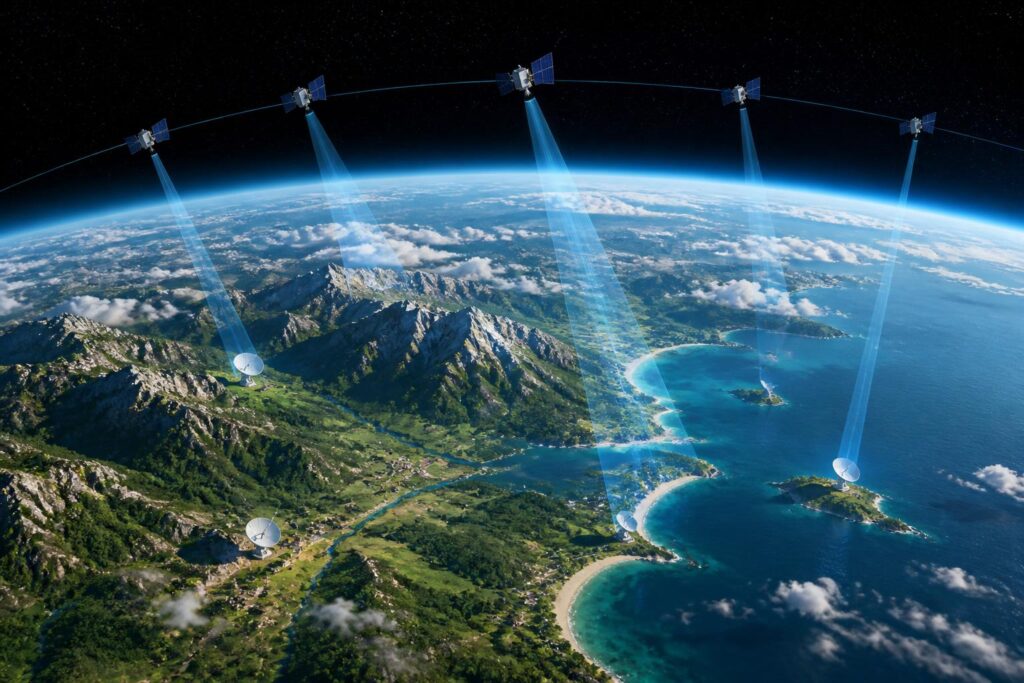
For many years, access to the Internet has depended largely on terrestrial infrastructure such as fiber-optic cables, mobile base stations, and regional transmission routes. This model works effectively in urban areas and places with high population density, but it is more difficult to deploy in mountainous regions, on islands, in deserts, or in areas frequently affected by natural disasters. Low-Earth orbit satellite networks, commonly known as LEO, are increasingly being considered a notable supplementary approach to this connectivity challenge.
Unlike traditional satellite systems positioned in high orbits, low-Earth orbit satellites fly closer to Earth. The shorter distance allows signals to travel back and forth more quickly, thereby reducing latency in many use cases. However, a LEO network is not simply a matter of sending satellites into space. To create a valuable service, providers must also coordinate a large number of satellites, ground stations, user terminals, orchestration software, and data management processes.
Why does low-Earth orbit make a difference?
Geostationary satellites have the advantage of appearing almost stationary relative to a point of observation on the ground, which makes antenna alignment relatively convenient. In return, they are located extremely far away. Signals must travel a long distance between the ground and the satellite, resulting in higher latency, especially in services that require rapid responses.
Low-Earth orbit satellites operate at a much lower altitude than geostationary satellites. When a user sends data, the signal can reach a nearby satellite and then be relayed to a ground station or another satellite within the same system. Lower latency can better support online meetings, access to cloud services, remote device control, and real-time interactive applications.
Nevertheless, LEO satellites are constantly moving across the sky. A single satellite covers an area only for a certain period before leaving the field of view. Therefore, a stable service requires a sufficiently large constellation and a mechanism for switching connections between satellites almost imperceptibly to users. This is what gives LEO networks both great potential and complex technical requirements.
Where this technology can create value
The most obvious application of low-Earth orbit satellite networks is providing Internet access to areas that lack suitable broadband infrastructure. Running cables to a household in difficult terrain can take considerable time and cost. In such cases, a terminal connected to a satellite can shorten the deployment process. This does not mean satellites will completely replace fiber-optic or mobile networks; rather, they provide an additional option where terrestrial solutions have not yet met requirements.
In maritime activities, aviation, and long-distance transportation, satellite connectivity can help maintain communications when vehicles travel beyond the coverage of terrestrial networks. For research, extraction, or monitoring activities in remote areas, this connection supports sending data to central facilities, tracking equipment, and coordinating personnel. The ability to maintain continuous connectivity is also useful in rescue operations when communications infrastructure in the affected area has been damaged.
Natural disasters make the role of infrastructure that does not depend entirely on the ground more apparent. Storms and floods, earthquakes, or landslides can disrupt the power grid, transmission cables, and base stations. If backup power and suitable terminals are available, satellite networks can create a temporary communications channel for coordinating rescue efforts, providing situation updates, and connecting teams at the scene. However, actual effectiveness still depends on weather conditions, operational capacity, and whether the equipment was prepared in advance.
It is not only about satellites
A common misunderstanding is to view satellites as the entire space-based Internet system. In reality, the user experience also depends on antennas, routers, power supplies, ground stations, and the network systems behind them. User terminals need to track satellite positions, adjust the connection direction, and switch between satellites as they move. These operations must occur quickly and reliably to minimize connection loss.
Orchestration software plays a role no less important than hardware. The network must allocate resources by area, handle situations in which many users access it simultaneously, detect faults, and select suitable transmission routes. As the satellite constellation grows, the amount of data on equipment status and link quality also increases. This requires monitoring, automation, and maintenance systems capable of operating continuously.
In some designs, satellites can exchange data with one another instead of always transmitting directly to the nearest ground station. Inter-satellite links can shorten routes in certain cases and expand service capabilities over oceans or remote areas. However, maintaining these links imposes high demands on synchronization, routing, processing capacity, and energy management on the satellites.
Limitations that must be viewed realistically
LEO networks are not a cost-free solution to the digital divide. Users still need a terminal, a stable power supply, and an installation area with a relatively unobstructed view of the sky. In places with many obstacles, harsh weather, or unreliable electricity, service quality may be affected. Equipment and subscription costs are also decisive factors in determining access for households, schools, small businesses, and local agencies.
Service availability also depends on user density and the capacity of the satellite constellation. An area with too many devices accessing the network at the same time can place pressure on radio resources. Therefore, coverage on a map does not mean that everyone in that area will receive the same connection quality. Providers must balance expanding coverage, increasing capacity, and maintaining stability.
Frequency management and rights to use orbital slots are also important issues. Multiple systems operating in space can increase the risk of signal interference if they are not properly coordinated. In addition, countries need to establish regulations concerning licensing, data protection, responsibility when incidents occur, and the right to provide services across borders. Technology is developing rapidly, but regulatory frameworks need to keep pace without creating unnecessary barriers to innovation.
The challenge of space debris and sustainability
The increasing number of satellites has brought greater attention to the issue of space debris. A satellite that has completed its mission, lost control, or collided with another object can become a hazard to operating spacecraft. Collisions at high speeds can create many fragments, further complicating the orbital environment and increasing the risk of subsequent collisions.
Therefore, designing a modern satellite constellation is not solely about data transmission capabilities. Operators need to account for orbit tracking, collision avoidance, satellite disposal at the end of its operational life, and minimizing the risk of creating additional debris. These requirements call for coordination among businesses, regulatory authorities, and international organizations. The benefits of connectivity should not be gained at the cost of diminishing the long-term usability of space.
The position of satellite networks in digital infrastructure
Rather than asking whether satellite networks will replace fiber optics, a more appropriate view is to regard them as complementary infrastructure layers. Fiber optics still have major advantages in capacity and stability on fixed routes. Mobile networks are suitable for personal devices and areas with concentrated populations. Satellites provide value where rapid deployment is needed, terrestrial infrastructure is difficult to build, or a backup channel is required.
A flexible connectivity system in the future may combine multiple transmission methods. Devices or enterprise networks could switch between cable, mobile, and satellite connections depending on location, cost, priority level, and the status of disruptions. This approach reduces dependence on a single infrastructure system while increasing the ability to keep critical services operating.
For LEO networks to have a broader impact, deployment policies also need to focus on accessibility, not just the number of satellites. Connectivity programs for schools, healthcare facilities, shelters, and remote communities can deliver clear benefits if accompanied by training, maintenance, and technical support. Connectivity is most meaningful when it helps users access education, healthcare, public services, and economic opportunities, rather than merely providing another connection.
Low-Earth orbit satellite networks are expanding the way people envision Internet infrastructure. This technology can narrow geographical distances, support emergency response, and create additional options for vehicles operating outside terrestrial coverage. But to develop sustainably, it must be evaluated simultaneously in terms of performance, cost, orbital safety, data protection, and social impact. When assigned the right role within a multilayered connectivity ecosystem, low-Earth orbit satellites can become an important complement to digital infrastructure rather than a promise to replace every existing technology.
