


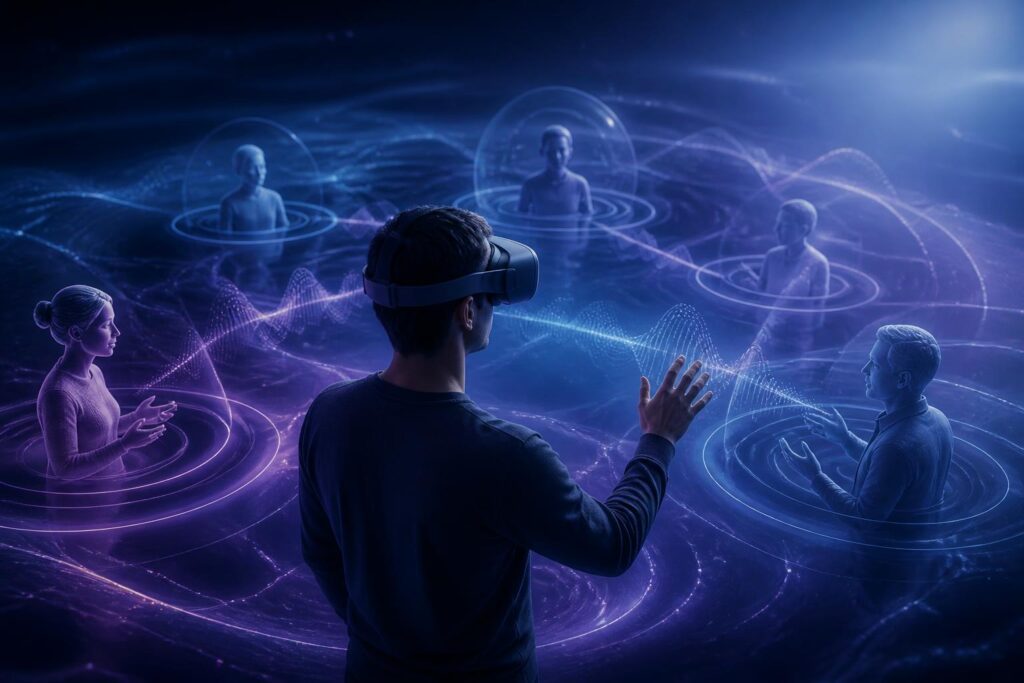
When virtual worlds are mentioned, most attention tends to focus on visuals. Users picture display headsets, avatars capable of moving, three-dimensional objects, and spaces rendered with computer graphics. However, the feeling of truly being present somewhere does not come only from what the eyes see. Footsteps echoing from behind, a voice changing with distance, or a door opening in the next room can make a digital space far more convincing than a beautiful scene that is completely silent.
Sound in virtual worlds is therefore no longer a decorative layer added at the end. It is part of the architecture, communication, and experience. When carefully designed, sound helps users navigate, recognize the presence of others, and sense the scale of an environment. When ignored, it can make an elaborately constructed world feel flat, confusing, or exhausting. This issue deserves attention not only from a technical perspective, but also from the perspective of experience design and how people interact in digital spaces.
Why Does Sound Create a Sense of Presence?
In everyday life, people do not perceive their surroundings through a single sense. When entering a room, we simultaneously see its arrangement, hear echoes, recognize voices, and sense the distance between ourselves and objects. Sound provides information that images sometimes cannot fully convey, such as whether a space is large or small, empty or crowded, quiet or filled with activity taking place nearby.
In virtual worlds, these signals can be simulated through spatial audio. A sound source processed to change according to the listener’s position creates a sense of direction and distance. When users turn their heads, the sound can shift accordingly. When they move away from a character, the voice can gradually become quieter; when they stand behind a wall, the sound can be reduced or altered. These small changes help the brain connect sound with images and movement, thereby creating a perception that the space has depth.
What matters is that sound does not need to be completely identical to real life to be effective. A good design can simplify many elements as long as it preserves a reasonable relationship between the sound source, position, and action. Users do not necessarily analyze every layer of sound, but they will notice when a voice comes from the wrong direction, footsteps do not match the movement, or a space that should be quiet is filled with unrelated sounds.
Sound as a Navigation Tool
In a three-dimensional environment, users can easily become disoriented if they rely only on visuals. Identical corridors, expansive areas, or obstructed views all increase the burden of remembering one’s location. Sound can function as a soft guidance system, helping users understand that activity is taking place ahead, that an open area lies to the left, or that someone is calling from behind.
This form of navigation does not necessarily require turning every sound into a direct notification. An area with its own ambient sound, a stream flowing from a fixed direction, or machinery that changes with distance can also create a sensory map. Users gradually associate sound characteristics with particular spaces without having to read directions continuously. This is the difference between an environment that merely provides information and one that allows users to explore on their own.
However, navigational sounds must be clearly prioritized. If every object produces sound at a similar level, users will have difficulty knowing which signals matter. The sound of an event requiring attention should differ from background noise. The voice of someone interacting directly should take priority over decorative sounds. A good environment is not the one with the most sounds, but the one in which every sound has a clear role and position.
Voices, Distance, and Natural Communication
Voice communication in virtual worlds is often viewed as another version of an online call. But when sound is tied to an avatar’s position, a conversation can take on many characteristics of an in-person encounter. Two people standing close together can talk without opening a separate channel. A group farther away can still be heard faintly. Users can also recognize who is speaking without having to constantly look at displayed names.
Audio distance also creates natural social norms. Users can move closer to hear more clearly, step away to end a conversation, or find a quiet corner before speaking. These behaviors make a virtual space feel more like a place than an interface containing conversation windows. However, this mechanism is useful only when users understand how it works. If they do not know who can hear them, how far their voice travels, or why the volume changes, they may feel uneasy.
Sound design therefore needs to go hand in hand with transparency. Users should have ways to identify the microphone status, the range over which their voice is transmitted, and who is within hearing range. Options such as adjusting each person’s volume, temporarily muting, or switching to nonverbal communication are not merely convenience features. They help users control the extent of their presence and prevent sound from becoming a source of pressure.
Silence Is Also a Design Element
A common mistake is trying to ensure that every area in a virtual world always contains sound. Continuous background music, dense environmental noise, and repeated effects may initially make a space seem lively, but over time they can become exhausting. People need periods of silence to distinguish signals, rest, and sense changes in their surroundings.
Silence does not mean the complete absence of any sound. It may consist of a very soft background, a sparse rhythm of sounds, or the deliberate absence of signals that appear elsewhere. When moving from a crowded area into a quiet space, users recognize the transition not only with their eyes but also with their ears. This contrast makes both areas more distinct.
Sound can also create a rhythm for the experience. A learning space, exhibition, or meditation area needs a different organization of sound from a place where a game or live event takes place. Not every experience needs constant stimulation. Sometimes, allowing users to hear environmental sounds gradually thin out is also a way of inviting them to slow down and observe more carefully.
Challenges Related to Health, Privacy, and Control
Sound creates a sense of presence but can also become a source of discomfort. Excessive volume, repetitive sounds, harsh frequencies, or sudden changes can make an experience stressful. Designers cannot assume that everyone hears the virtual world in the same way. Hearing ability, the devices being used, the surrounding environment, and each person’s sensitivity to sound vary greatly.
For this reason, adjustment options should not be treated as an afterthought. Users need to be able to control overall volume, voice volume, environmental sounds, and background music independently. Important signals should also have visual or haptic alternatives, so that people who cannot hear clearly can still receive necessary information. A well-designed virtual world does not force users to rely on a single way of perceiving it.
Privacy is another issue. A voice conveys not only the content of a statement but also clues about the speaker’s emotions, age, or condition. When a conversation takes place in a space with many people, users need to understand who is listening and within what range the sound is being transmitted. Designing clear hearing boundaries, status indicators, and mute controls helps reduce the ambiguity that can easily arise in digital environments.
From Attention-Grabbing Effects to the Language of Space
In the early stages of a virtual-world project, sound is often used to create an immediate impression. A loud explosion, a transition effect, or urgent background music can capture users’ attention right away. But sound’s long-term value lies in its ability to build a consistent language for the entire space.
That language can be expressed through the distinct timbres of different areas, the way actions receive corresponding sound feedback, or the way voices change according to the environment. When these rules are maintained, users can learn to read the space with their ears. They do not merely hear an isolated effect; they also understand what that effect says about where they are standing and what is happening around them.
To achieve this, development teams need to incorporate sound into the design process from the beginning. They should test it under various conditions, with different types of devices, and over different periods of use. A sound that is impressive for a few minutes may become irritating if repeated for hours. A voice-transmission system that is clear in a quiet place may work poorly when users are in an environment with a great deal of background noise. Experience evaluation therefore needs to pay attention to details that are often overlooked in a short demonstration.
Virtual worlds are often described as places where images, data, and interaction meet. But for a digital space to have depth, sound needs to be regarded as part of its structure rather than a decorative overlay. It helps users navigate, recognize others, sense distance, and understand changes in the environment. At the same time, it requires restraint, transparency, and control so that the sense of presence does not turn into overload.
The future of virtual worlds may not be determined solely by screen resolution or the level of detail in avatars. A memorable space also depends on how it makes users hear where they are, who is present, and when they need quiet. When deliberately designed, sound transforms a digital landscape into a place with its own rhythm, distances, and emotions.
