


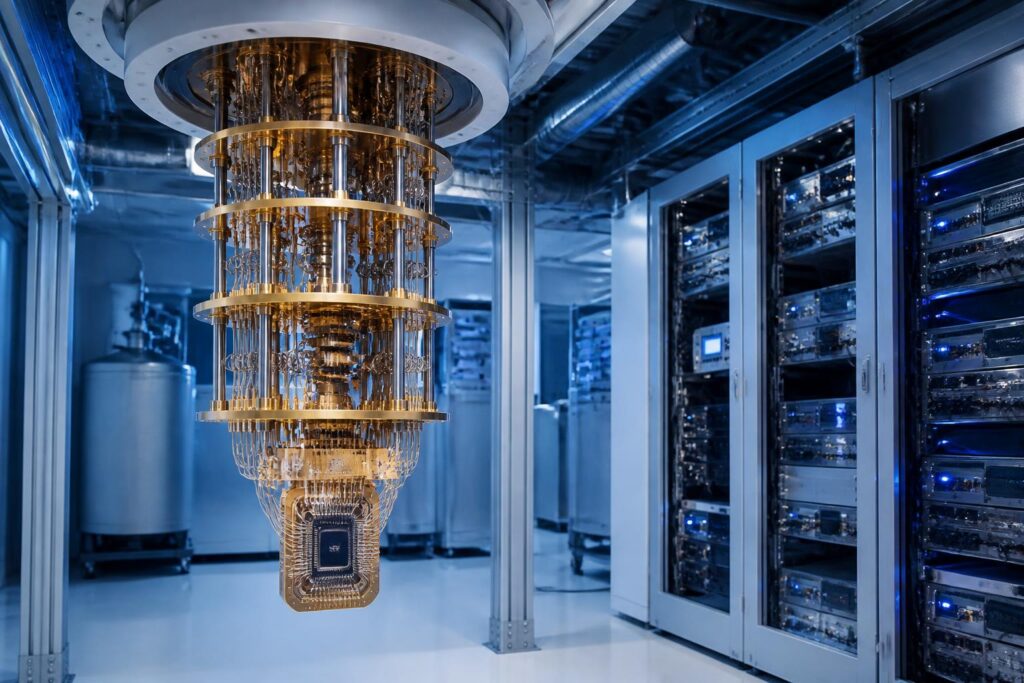
When quantum computers are mentioned, people often focus on the number of qubits or claims about processing speed. However, a quantum system cannot operate with just a single chip placed inside an ordinary server. Behind the qubits lies a complex infrastructure consisting of cooling equipment, signal lines, control systems, measurement software, and multiple layers of protection against noise. If even one link is missing, the theoretical capabilities of the qubits will be difficult to turn into reliable computational results.
This creates a more realistic way of looking at the quantum computing race. Success is measured not only by creating a new qubit, but also by the ability to maintain its state, deliver commands at the right time, read results with appropriate accuracy, and scale the entire system without allowing operating costs to grow beyond control. At the current stage, infrastructure challenges may be just as decisive as the qubit fabrication technology itself.
Why Do Qubits Need a Special Environment?
Qubits can be created using many different physical platforms, such as superconducting circuits, trapped ions, neutral atoms, or light-based systems. Each platform has its own requirements, but they all share the fact that quantum states are highly sensitive to the external environment. Heat, vibration, electromagnetic radiation, and unwanted interactions can all alter the state that the machine is trying to control.
For systems using superconducting circuits, operating temperatures generally need to be lowered to extremely low levels to maintain the necessary properties of the materials. Dilution refrigerators are used to create multiple temperature stages, with the area containing the chip being the coldest. This equipment is not like a household refrigerator shrunk down in size. It has a multilayer structure and requires insulation, pumping systems, and strict installation procedures. Every cable entering the cold region can carry heat, so the number and arrangement of connections must be carefully calculated.
Low temperature is not the only requirement. Trapped-ion platforms need a high-vacuum environment so that the ions do not collide with gas molecules. Platforms using neutral atoms require stable laser and optical systems. Photonic approaches, meanwhile, depend on light sources, beam splitters, detectors, and the ability to align transmission paths. In other words, choosing a type of qubit also means choosing an accompanying technical ecosystem.
Control Signals Must Pass Through Multiple Layers
Qubits do not perform calculations in the same way that a conventional processor executes instructions in transistors. Quantum computers require control pulses designed in terms of frequency, amplitude, duration, and sequence. These pulses act on the qubits to create the necessary transformations, after which the measurement system collects the output state.
In quantum computers using superconducting circuits, the control section is usually located outside the cold region. Signals must pass through multiple sections of cable and filters before reaching the chip. Each section can attenuate the signal, create reflections, or introduce additional noise into the system. Therefore, the control architecture must balance two seemingly opposing requirements: transmitting enough signal to act precisely on the qubits while not introducing too much heat and noise into the operating environment.
In the opposite direction, qubit measurement signals are usually very weak. They need to be amplified in stages before being sent to electronic equipment at higher temperatures. These amplifiers must have low noise and operate stably for long periods. Even a small change in the characteristics of the measurement path can cause the software to misinterpret the results. Therefore, calibration is not a task performed once and then ignored, but a permanent part of the operating process.
Quantum Control Is a Hardware and Software Problem
An effective quantum control system needs to combine high-speed electronic equipment with software capable of fast scheduling and feedback. The software must convert a description of a quantum circuit into a sequence of pulses suitable for the type of hardware being used. It must also track the limitations of each qubit, such as its resonance frequency, coherence time, and degree of interaction with neighboring qubits.
These parameters are not completely fixed. They can change over time because of temperature, vibration, or device drift. Therefore, quantum computers need automated procedures to check, calibrate, and update parameters. A platform that provides only a programming interface without sufficiently capable diagnostic tools will have difficulty supporting large experiments, because operators will have to spend too much time searching for the causes of deviations.
Another important difference lies in the feedback loop. In many processes, the system does not simply send commands and wait for the final result. It may need to read an intermediate state and decide on the next step based on the measurement result. This requires the control equipment, software, and measurement system to work together with low latency. As the number of qubits increases, scaling this feedback loop becomes an architectural challenge rather than simply a matter of buying more servers.
Scalability Does Not Mean Increasing the Number of Qubits
A chip with more qubits does not necessarily create a more useful quantum computer. The system must also provide enough control lines, measurement channels, and data-processing capacity. If each qubit requires multiple wires or dedicated equipment, the size of the external system may grow faster than the number of qubits on the chip. This creates a need to integrate more functions into equipment located near the cold region or to develop new control methods that reduce the number of connections.
Scalability is also related to uniformity. In a small system, engineers can inspect each qubit and adjust it manually. As the number increases, that process becomes too time-consuming. Qubits need to have relatively stable characteristics so that calibration procedures can be automated. Supporting components such as amplifiers, filters, pulse generators, and detectors must also be manufactured with consistent quality.
This is why the quantum computing industry needs more than just physicists. Electrical engineers, telecommunications specialists, refrigeration engineers, software developers, control experts, and equipment technicians all play important roles. A quantum system can fail because of a mechanical, thermal, or software problem even when the physical design of the qubits is correct.
Practical Operation Requires Procedures Different from Those for Traditional Servers
Traditional servers are generally designed to power on, accept workloads, and operate continuously for long periods with relatively standardized monitoring procedures. Current quantum computers often require more preparation steps. The system must reach suitable temperature or vacuum conditions, verify the stability of the equipment, run calibration procedures, and assess measurement quality before carrying out the main experiments.
Preparation and maintenance time therefore become factors in computational capacity. If a system has many qubits but frequently has to stop for manual calibration, its practical utilization may be low. Operators need to track parameter histories, identify signs of degradation, and distinguish hardware errors from errors in the control circuit. The ability to keep detailed logs is also important, because quantum results are often probabilistic and cannot be evaluated from a single run.
The deployment environment is another issue worth noting. A quantum computer may be placed in a laboratory, a data center, or a specialized facility, but each location has different conditions for power, cooling, vibration isolation, and safety. When equipment is provided through a cloud computing platform, users cannot directly see the infrastructure behind it. Nevertheless, providers still have to manage access schedules, allocate run time, isolate workloads, and protect control data.
What Does This Mean for Businesses?
For businesses, accessing quantum computing does not necessarily begin with purchasing a dedicated system. The costs and operating requirements make many organizations better suited to experimenting through cloud services or partnerships with laboratories. In the early stages, the value lies in determining which problems can be modeled with quantum circuits, what data needs to be prepared, and which criteria should be used for comparison with classical methods.
Businesses should also avoid evaluating platforms based solely on a single qubit-count figure. More practical questions include wait times, device stability, access to parameters, programming tools, documentation quality, and suitability for the problem at hand. A platform with fewer qubits but that is easier to experiment with, has a clear monitoring system, and offers good support may be more useful than a larger platform that is difficult to access.
In the long term, quantum infrastructure may develop toward a combination of quantum processors and classical computers. Classical computers will handle coordination, data preprocessing, parameter optimization, and result analysis, while quantum hardware will perform the appropriate portions of the computation. This model brings the boundary between quantum laboratories and data centers closer together, while also creating new requirements for connectivity, security, and resource management.
Conclusion
A quantum computer is not merely a chip with many qubits. It is a multilayered system in which the physical environment, control equipment, software, calibration procedures, and operational capabilities must work closely together. Limitations involving cooling, signals, measurement, and connection scaling can determine whether a promising design becomes a practical computing tool.
From this perspective, progress in quantum computing should not be understood simply as a race to increase the number of qubits. A significant advance could also be more efficient cooling equipment, lower-noise control systems, more automated calibration procedures, or software that enables more stable use of the hardware. As the infrastructure layers mature together, quantum computers will have a greater chance of moving beyond demonstrations and becoming components that can be integrated into larger computing systems.
