


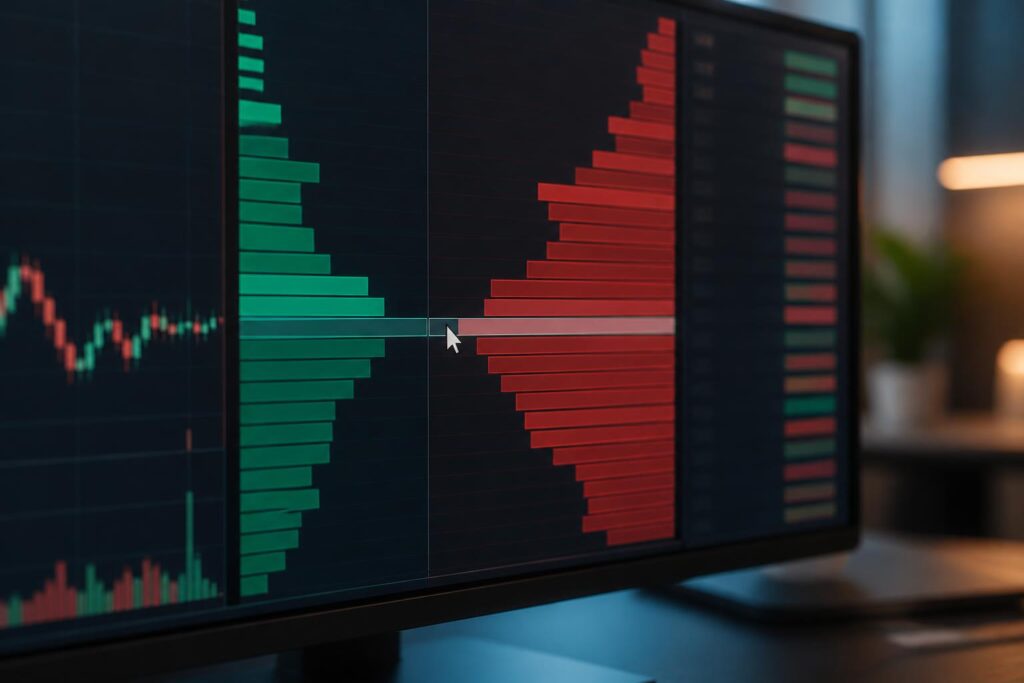
Many newcomers to the cryptocurrency market tend to focus on just one prominent number on the screen: the current price. However, that price is not always the level at which a large buy or sell order can be executed in full. Behind the trading interface is a mechanism that continuously matches pending buy and sell orders. This mechanism is commonly represented by the order book, where users can observe part of the liquidity status of a trading pair at a given moment.
Reading the order book cannot reliably predict whether the price will rise or fall. Nor does it turn a risky trade into a safe one. Prices in the order book can change very quickly, orders can be canceled, and unexpected movements can still occur. Nevertheless, understanding how the order book operates helps users distinguish between the reference price and the actual execution price, choose an appropriate order type, and limit the risk of buying too expensively or selling too cheaply due to insufficient information.
What Is an Order Book?
An order book is a list of buy and sell orders waiting to be matched on a specific market. Each trading pair has its own order book, such as a pair involving a cryptocurrency asset and a quote currency. Orders in the book are generally arranged by price and quantity.
On the buy side, traders submit the highest price they are willing to pay. A buy order with a higher price is generally given priority over one with a lower price, assuming other conditions are equal. On the sell side, traders submit the lowest price they are willing to accept. A sell order with a lower price is generally prioritized over a sell order at a higher price.
The two most important levels are the highest bid and the lowest ask. The highest bid is commonly called the best bid, while the lowest ask is the best ask. The gap between these two levels is called the bid-ask spread, or spread. When the spread is wide, users may have to pay significantly more if they buy immediately, or receive significantly less if they sell immediately.
How Are Orders Matched?
A trade is executed when a buy order accepts the price of a sell order, or a sell order accepts the price of a buy order. The system then matches the two sides according to the exchange’s rules. The price displayed on a chart usually reflects a recent completed trade, rather than necessarily being the price the user’s next order will receive.
Imagine an order book with multiple sell levels arranged from low to high. A small buy order may be filled entirely at the lowest ask. But if the buy order is larger than the quantity waiting at that level, the remaining portion will continue to be matched at higher sell levels. As a result, the entire order is executed at several different prices. The trade’s average price may therefore be higher than the first price the user sees.
The same thing happens with a large sell order. If the buy volume at the highest price is insufficient, the remaining portion may be matched at lower prices. This is one of the reasons the final execution price may differ from the initial expectation.
Market Orders and Limit Orders
Market Orders
A market order is intended to be executed immediately against the prices currently available in the order book. The advantage of this order type is speed. Users do not have to wait for the market to return to a predetermined price. In markets with abundant liquidity and moderate trading volume, the difference between the expected price and the actual price may be small.
However, a market order does not guarantee a fixed price. If the order book is thin, the order size is large, or the market is highly volatile, the order may sweep through multiple price levels. Users need to distinguish between two concepts that are often conflated: an order being executed quickly does not mean it is executed at a good price.
Limit Orders
A limit order allows users to set a maximum price when buying or a minimum price when selling. The order is executed only at the specified price or a more favorable price, depending on the platform’s mechanism. This is a useful tool when users value price control more than speed.
The trade-off is that a limit order may not be filled. If the market does not reach the specified price, or if there is insufficient matching volume, the order will remain in the book or be canceled according to the conditions selected by the user. A limit order helps prevent buying above the expected price, but it does not guarantee that the trade will take place.
Users should also carefully check how the order is placed. Some interfaces may offer options to fill the entire order only, allow partial fills, automatically cancel the remaining portion, or keep the order open until the user cancels it. The names and operation of these options may differ between platforms, so users should not rely solely on habits formed on one exchange when trading elsewhere.
Why Does Slippage Occur?
Slippage is the difference between the price a user expects and the actual execution price. It can occur when liquidity is low, order size is large, the market is moving quickly, or many trades are taking place at the same time. Slippage is not necessarily a sign that the system is malfunctioning. In many cases, it is the direct result of an order having to use multiple price levels in the book.
Suppose someone wants to buy a large quantity of an asset, but only a small portion of the volume is available at the lowest ask. The remainder will move successively to higher sell levels. The average price rises as the order moves deeper into the book. If the user only observes the first price on the screen without examining the order book’s depth, they may underestimate the actual cost of the trade.
Slippage can also occur in an unfavorable direction when a user sells. During a sharp decline, buy orders at higher levels may be filled or withdrawn quickly. A market sell order submitted afterward will encounter lower buy levels. The more volatile the market, the more important the time between placing and executing an order becomes.
How to Read an Order Book More Carefully
First, identify the units used for price and quantity. Some interfaces display quantity as the number of assets, while others may display it as converted value. Without checking the units, users can easily misjudge how thick or thin the order book really is.
Next, observe multiple price levels instead of looking only at the highest bid and lowest ask. Levels near the current price show immediate liquidity, while deeper levels indicate the volume that may be available if the order is large. Even so, this is only a snapshot at a particular moment. A large order wall may be canceled before the price reaches it, so it should not be treated as a firm commitment by the market.
The spread also deserves attention. A narrow spread generally makes entering and exiting a position more favorable in terms of price, but it does not automatically eliminate other risks. A market with a narrow spread can still be highly volatile or lack liquidity at deeper levels. Conversely, a wide spread is a signal for users to consider reducing their order size, using a limit order, or waiting for more suitable conditions.
Finally, users should review the trade estimate before confirming. If the platform displays the expected average price, the quantity that may be filled, and the level of slippage, this information helps users form a clearer picture of the outcome. They should not look only at the nominal total value while overlooking the amount of the asset actually received or the amount of money actually obtained after the trade and related fees.
An Order Book Is Not a Certain Forecasting Tool
A common mistake is to interpret every large volume in the order book as a definite signal that the price will reverse. In reality, pending orders can be added, modified, or canceled. An area with many sell orders may create the impression of resistance, but if those orders disappear, their impact on the price also changes. Similarly, many buy orders below do not guarantee that sellers will not push the price lower.
The order book also reflects activity only on the market the user is observing. Liquidity on one platform does not fully represent the entire market. Prices, spreads, and depth may differ between exchanges or between trading pairs. Comparisons need to take into account the timing, asset type, deposit and withdrawal conditions, and the specific risks of each platform.
Therefore, the order book should be viewed as a tool for understanding execution possibilities and trading costs, not as a prophecy. Buying and selling decisions should still be based on one’s objectives, risk tolerance, holding period, and ability to accept the price moving against expectations.
Practical Principles When Placing Orders
For trades of significant size, users may consider splitting an order into smaller portions rather than placing the entire amount in the market at once. This does not guarantee a better price, but it can reduce the risk of a single order sweeping through too many price levels. Users should also start with a small quantity to check how the platform displays the price, execution status, and order cancellation conditions.
When price control is the priority, a limit order is often more suitable than a market order, provided the user accepts the possibility of not being filled. When fast execution is necessary, a market order may be more convenient, but users should review the order book depth and trade size beforehand. In both cases, confirming the correct trading pair, the correct buy or sell direction, and the correct quantity units is an essential step that cannot be skipped.
In addition, users should not place an order solely because they see a short-term movement on the screen. The cryptocurrency market can change quickly, causing users to shift from a planned decision to an emotional reaction. Determining in advance the acceptable price, maximum quantity, and conditions for stopping trading can help limit rushed decisions.
Conclusion
An order book is a real-time map of pending buy and sell orders in a cryptocurrency market. It helps users understand the highest bid, lowest ask, spread, liquidity depth, and the possibility that an order will be filled at multiple price levels. By combining order-book analysis with the appropriate choice between market and limit orders, users can reduce surprises during the trading process.
Even so, the order book does not reflect every risk and does not guarantee an accurate prediction of price direction. Orders can change, liquidity can disappear, and the market can move before a trade is completed. Understanding the tool’s limitations is no less important than knowing how to use it. The reasonable goal is not to find a certain signal, but to make more transparent decisions about price, quantity, and the level of risk that can be accepted.
