


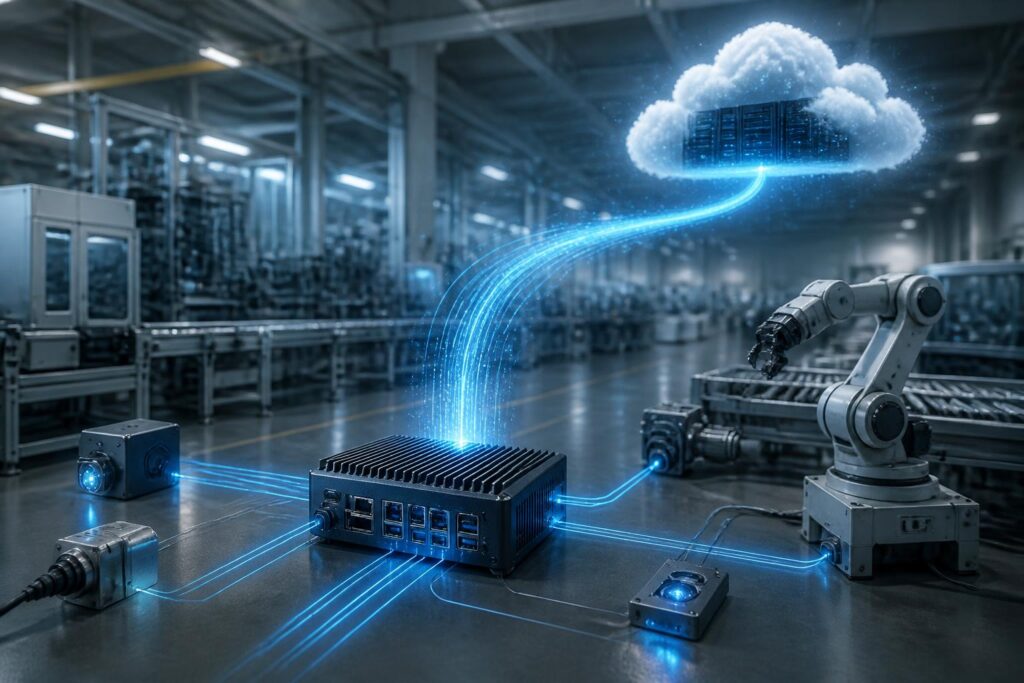
For many years, the familiar image of cloud computing has been data sent from users’ devices to centralized data centers for storage and processing. This model offers significant scalability, enabling businesses to access computing resources without having to build the entire infrastructure themselves. However, as the number of connected devices has grown and applications have come to require near-instant responses, sending all data to a remote location has begun to reveal certain limitations.
Edge computing emerged in this context. Instead of processing all information at a centralized data center, this model distributes some computing and storage capacity closer to where the data is generated. This could be a server located in a factory, a network device in a store, a traffic control system, or a computer integrated into specialized equipment. This approach does not completely replace cloud computing; rather, it adds a processing layer between devices and the cloud.
How does edge computing work?
At a basic level, an edge computing system consists of data-generating devices, nearby processing nodes, and cloud infrastructure or a central data center. Cameras, sensors, industrial machinery, retail devices, and phones can all be sources of information. An edge node receives data and performs operations such as filtering, classification, analysis, or control responses. Only data that needs to be stored for a long time, aggregated, or processed at large scale is then sent to the central system.
The key point lies in dividing the workload. A device does not necessarily have to send an entire stream of raw data over a long distance and wait for it to be processed. It can send a portion of the information in a condensed form, or simply report a noteworthy event. For example, in a monitoring system, an edge node can detect an abnormal condition and send an alert together with the relevant data, instead of continuously transmitting every frame to the central system. This arrangement helps the system respond more quickly and reduces the amount of data that must travel across the network.
Why is processing data close to devices important?
The most apparent benefit is reduced latency. When an application needs to respond within a short period, having data pass through multiple network layers to a remote data center and then return can affect the user experience or operational efficiency. With a processing node nearby, some decisions can be made locally. This is especially useful for machinery control systems, safety monitoring, traffic management, or applications that interact directly with users.
Edge computing also helps reduce pressure on network connections. In practice, not all data has equal value, and not all data needs to be retained indefinitely. Preprocessing at the edge allows systems to eliminate duplicate data, compress information, create summaries, or forward only the portions needed for analytical purposes. When the volume of generated data is very large, this approach can help organizations use network and storage resources more purposefully.
Another advantage is the ability to maintain some operations when the connection to the cloud is unstable. If every function depends on the central system, a network failure can interrupt a process. With an architecture that includes an edge layer, essential operations can continue to be performed locally within the system’s design limits. However, this does not mean that edge computing completely eliminates dependence on networks. Nodes still need to be synchronized, updated, and monitored, while data may still need to be sent to the central system for other tasks.
Fields that may benefit
In manufacturing, edge nodes can receive data from machinery and sensors to monitor operating conditions, detect signs of abnormalities, or support process control. Analyzing data near the production line shortens the time between when data appears and when the system provides a response. More aggregated information can still be sent to a central platform for monitoring multiple factories, preparing reports, or supporting maintenance planning.
In retail, edge processing can support systems that manage equipment, goods, and store spaces. A store may need rapid responses from on-site devices, while aggregated data about business operations is sent to a central system. This layered model helps businesses separate tasks requiring immediate responses from those involving long-term analysis.
In transportation and urban management, data from multiple sources can be processed at locations near the field. A control system may need to assess conditions locally before sending summarized information to a management center. This approach helps reduce response times in situations where decisions cannot wait for all the data to be transmitted through centralized infrastructure.
Edge computing is also suitable for locations with limited connectivity or requirements that data not be transmitted too broadly. Places such as manufacturing facilities, vehicles, construction sites outside urban areas, or temporary locations may require local processing capacity. However, the choice of model must still be based on actual requirements, rather than treating edge computing as the default solution for every system.
The challenges are not limited to hardware
Bringing servers or computing devices closer to where data is generated does not automatically create an efficient system. The first challenge is managing a large number of distributed nodes. A centralized data center is generally much easier to inventory, monitor, and update than numerous devices scattered across different locations. When an edge node fails, loses connectivity, or has an inconsistent configuration, handling the issue remotely can become complicated.
Security also needs to be reconsidered. Each edge node is a potential attack point, especially when devices are placed in environments that an organization cannot fully control. Systems need mechanisms for device authentication, appropriate access controls, data encryption both in transit and at rest, monitoring for abnormal activity, and software update procedures. Protecting the connection to the central system is not enough if the devices in the field themselves are not managed rigorously.
Data governance is another issue. Organizations need to determine what types of data will be processed locally, what types must be sent to the central system, how long data will be stored, and who has access to it. Without clear rules, distributing data can create copies that are difficult to control, complicate audits, and increase the risk of information being used for improper purposes.
In addition, developing software for edge environments requires a different approach from developing applications that run only on a centralized platform. Software must account for changing network conditions, uneven hardware resources, remote update capabilities, and situations in which devices temporarily operate independently. A sound architecture needs mechanisms for recovery, logging, version checking, and handling data conflicts when connectivity is restored.
Does edge computing replace the cloud?
The answer is usually no. The two models serve different needs and can complement each other. Edge computing is suitable for processing that requires rapid responses, reducing transmission traffic, or maintaining local operations. The cloud and data centers still have advantages when it comes to centralizing data, providing resources at scale, training models, conducting long-term analysis, and managing multiple locations.
In a hybrid architecture, a device sends data to an edge node for initial processing. The edge node provides the necessary response locally and then sends the results or selected data to the central system. The central system can use this information to generate reports, identify trends, and update operating policies. When necessary, new configurations are distributed back to the edge nodes. The effectiveness of the model depends on how clearly the boundaries between the layers are designed.
How to evaluate the model before deployment
Businesses should not begin by buying more devices and only afterward looking for a suitable problem to solve. The first step is to identify which applications actually face issues related to latency, bandwidth, the ability to operate during connectivity loss, or the need for local processing. If a process does not require rapid responses and does not involve large amounts of data, a centralized model may remain simpler, easier to manage, and more suitable.
Next, it is necessary to map the flow of data from its source to the place where it is stored and where decisions are made. This map helps answer important questions: Which data requires an immediate response? Which data can be processed in batches? Which data is sensitive? How long should it be stored? And which functions must the system maintain when connectivity is interrupted? On that basis, the organization can choose its devices, software, and connectivity approach.
Conducting a small-scale pilot is also a way to reduce risk. A pilot project should have specific evaluation criteria covering latency, stability, network usage, operating costs, update capabilities, and security. The results should be reviewed together by the technical, operations, and data governance teams, because a solution that is faster but difficult to maintain may not create long-term value.
Edge computing, therefore, is not merely about moving computers out of the data center. It represents a change in how data flows are organized, processing authority is allocated, and operational responsibilities are designed. When used in the right places, this model helps systems respond more flexibly to real-time requirements and the growth in connected devices. When deployed without adequate planning, it can create additional points of failure, management costs, and security risks.
As data is increasingly generated in many different locations, edge computing will continue to be a notable component of digital infrastructure. Its core value does not lie in replacing one technology with another, but in its ability to bring processing decisions closer to where those decisions need to be made. A balanced combination of edge, network, and cloud will determine whether a system is truly fast, secure, and easy to operate.
