


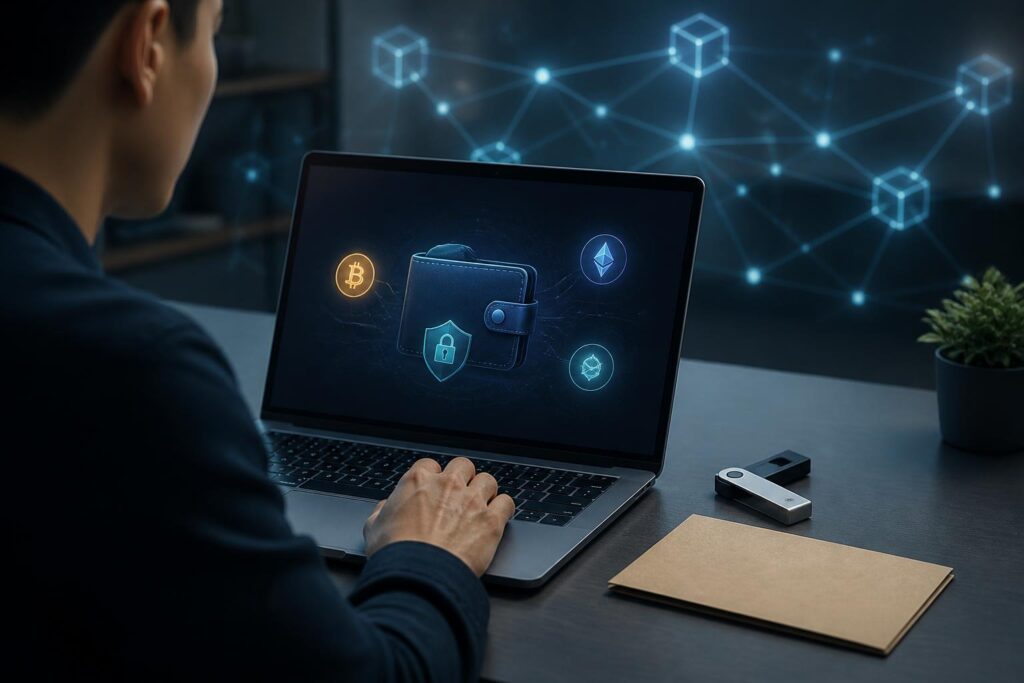
Many people first encounter blockchain by creating a wallet, receiving digital assets, or connecting to a decentralized application. The interfaces of these applications can sometimes make users feel as though they are opening an online bank account. However, the similarity is only superficial. A blockchain wallet is not a place where money is held according to the traditional account model, and the wallet provider generally does not have the authority to make decisions on behalf of the asset owner.
This difference is highly significant. When users misunderstand the nature of a wallet, they may store their recovery phrase in an unsafe place, send assets to the wrong address, sign a transaction without reading its contents, or assume they can call customer support to reverse every mistake. Blockchain can provide a transparent record of transactions that is difficult to alter arbitrarily, but the system does not automatically protect users from every careless decision.
What Does a Blockchain Wallet Actually Do?
Conceptually, a blockchain wallet is a tool that helps users manage the information needed to interact with a network. A wallet creates or stores cryptographic keys, allowing the owner to prove control of an address and authorize transactions. Assets associated with an address on a blockchain are still recorded on the network; the wallet is not like a safe containing physical coins inside.
An address can be understood as information that allows others to send assets to it, while a private key is the data used to prove control over the assets associated with that address. This description is only illustrative, because each blockchain has its own technical rules. Even so, the core principle remains consistent: the person who controls the appropriate key can perform actions accepted by the network, while someone without the key generally cannot arbitrarily replace the owner.
Therefore, losing access to a key or recovery phrase can mean losing the ability to use the assets. This is a fundamental difference from many traditional financial services, where users can verify their identity and request that access be restored through an intermediary institution. With a self-custodial wallet, there is not always an entity that can verify that the person making the request is truly the owner and then restore access.
Private Keys and Recovery Phrases Are Not Ordinary Passwords
A password for an online service can usually be changed or reset. Private keys and recovery phrases play a deeper role. They may allow a wallet’s control to be restored on another compatible device or software. Someone who obtains this information may be able to use the assets without knowing the wallet owner’s name, email address, or ordinary login details.
Therefore, a recovery phrase should be treated as the most highly sensitive information. It should not be captured in a screenshot, sent through a chat application, stored in email, entered into an online form, or provided to someone claiming to be a support representative. A website with a professional interface can still be a fake site. Any request for a recovery phrase to “verify,” “unlock,” or “protect your assets” should be treated with particular caution.
The appropriate method of storage depends on the value of the assets, frequency of use, and each person’s ability to manage them. Some people choose to write recovery information on durable material, store it in a private place, and limit the number of people who know about it. What matters is not following one single method, but understanding how stored information could be lost, damaged, copied, or accessed without authorization. Backup copies also need to be considered carefully, because the more copies there are, the more potential points of exposure exist.
How Are Custodial and Self-Custodial Wallets Different?
With a self-custodial wallet, users directly control the keys. The software provider may supply an interface or technical tools, but generally does not hold the keys on the user’s behalf. This model provides greater autonomy while also shifting more of the security responsibility to the individual. Users must inspect their devices themselves, protect their recovery information, identify fake applications, and think carefully before signing transactions.
With a custodial service, the keys or authority to operate the assets may be held by an organization according to that service’s model. Users generally log in with an account and may receive support when certain problems occur. However, the ability to use the assets then depends significantly on the procedures, terms, security measures, and operational status of the service provider. “Not holding the keys yourself” does not mean there is no risk; the risk has merely shifted from self-custody to evaluating and trusting an intermediary.
No option is absolutely suitable for everyone. Beginners may prioritize ease of use but still need to understand withdrawal conditions, support limitations, and account-protection methods. Those who choose self-custody need to accept that greater control comes with greater responsibility. The important question is not which model sounds safer, but whether users understand whom they are giving authority to and whether they are capable of managing that authority.
A Receiving Address Is Not a Guarantee That a Transaction Will Succeed
One common mistake is to view pasting an address into a money-sending field as a simple action without consequences. In reality, the sender needs to check the network, type of asset, destination address, and any additional requirements imposed by the receiving service. In some cases, the same string of characters, or addresses that appear similar, may belong to different networks. A wallet interface may issue a warning, but it cannot always prevent users from confirming the transaction.
Before sending, users should follow a slow and deliberate process. They can compare the address in multiple places, confirm the correct network, check the selected asset, and determine whether the recipient requires an additional identifier. For an important transfer, sending a small test amount first may help reduce risk, although it does not eliminate the possibility of error entirely. After confirmation, users should bear in mind that blockchain transactions generally do not work like bank orders that can be canceled at will by making a phone call.
An address should also not be treated as proof of identity. An address may not reveal who is behind it, where they are located, or whether they are trustworthy. The fact that a transaction is recorded on the network only shows that the transaction data was accepted by the system according to the applicable rules; it does not by itself prove the transaction’s purpose, quality, or legality in the real world.
Signing a Transaction Grants Authority; It Is Not Merely Clicking Confirm
When connecting a wallet to an application, users may be asked to sign a message or transaction. These two actions should not be regarded as harmless procedural steps. Depending on its content, a signature may confirm an action that transfers assets, grants permission to use assets, or interacts with a contract on the network. If users do not understand what the application is requesting, they should not sign merely because they want to close a warning window.
A safe practice is to read the domain name, check the source of access, carefully review the information displayed in the wallet, and consider the permissions requested by the application. Users should not connect their wallets to sites sent through messages from unknown sources, advertisements creating time pressure, or invitations promising guaranteed returns. Signs such as requests for a recovery phrase, demands to install unidentified software, or pressure to sign immediately to avoid “missing an opportunity” should be treated as serious warnings.
After using an application, users should also review the permissions they have granted if the wallet and network support this function. Disconnecting an interface does not necessarily mean that all permissions granted on the blockchain have been revoked. This is why access permissions need to be managed separately rather than simply removing the website from the list of connected applications.
Turning Control Into a Responsible Management Process
Safety with blockchain wallets does not come from a single tip. It is the result of many small habits maintained consistently. Users should update their operating systems and wallet software from official sources, protect their devices with an appropriate locking method, limit the installation of unnecessary applications, and avoid using compromised devices for important transactions. Separating a wallet used for experimentation from one used for long-term storage can also help limit the consequences of interacting with an unfamiliar application.
Alongside technical security, users need to establish decision-making principles. Do not invest or send assets merely because of a promotional claim, do not treat a displayed balance as proof of profit, and do not confuse the transparency of on-chain data with the safety of a project. Blockchain can record a transaction very clearly, but it does not guarantee that users have properly understood the product, counterparty, or related legal and operational risks.
Before placing assets in a wallet or application, users should answer three questions for themselves: Whom am I giving authority to? If I lose access, what is the plan for dealing with it? And can this transaction be reversed? If these questions cannot yet be answered, pausing is usually safer than acting hastily. Autonomy has value only when accompanied by the ability to understand, verify, and take responsibility for one’s choices.
Conclusion
A blockchain wallet is a tool for managing control over assets on a network, not a bank account backed by an organization that guarantees every situation. Private keys, recovery phrases, receiving addresses, and transaction signatures each serve different roles, but they all lead to the same principle: users need to know exactly what they hold, whom they are granting authority to, and which actions may be irreversible.
Understanding the nature of a wallet correctly does not eliminate all risks, but it helps users identify risks before they become losses. In the blockchain ecosystem, caution is not an obstacle to the technological experience. It is a condition for control over digital assets to truly belong to the person using them.
