


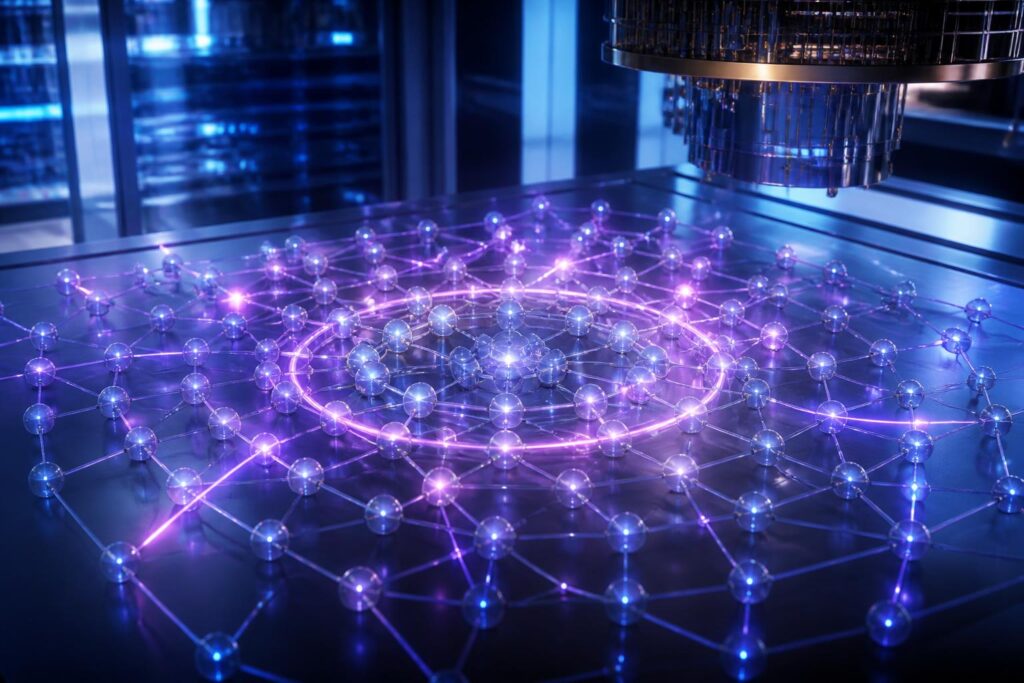
In every computing system, errors cannot be eliminated completely. Conventional computers address this problem through mechanisms such as redundant bits, error-correcting codes, and data integrity checks. Quantum computers also need error correction, but the challenge is far greater. A classical bit can be in only one state, 0 or 1, at a given time, whereas a qubit can exist in a superposition and become linked to other qubits through quantum entanglement. Directly observing a qubit to check it can therefore alter the very information the system is processing.
This is one of the reasons that the number of qubits reported is not enough to evaluate a quantum computer’s practical capabilities. A device with many physical qubits, each of which can easily lose its state or produce an incorrect computation, is not necessarily more useful than a smaller system that is better controlled. To run long and reliable algorithms, the field needs to build logical qubits—units of quantum information protected by multiple physical qubits. The path from physical qubits to logical qubits is at the heart of quantum error correction.
How Can Qubits Go Wrong?
A qubit is an extremely sensitive physical system. Depending on the technology, it may be created from superconducting circuits, trapped ions, neutral atoms, photons, or other platforms. Although their implementations differ, all of these systems face environmental noise and errors during control. Heat, electromagnetic fluctuations, unintended interactions with measurement equipment, or inaccuracies in control pulses can all alter a qubit’s state.
Some basic errors can be envisioned as flipping a qubit’s state, destroying its quantum phase, or causing its state to gradually deteriorate. In classical computing, a flipped bit can often be detected by comparing it with a copy. For qubits, completely copying a quantum state is not a valid solution. Moreover, quantum information is often encoded in a superposition, so measuring the entire qubit will collapse the state and eliminate the information that needs to be protected.
Errors do not occur only in individual qubits. A quantum gate may be performed incorrectly in part, the readout may be inaccurate, and errors among multiple qubits may be correlated. Therefore, an error-correction system must track multiple sources of deviation at the same time while preserving the quantum properties of the computation.
From Physical Qubits to Logical Qubits
The core idea of quantum error correction is to distribute the information of a logical qubit across a group of physical qubits. A logical qubit is not a separate component in the conventional sense. It is a state encoded in a structure made up of multiple qubits, in which the relationships among them help the system determine whether an error has occurred.
Rather than directly measuring the logical information, the controller performs auxiliary measurements called error-syndrome measurements. These measurements do not reveal the full quantum state of the logical qubit, but they provide indications of the type or relative location of an error. The system can repeat the checking process, analyze the signals obtained, and then apply a correction operation or take the error into account when decoding the final result.
This mechanism is like inspecting a network through monitoring points instead of opening all the data inside it. If some relationships among the qubits are no longer consistent, the decoder can infer the error chain that most likely occurred. Crucially, syndrome measurements are designed not to directly reveal the value of the logical qubit. As a result, checks can take place without necessarily destroying the computation.
One error-correcting code widely used in research is the surface code. In this approach, qubits are arranged on a topological structure and continuously checked through neighboring relationships. The surface code is attractive because it can operate with relatively local interactions, making it suitable for some hardware architectures. However, it also requires many physical qubits, stable repeated measurements, and a decoder fast enough to process error data.
Why Doesn’t Adding More Qubits Necessarily Reduce Errors?
In conventional computing, increasing redundancy is often a fairly direct way to improve reliability. In quantum computers, adding qubits is meaningful only when the additional qubits are good enough and can work together according to the error-correcting code. If each new qubit introduces many errors of its own, the system may become more complex without producing a more reliable logical qubit.
The error threshold concept helps describe this condition. Some error-correcting codes can reduce the error probability of a logical qubit if errors in the physical components remain below a certain level and the assumptions about the types of errors are satisfied. In that case, increasing the scale of the code can provide greater reliability. Conversely, if hardware quality has not reached the necessary conditions, scaling up the code may not be enough to offset errors arising during measurement, control, and connectivity.
The error threshold is not a single number that applies equally to every quantum computer. Its value depends on the hardware architecture, noise model, method of implementing quantum gates, measurement quality, and decoding strategy. One design may have an advantage in connectivity but struggle to read out qubits; another may preserve states for longer but require more control steps to perform an operation. Therefore, error correction must be evaluated across the entire operating chain rather than by looking at just one isolated metric.
Challenges Beyond the Error-Correcting Code Itself
The first challenge is creating physical qubits that are stable enough. Qubits must be isolated from noise while still being controllable and measurable when necessary. These two requirements are partly in tension: connections to control equipment make computation possible, but also open additional paths for noise to enter. In a large system, maintaining uniform operating conditions across many qubits is a significant engineering problem.
The second challenge is scaling the system without losing the ability to control it. Wires, pulse generators, cooling equipment, optical components, or trapping systems must all work together. As the number of qubits increases, the number of syndrome measurements also grows, and the data that must be processed becomes larger. The classical controller must collect information, detect error patterns, and make decisions quickly enough that it does not become a bottleneck for the entire machine.
The third challenge is that errors may not be independent. Many error-correction theories work more favorably when errors occur separately and with low probability. In real hardware, a failure in the controller or a common noise source can affect many qubits simultaneously. Such correlated errors can reduce the effectiveness of the code because the redundant information is no longer distributed in an ideal way.
In addition, measurements and quantum gates also need to be error-corrected. It cannot be assumed that only qubit states suffer errors while every surrounding operation is perfect. A system may have qubits that store information well but unstable measurements, or accurate measurements but inter-qubit gates that generate too many errors. A practical design must balance multiple types of errors within the same architecture.
Impact on How Quantum Computers Are Evaluated
Quantum error correction changes the question of technological progress. Instead of asking only how many qubits a device has, it is necessary to examine the quality of each qubit, how many computational cycles the system can perform before errors accumulate, and how many physical qubits can be combined into an effective logical qubit. It is also necessary to distinguish between demonstrating a technique under controlled conditions and being able to run a long program with predictable reliability.
Logical qubits are a more important measure for applications that require deep computations. However, even the number of logical qubits does not tell the whole story. Logical qubits must be connected in suitable ways, be capable of performing the necessary gates, and maintain their states for a sufficient amount of time. One algorithm may require few qubits but a very large number of steps, while another may need more qubits but have a lower depth. Error-correction capabilities must be evaluated alongside the characteristics of the algorithm.
This also explains why claims about quantum computers often need to be read carefully. An experimental result may show that an error-correcting code works in a particular configuration, but that does not necessarily mean a complete fault-tolerant quantum computer has been achieved. The gap between observing a trend toward reduced errors and operating a large-scale system also involves hardware, control software, decoding, and maintenance procedures.
Why Is Error Correction Still Necessary?
One might ask whether quantum algorithms can be designed to avoid errors on their own. Optimizing algorithms and choosing suitable problems can certainly reduce hardware requirements, but they cannot completely eliminate state degradation. Long computations, circuits with many layers of gates, or tasks requiring high precision will still need a principled protection mechanism.
Quantum error correction is not intended to turn qubits into completely immortal versions of themselves. The practical goal is to make the error probability of a logical qubit decrease as the system is scaled up correctly. This represents an important shift: rather than trying to keep every physical qubit perfect, designers accept that small components may fail and build a logical layer capable of detecting, isolating, and handling those errors.
This path requires coordination among physics, electrical engineering, computer science, information theory, and control. There is no single error-correcting code suitable for every platform. Each architecture must find a balance among the number of qubits, connectivity, measurement time, control costs, and noise levels. Advances in one layer may only become effective when the other layers keep pace as well.
Therefore, the bottleneck for quantum computers is not simply the creation of more qubits. The larger bottleneck is turning vulnerable qubits into logical units that can operate reliably during a computation long enough to matter. From this perspective, quantum error correction is not an add-on feature introduced at the end, but the foundation that determines whether quantum computers can move beyond the demonstration stage and become reliable computing tools.
