


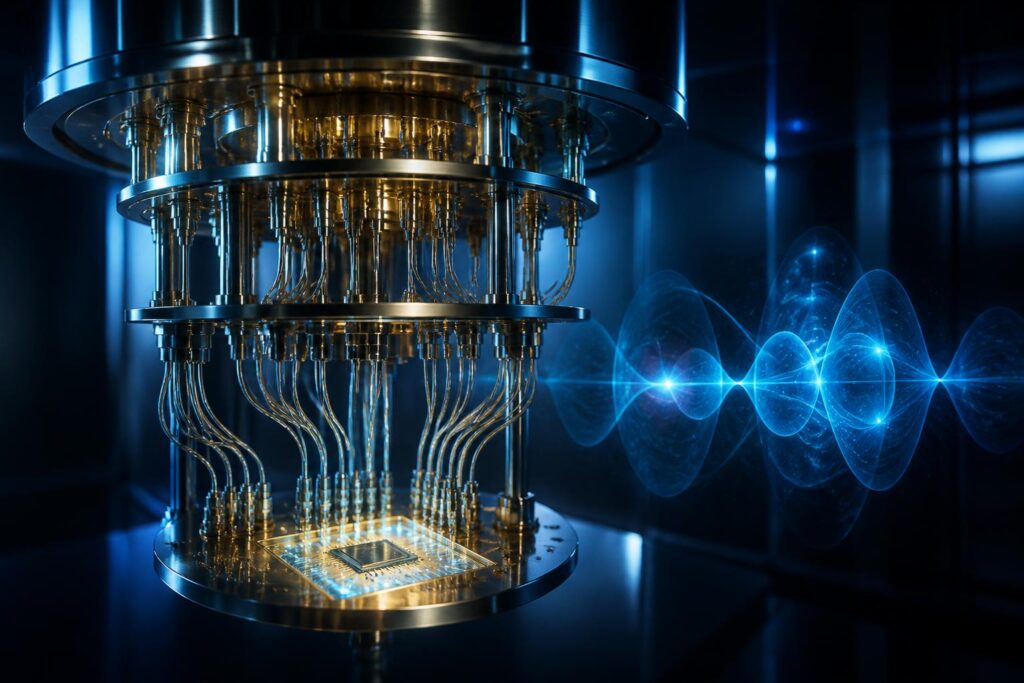
When people talk about quantum computers, the concept usually mentioned first is the qubit. It is the unit of information corresponding to the bit in a traditional computer, but it does not operate in the same way. An ordinary bit is represented by one of two values, 0 or 1, whereas a qubit can be prepared in a combined state of both possibilities before it is measured. This characteristic opens up a new way of processing information, but it also makes qubits particularly sensitive to their environment.
A qubit is not a single object or a component with a fixed shape. It can be created from many different physical systems, such as superconducting circuits, trapped ions, neutral atoms, photons or special defects in solid materials. Although the technologies differ, all of these systems must provide two distinguishable, controllable and measurable quantum states. On this foundation, researchers can build quantum operations.
How Is a Qubit Different from a Bit?
A traditional bit can be imagined as a switch in either the off or on position. Under ideal conditions, its value is 0 or 1. A qubit also has two basis states, commonly denoted |0> and |1>, but before measurement, its state can be a superposition of these two states. In general terms, a qubit’s state is described by two probability amplitudes. When a measurement is performed, the system produces only one specific result, 0 or 1, with a probability that depends on the state that was prepared.
This does not mean that a qubit is simply a bit with multiple values at once in the ordinary sense. Quantum information lies in the amplitudes and the phase relationship between the components of the state. These characteristics can be changed by precisely controlled operations, but they can also be destroyed by external noise. Therefore, the advantage of quantum computers comes not only from qubits having superposed states, but also from the ability to combine superposition, interference and entanglement in a suitable algorithm.
Creating Two Usable Quantum States
The first step in building a qubit is to identify a physical system with two quantum states that serve as the equivalents of 0 and 1. In superconducting circuits, these states are created in a special electrical circuit operating at very low temperatures. In trapped ions, information can be encoded in the ion’s energy levels. In photon-based systems, properties such as polarization or path can be used to represent the states.
The two basis states must be stable enough to store information for the necessary period, but they must also be capable of being switched by a control signal. This is a difficult balance to achieve. If a qubit is too easily affected, it will quickly lose information to the environment. If it is too difficult to manipulate, quantum gates cannot be performed quickly and accurately. A good hardware platform must therefore provide a sufficiently long coherence time, flexible control and high measurement accuracy at the same time.
In practice, qubits do not exist in complete isolation from the surrounding equipment. Control circuits, wiring, lasers, electromagnetic fields or optical components can all interact with the quantum system. These interactions must be designed so that deliberate effects are stronger than unwanted noise. Even a small mechanical vibration, thermal fluctuation or electromagnetic variation can distort a calculation if it is not minimized.
Controlling Qubits with Quantum Gates
After a qubit has been created, the system needs to change its state according to a program. In traditional computers, processors use logic gates to transform bits. Quantum computers also have gates that serve a similar role, but they must follow the rules of quantum mechanics. Some gates change the probability of observing the basis states, while others create interactions between two or more qubits.
Control operations are usually performed using electrical pulses, microwave pulses, laser beams or other physical signals, depending on the qubit platform. The shape, duration and intensity of the pulses must be carefully calibrated. A pulse that is too weak may not bring the qubit to the desired state; a pulse that is too strong or applied for too long can create an unintended transition. As the number of qubits increases, the control problem becomes more complex because a signal intended for one qubit may inadvertently affect a neighboring qubit.
A complete quantum computation usually consists of many successive layers of gates. Each additional layer creates another opportunity for errors to occur. Therefore, the ability to perform a single gate with high accuracy is not enough to demonstrate that a system can run a large algorithm. Developers must also evaluate qubit stability, the level of noise when multiple qubits are connected and the ability to maintain computational quality over many steps.
Why Do Qubits Easily Lose Their State?
The phenomenon in which a qubit loses its quantum properties through interaction with the environment is commonly called decoherence. A qubit can be affected by heat, radiation, material vibrations, electromagnetic fields or errors in control equipment. When information about the quantum state spreads into the environment, it becomes difficult for the system to preserve the coherence required for computation.
This is why many quantum computers must operate under demanding conditions. Superconducting circuits are often placed in deep-cooling systems to reduce thermal noise. Platforms using ions or atoms must control the vacuum environment and light with high precision. Photon-based systems require light sources, beam splitters and sensors to be kept stably aligned. Each method has its own advantages, but no method completely eliminates the noise problem.
Decoherence must be distinguished from control errors. A qubit may lose its state because of the environment, but it may also be manipulated incorrectly because a control pulse is inaccurate. In addition, imperfect measurement and unwanted interactions between qubits can create errors. Evaluating a quantum platform therefore requires examining many types of metrics rather than simply counting the number of installed qubits.
Measurement Turns a Quantum State into a Classical Result
A traditional computer can read a bit without necessarily changing its value. With a qubit, measurement plays a different role. When measured, a superposed state is converted into an observable result, usually 0 or 1 according to the selected measurement basis. After measurement, information about the previous state is no longer preserved in its original form.
To obtain a result, each platform uses its own sensing mechanism. One system may detect a change in an electrical signal, while another observes light emitted by an ion or records a photon’s path. The measuring device must be sensitive enough to distinguish the states, but it must not introduce too much noise into the system before it is needed.
A single run of a quantum circuit produces only one specific sequence of results. Therefore, users usually have to repeat the same circuit many times and then aggregate the frequencies of the results. The resulting distribution helps estimate the probabilities produced by the algorithm. This is an important difference from many classical computations, in which the same input and program generally produce a definite result in the absence of hardware or software errors.
Quantum Error Correction Is Not the Same as Data Backup
Qubits are prone to errors to such an extent that a practical quantum computer cannot rely solely on individual physical qubits. A common approach is to use many physical qubits to encode one logical qubit, and then check for signs that an error has occurred without directly measuring all of the information being protected. These checks can help detect and gradually correct certain errors.
The challenge is that an arbitrary quantum state cannot be copied in the same way as a computer file. The system must use error-correcting codes and auxiliary measurements designed specifically for quantum information. The number of physical qubits required for one logical qubit can be large, depending on the quality of the hardware, the type of code and the level of accuracy required by the application. Therefore, increasing the number of qubits does not necessarily mean an immediate increase in useful computing power.
A promising system needs not only many qubits, but also the ability to keep those qubits operating for long enough, connect them in a suitable way, perform gates with low error rates and support an error-correction process. This is why the quantum-computing industry continues to focus strongly on improving materials, device design, control techniques and software at the same time.
What Determines Practical Applicability?
For end users, the important question is not how many qubits a machine has on its specifications sheet, but what problems it can solve with reliable results. A quantum algorithm needs to take advantage of the structure of the problem, fit the way the qubits are connected and withstand the limitations of the hardware. If a circuit is too long compared with the time for which the state can be maintained, the theoretical benefit may disappear before the result is measured.
At the present stage, quantum computers are still being studied for specialized classes of problems, such as simulating quantum systems, optimization or processing certain mathematical structures. Not every problem is suitable, and quantum computers are not designed to replace conventional computers for everyday tasks. Many practical systems may require a hybrid architecture in which a classical computer prepares data, controls the process, handles part of the work and analyzes the results from the quantum processor.
Understanding a qubit’s life cycle helps provide a more realistic view of this technology. A qubit must be created from a suitable physical system, isolated while remaining controllable, passed through quantum gates with high accuracy and then measured using sensitive equipment. Each stage has its own limitations, and each affects the final result.
The prospects for quantum computers therefore depend not only on compelling algorithmic ideas. They also depend on the ability to turn fragile quantum states into a scalable, testable and error-correctable computing platform. As these requirements are met more effectively, qubits will have a greater chance of moving from research subjects to components of systems that solve problems conventional computers find particularly difficult.
