


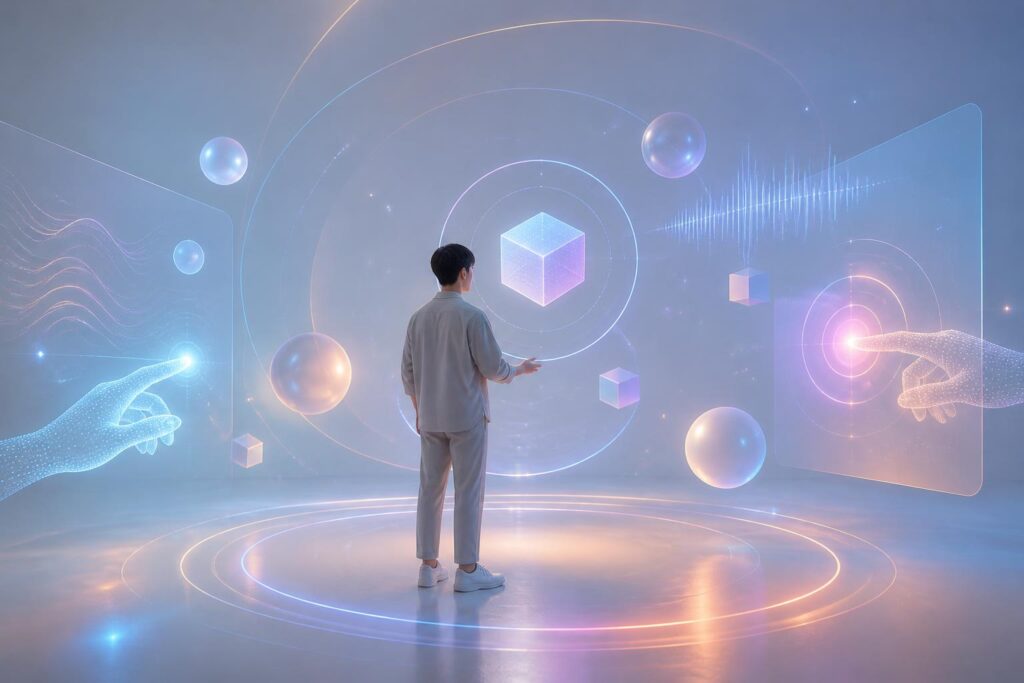
When entering a virtual space, users do not merely see a scene built with software. They also seek the feeling that they are inside that scene, able to observe, move, interact, and respond as a subject rather than simply view content on a screen. This feeling is often called a sense of presence. It is one of the factors that determines whether a virtual experience becomes convincing or is quickly dismissed.
A sense of presence does not mean that technology must recreate the real world perfectly. A space with simple graphics can still draw users in if its important signals are organized consistently. Conversely, highly detailed visuals with unnatural movement, mismatched sound, or unpredictable interactions can immediately remind users that they are merely controlling an interface. Therefore, the core issue lies in how the senses, actions, and feedback are connected to one another.
Presence Is More Than Seeing Another World
In ordinary experiences, people continuously receive information from many sources. The eyes perceive position and distance, the ears help orient us toward sounds, the body senses movement and balance, and the mind compares these signals to form an understanding of space. Virtual environments seek to simulate or coordinate part of this process through screens, headsets, headphones, controllers, and sensors.
Visuals are the most noticeable layer. The viewpoint, depth, lighting, and scale of objects help users understand where they are standing. When the scenery changes accordingly as users turn their heads, the brain has more reason to regard that space as a place that can be explored. If the viewpoint lags, the image shakes abnormally, or the proportions between objects are inconsistent, the sense of presence will diminish regardless of how high the graphics quality is.
Sound also plays an important role. A noise coming from behind, footsteps that change according to the surface, or a sound that grows quieter as its source moves farther away can provide information that visuals have not conveyed sufficiently. Sound does not necessarily have to be complex. What is essential is that it corresponds to the position, timing, and action taking place. When the ears receive signals that do not match what the eyes see, users may feel that the environment is unnatural.
Consistency Between Actions and Feedback
Users feel present in a space when their actions produce feedback that is easy to understand. A gesture, controller operation, or character movement should lead to a reasonably predictable result. If users reach toward an object and it responds immediately, the connection between intention and outcome becomes clear. If the same action sometimes works and sometimes does not without an apparent reason, the sense of control over the space quickly disappears.
Feedback is not limited to an object changing position. It may be a brief sound, a change in lighting, movement of a virtual hand, or a slight vibration from a device. Each signal should serve to explain what has just happened. Too little feedback leaves users confused, while too much makes the experience noisy and makes it difficult for them to distinguish important signals from decorative effects.
Latency is a particular challenge. The more noticeable the gap between the moment users perform an action and the moment the system responds, the greater the risk that the experience will feel disrupted. Not every situation requires immediate feedback to the same degree, but actions directly related to movement, orientation, and grasping generally need to feel seamless. Good design should prioritize the interactions users perform most often rather than spreading resources across details that have little impact on the experience.
The Virtual Body and the Scale of Space
People do not perceive their surroundings only through their eyes. They also have an awareness of their own position within those surroundings. For this reason, the design of a virtual body, virtual hands, or an avatar can significantly affect the sense of presence. A hand that moves in the correct direction but does not match the user’s posture can still create a sense of disconnection. An avatar with an unreasonable height, reach, or movement speed can likewise make the space feel unfamiliar.
However, not every experience needs to simulate the entire body. Displaying only part of the body can reduce processing demands and avoid artificial movements. What matters is that the displayed part fits the way users interact. If the system only allows observation and selection, a simple cursor or hand may be sufficient. If users need to manipulate objects, information about reach and hand orientation becomes more important.
Scale is also an easily overlooked factor. A door that is too small, objects that are too large, or distances between characters that do not match everyday expectations will disorient users. Some virtual spaces may intentionally alter scale to create a strange feeling or serve an artistic purpose. In such cases, the change needs to be presented consistently so users understand that it is a rule of the world they have entered rather than thinking that the system is malfunctioning.
Why Aren’t Realistic Graphics Enough?
Realistic visuals are often seen as the shortest path to making a virtual space more convincing, but they are not the only factor, nor are they always the most important one. A scene can be beautiful yet still feel lifeless if users do not know what they can do in it. The experience of presence is strengthened when the environment responds to actions, provides navigational cues, and maintains stable rules.
A minimalist style can sometimes offer advantages. When users do not have to process too many details, they can focus more easily on the goal, the characters, or the relationships between objects. A deliberate design can use color, shape, and sound to guide attention without copying the entire real world. Consistency between the visual style and the way users interact is often more important than trying to make everything resemble real life.
Virtual spaces also need to acknowledge users’ limitations. Some people are sensitive to movement, changes in viewpoint, or sensations of imbalance. If an experience continually subjects users to movements they did not initiate, the sense of presence can turn into discomfort. Therefore, options such as adjusting speed, changing the method of movement, reducing vibration effects, or allowing users to stop should not be regarded as secondary details. They are part of responsible experience design.
Presence in Spaces with Multiple People
When a virtual space includes multiple participants, the sense of presence is no longer determined only by the relationship between the user and the environment. It also depends on how other people appear, move, and communicate. An avatar does not need to look exactly like a human, but it needs to convey some basic signals, such as gaze direction, attentiveness, or the intention to interact.
Communication in virtual spaces can rely on voice, gestures, eye contact, or preprogrammed actions. Each form has advantages and limitations. Voice is convenient for quick exchanges but can put pressure on people who do not want to speak publicly. Gestures make conversation less dependent on language, but if the action library is too limited, users will have difficulty expressing nuance. A good system should offer multiple ways to participate rather than forcing everyone to communicate in a single manner.
The sense of presence among multiple people is also connected to personal boundaries. Distance, approach direction, and the way another character appears within one’s field of view can all affect comfort. Virtual spaces need mechanisms that help users control who can come near them, hear them, or interact with them. This is not only a matter of safety; it is also a condition that allows users to focus on conversations and shared activities.
From an Impressive Experience to a Useful One
An effect that surprises users for a few minutes does not necessarily create long-term value. A sense of presence is more meaningful when it serves a clear purpose, such as helping users understand a space, practice an action, coordinate with others, or take part in a story. If effects are intended only to impress without supporting the objective, they can easily become distractions.
Designers need to begin by asking what users need to feel, rather than simply asking what technology can be added. In a learning environment, presence may come from the ability to observe a model from multiple angles and experiment without fear of damaging the object. In a virtual meeting, it may come from recognizing who is speaking and who is paying attention. In a game, it may be tied to the feeling of controlling a character and understanding the rules of the world.
Evaluation should also go beyond technical metrics. Response speed and visual quality are important, but users’ feedback about clarity, comfort, autonomy, and fatigue also needs to be considered. A successful experience does not necessarily make users completely forget that they are in a digital environment. It helps them focus long enough on the main activity while still allowing them to recognize and control their own limits.
A Feeling Built from Many Layers
A sense of presence in a virtual space does not arise from a single device or an individual graphics technique. It is built through the coordination of visuals, sound, movement, feedback, scale, the virtual body, and interaction rules. If just one important layer is out of alignment, users may recognize the artificiality of the environment. Conversely, a design that is appropriately restrained, consistent, and respectful of users’ ability to control their experience can still create a convincing one.
In developing virtual worlds, the goal should not be to make people forget the real world at any cost. A more reasonable goal is to create a space that they understand, can use, and want to return to because of meaningful activities. When technology knows how to step into the background and support human perception and action, the sense of presence can become the foundation for a more useful, accessible, and sustainable virtual world.
