


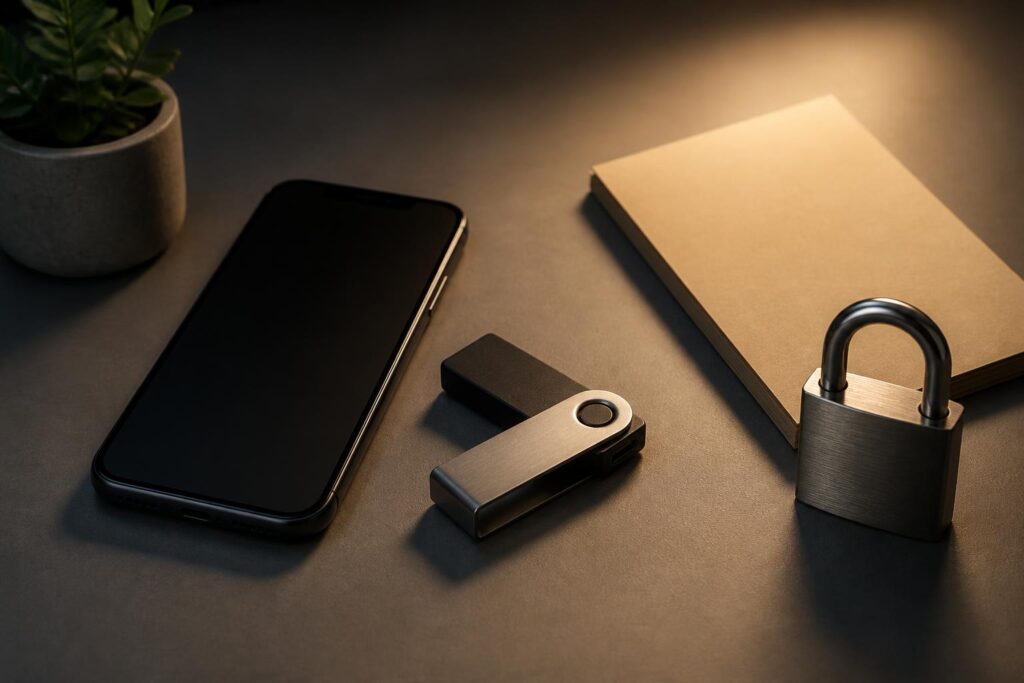
Control Comes with Responsibility
In cryptocurrency, the term “self-custody” is commonly used to describe a way for users to directly control access to their assets instead of entrusting all management to an exchange or intermediary service. This is one of the characteristics often mentioned when discussing the autonomy of digital assets. However, self-custody is not simply a matter of downloading a wallet application, receiving an address, and transferring money into it. Users must also understand what a private key is, what role a recovery phrase plays, how transactions are confirmed, and why a small mistake can lead to irreversible consequences.
A self-custody wallet does not hold money in the same way that a physical wallet holds cash. The assets are still recorded on the blockchain network, while the wallet manages the information needed to prove control over the corresponding address. In other words, a wallet application is a tool for generating, storing, and using cryptographic keys. If access to this key is lost, the user may no longer be able to carry out transactions, even though the asset data still exists on the blockchain.
What Does a Wallet Actually Store?
The term “cryptocurrency wallet” can sometimes lead newcomers to imagine that assets are located inside a specific file or device. This understanding is not entirely accurate. The blockchain records the state of addresses and the transactions that have taken place. A wallet provides an interface for users to view balances, create transactions, and use a private key to sign those transactions.
A private key is confidential information that allows the signer to prove they have control over the assets associated with an address. In practical terms, anyone who obtains the private key or information that can restore the private key may be able to transfer the assets, depending on the rules of the network. Therefore, a private key should not be regarded as an ordinary password. A password can sometimes be reset through email or customer support. A private key does not have a similar centralized reset mechanism.
Many wallets intended for general users use a recovery phrase consisting of multiple words to generate or restore a set of keys. This phrase is usually easier to record than a long string of characters, but its security value is extremely high. Anyone with the recovery phrase can restore the wallet on another device, so protecting the phrase must take priority over protecting only the phone on which the wallet application is installed.
A Recovery Phrase Is Not an Ordinary Identifier
A common mistake is to photograph the recovery phrase, save it in a notes application, email it to oneself, or store it on a cloud service “in case it is needed.” These methods create additional digital copies and expand the number of points through which the phrase could be exposed. Phones, email accounts, personal computers, and online storage services can all become targets of malware, phishing, or unauthorized access.
For many people, a more cautious approach is to write the recovery phrase on a durable material, keep it in a private place, and limit the number of people who know it exists. The record should not be kept beside the device that is regularly used with the wallet, nor should it be left somewhere that guests, repair workers, or unauthorized people can easily see it. If a backup copy is made, users need to consider both the risk of physical loss and the risk that multiple copies could be discovered at the same time.
A recovery phrase should also not be entered into a website or application of unclear origin simply because someone claims to be a support representative. Legitimate services do not need users to send the entire phrase by message to “verify an account,” “unlock a wallet,” or “fix a transaction error.” Such a request is a very strong sign of fraudulent activity. Users should also be wary of offers of rewards, gifts, or urgent assistance that require them to provide a private key.
How Are Hot Wallets and Hardware Wallets Different?
A hot wallet is a wallet installed on a phone, computer, or browser that has an Internet connection while it is being used. The advantages of this type of wallet are convenience, easy installation, and suitability for frequent transactions. Users can quickly connect to blockchain applications, check balances, or sign transactions. In return, the key may come into contact with the online environment and depend more heavily on the security of the device.
A hardware wallet is a specialized device designed to limit the private key’s direct exposure to a computer or phone. When a transaction is created, the device may require the user to review the information and confirm it through a separate action. This approach helps reduce certain risks, but it does not make a hardware wallet an absolutely safe tool. The recovery phrase remains a decisive factor. If the phrase is exposed, the device is replaced with an untrustworthy product, or the user mistakenly confirms a malicious transaction, the assets may still be at risk.
No single type of wallet is suitable for every need. Assets used for small and frequent transactions may be managed differently from assets intended to be held for the long term. The important thing is to distinguish convenience from protection, while also avoiding keeping all assets in one place if doing so creates excessive risk. Whether using a hot wallet or a hardware wallet, users remain responsible for checking the download source, configuring security, and safeguarding recovery information.
Risks That Are Often Underestimated
The first risk is downloading the wrong application. The names, icons, and interfaces of fake applications may be designed to closely resemble those of genuine products. Such an application may request the recovery phrase from the outset or direct the user to an incorrect address. Searching for an application through advertisements, links in chat groups, or private messages increases the risk of accessing an untrustworthy source by mistake.
The second risk arises when users connect their wallets to decentralized applications. Connecting does not mean that assets are transferred immediately, but a signed transaction or permission may allow the application to carry out actions that the user does not fully understand. Therefore, before confirming, users should examine the application name, access address, transaction details, and permissions requested by the transaction. They should not sign merely because a window appears with a vague explanation or because they fear missing an opportunity.
The third risk is sending funds over the wrong network, to the wrong address, or as the wrong type of asset. An address may look like a long, difficult-to-read string of characters, making visual checking prone to error. The habit of copying and pasting does not completely eliminate the risk either, because malware can interfere with data in the clipboard. For transfers of significant value, users should compare the address in multiple places, check network compatibility, and consider sending a small test amount before carrying out the main transaction.
The fourth risk is confusing a transaction that has been created with one that has been confirmed by the network. A transaction may be pending, rejected, or not yet have reached a status at which the recipient can use the funds. Processing time depends on the network and related conditions, so users should check the status with an appropriate tool instead of relying solely on notifications from an application of unclear origin.
A Safer Wallet-Use Process
First, users should determine the purpose for which they will use the wallet. A wallet used for daily transactions should prioritize convenience, while a wallet used for long-term storage requires protection through a stricter process. Separating these purposes helps limit the situation in which a single application has access to all assets.
When creating a new wallet, the process should be carried out on a device from a clear and trustworthy source, with updated software, and without allowing others to observe the recovery phrase. After recording it, users should test their ability to restore the wallet according to official instructions before transferring significant assets. This test should be performed carefully, and the phrase must never be entered into an untrustworthy online form.
Before each transaction, users should pause to answer several basic questions: What asset am I sending? On which network? Has the receiving address been checked? Do I understand what I am being asked to sign? Are the fee and the amount actually received what I intended? If the answers are not clear, delaying the transaction is usually safer than confirming hastily. In an environment where transactions may not be reversible, slowing down is a protective measure, not a sign of indecision.
Users should also make plans for situations in which they lose a device, die, or are no longer able to manage their assets themselves. This plan may include instructions for an appointed trustee, ways to identify devices, and a backup access process, but it must be designed so that the recovery phrase is not exposed under normal circumstances. For large assets or complex ownership structures, seeking independent legal and security advice may be necessary. Private keys should not be shared with an adviser without an appropriate protection process.
Is Self-Custody Suitable for Everyone?
Self-custody provides autonomy but also requires risk-management ability, discipline, and a certain level of understanding. Newcomers may find the idea of not depending on an intermediary appealing, but that does not mean everyone must immediately transfer all their assets to a personal wallet. A custodial service may provide certain support and recovery mechanisms that a self-managed wallet does not, although the service itself also carries risks related to accounts, operations, and counterparties.
The decision to use a self-custody wallet should be based on each person’s actual capabilities: whether they can safeguard confidential information, whether they understand the transactions they are signing, whether they have prepared a contingency plan, and whether they accept responsibility when an error occurs. Self-custody is not a slogan to be adopted as a trend. It is an asset-management model that requires users to move from the role of customer to that of the person directly controlling the access system.
Conclusion
Self-custody wallets offer an approach in which control over cryptocurrency assets rests directly in the hands of users. But that control is meaningful only when private keys and recovery phrases are properly protected, transactions are checked before signing, and situations involving loss of access have been taken into account. Habits such as not sharing confidential information, using software from trustworthy sources, checking addresses and networks, and starting with an appropriate amount can significantly reduce common mistakes. In cryptocurrency, tools may become increasingly user-friendly, but responsibility for access ultimately remains with the person who holds the key.
