

Why can’t blockchain know what is happening outside on its own?
Blockchain is often described as a system capable of recording and validating transactions without the need for a single intermediary. This description is accurate within the scope of data that already exists on the network itself. However, most real-world applications need to know about events occurring outside the blockchain. An insurance contract may need weather data, a lending platform may need reference asset prices, while a payment application may need exchange rates or delivery status.
A smart contract cannot open a browser on its own, call a separate database, or check a real-world sensor. It only processes data brought into the network in a format the program can read. This is the gap that a blockchain oracle, often referred to as a network or service that provides data to smart contracts, attempts to address.
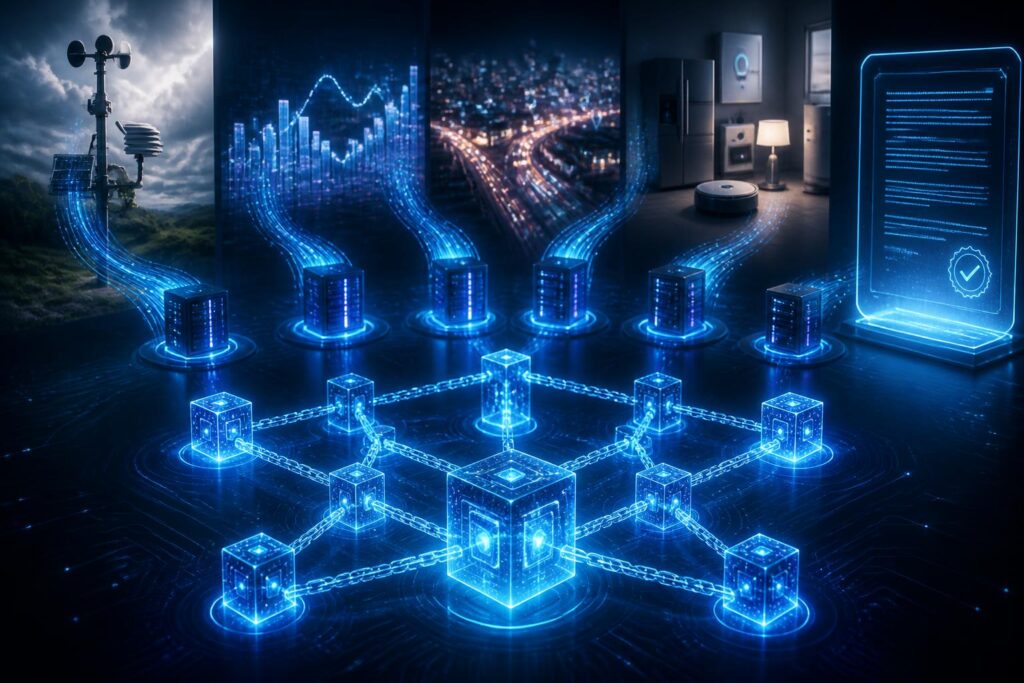
An oracle is not magic that turns real-world data into absolute truth. It is an infrastructure layer positioned between the outside world and the blockchain. This layer obtains data from one or more sources, processes it according to certain rules, and then transmits the result to a smart contract. Precisely because it serves as a connection, an oracle both expands the capabilities of blockchain and introduces risks into the system that cannot be resolved through cryptography alone.
How do oracles work?
In a simple form, a smart contract sends a data request. An external service receives the request, queries the appropriate data source, and sends the result back to the blockchain. The contract then uses this result to perform a programmed action, such as adjusting a rate, disbursing funds, making a payment, or triggering a condition.
This process can be organized in many ways. An oracle that uses only one data source has an easy-to-understand architecture but is heavily dependent on that source. If the source fails, is manipulated, or stops operating, the result transmitted to the contract may also be incorrect. Another model uses multiple providers and then applies an aggregation mechanism, such as taking the median value, removing anomalous data, or requiring a consensus threshold. A multi-source model generally improves resistance to distortion, but entails higher operating costs and greater complexity.
The important point is that after data is recorded on the blockchain, it can be well protected against arbitrary modification, but that does not prove the original data was correct. If an incorrect number is entered into the system, the blockchain can consistently preserve that incorrect number. Therefore, it is necessary to distinguish the integrity of the record from the correctness of the information reflected by that record.
Types of data that oracles commonly process
The most common group is market data, such as asset prices, exchange rates, or reference indices. This data is often used in decentralized finance applications to determine the value of collateral, calculate liquidation levels, or adjust trading conditions. Short-term discrepancies can produce unfair outcomes, especially when a contract responds automatically and there is no human review.
The second group is data from the physical world. A weather-based insurance contract may need rainfall, temperature, or disaster information. A supply chain may need the status of a shipment, the location of a vehicle, or inspection results. In these cases, the challenge lies not only in transmitting data but also in how it is measured, ownership of the equipment, the possibility of sensor forgery, and the confirmation process when sources produce different results.
The third group consists of events with legal or administrative characteristics, such as the status of a license, the outcome of a dispute-resolution process, or whether an obligation has been fulfilled. This is a sensitive area because the data may need to be interpreted in context, while smart contracts generally accept only rigidly structured values. A result that is technically correct can still lead to an inappropriate decision if legal rules change or the information is entered without sufficient context.
The greatest risks do not lie in a single line of code
When evaluating an application that uses an oracle, users often focus on the smart contract’s source code. This is an important part, but it is not enough. Risks can arise throughout the entire data chain, from the original source, collection method, and intermediary server to the confirmation-signing process and the way the contract responds to abnormal data.
The first risk is dependence on a single point. If a single data provider has the authority to determine the result, that structure is essentially still centralized, even if the contract is deployed on a distributed blockchain network. A technical incident, policy change, or fraudulent behavior at this point can affect many users at the same time.
The second risk is that data can be manipulated over a short period. A low-liquidity market, an unstable price source, or an inadequately protected sensor can create an abnormal signal. If the contract responds automatically without limitation mechanisms, an attacker may try to produce an outcome that benefits them. Using multiple sources does not automatically eliminate the risk, because the sources may all rely on the same underlying data or may all be affected by an unusual event.
The third risk is latency. Real-world data does not usually appear simultaneously everywhere. Meanwhile, blockchain processes transactions at particular points in time and may require the most up-to-date data. An old price, an unupdated delivery status, or delayed weather information can cause the contract to make a decision that is no longer appropriate. Therefore, an oracle’s design must clearly determine how long data is considered current and what the system will do when the data becomes too old.
Transparency does not mean easy verifiability
Blockchain can help users observe the history of data updates, the addresses that signed transactions, and the time a value was recorded. This is a significant advantage over a completely closed system. However, being able to see the record does not mean being able to verify the entire process that produced it.
Users still need to know where the data comes from, whether the source is independent, who has the authority to change the configuration, what the criteria are for removing abnormal data, and who is responsible when an incident occurs. If documentation only states that the data has been validated on the blockchain without explaining how it was validated before being put on-chain, readers may misunderstand the actual level of assurance.
This issue is especially important when an oracle provides information to contracts involving large amounts of value. A protocol may make its source code public, but if users cannot assess the quality of the data source or the governance mechanism, technical transparency still has not become meaningful transparency for financial decision-making.
How to design safer oracles
There is no single oracle model suitable for every application. Design should begin with the consequences of data inaccuracies. If a minor error only delays an unimportant operation, the protection requirements may be completely different from a situation in which incorrect data leads to asset loss or changes in legal entitlements.
The first measure is to use multiple data sources that are genuinely independent, rather than merely increasing the number of data points while all of them depend on a single origin. The system also needs a clear aggregation mechanism, acceptance thresholds, rules for handling data when it is excessively dispersed, and a pause mechanism when safe conditions are not met.
The second measure is to establish limits on the contract’s responses. Change thresholds, waiting periods, maximum slippage levels, or temporary lock mechanisms can reduce damage when an oracle fails. These mechanisms do not eliminate risk, but they help prevent an abnormal signal from immediately creating irreversible consequences.
The third measure is to separate the authority to update data from the authority to change the entire protocol. The governance structure should make clear who can add or remove sources, who can change parameters, whether changes require a waiting period, and how users will be notified. A system with multiple data providers can still face significant centralization risk if configuration authority is held by a single key.
Finally, a response process should be prepared for situations in which data cannot be verified. The contract may pause, switch to a conservative value, require additional confirmation, or transfer the dispute to another mechanism. Defining these situations in advance is far better than waiting for an incident to occur before attempting to intervene.
What should users read before interacting?
Before using an application that depends on an oracle, users should learn what type of data is being used and what actions that data affects. They should check the number of sources, the update frequency, how the system handles an unresponsive source, and the authority of the parties that can change the configuration.
Users should also ask about the possibility of reversing a transaction. If the data is incorrect, can users file a complaint, reverse the transaction, or receive compensation? Is the error-handling mechanism built into the contract, determined by a governance organization, or not specified at all? These questions do not make the system absolutely safe, but they help users understand the portion of the risk they are accepting.
Oracles show that blockchain does not exist separately from the real world. For an application to be meaningful, the network must still receive information from markets, devices, organizations, and people. The core challenge, therefore, is not only transmitting data on-chain, but also building a sufficiently reliable process for collecting, cross-checking, updating, and handling data when disagreements arise. When evaluating a blockchain project, the quality of the oracle layer should be considered part of the foundation, not a technical detail that can be overlooked.
