

Blockchain is often described as a system capable of recording and verifying data without a single central intermediary. Smart contracts draw their power from this characteristic: programmed conditions can be executed automatically when a transaction meets the requirements. However, one fundamental question remains: how do smart contracts obtain information from the outside world?
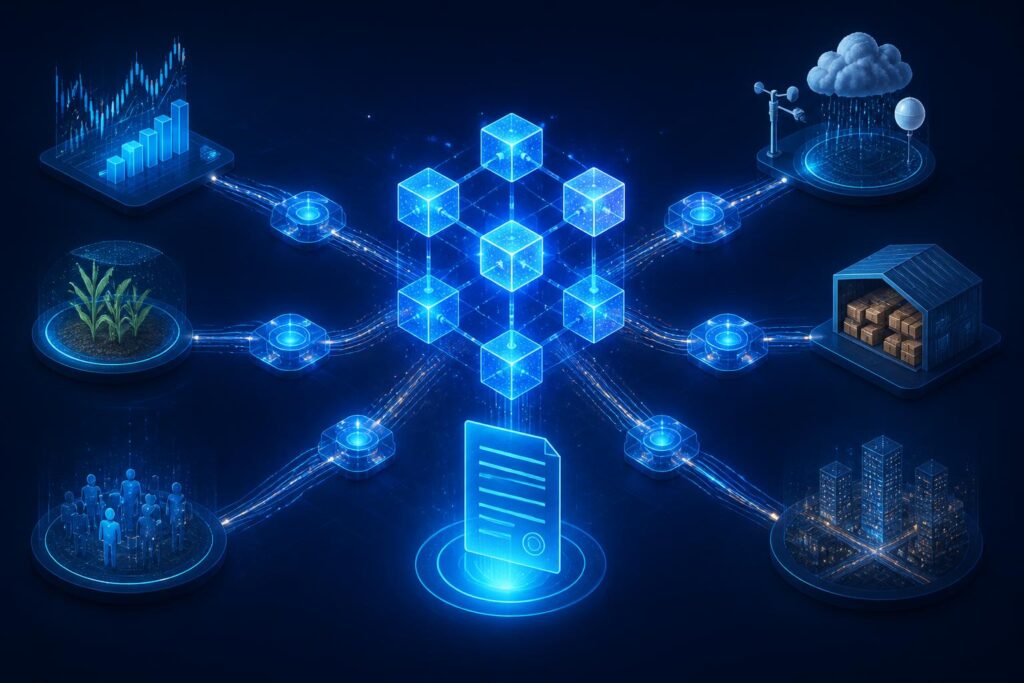
A contract running on a blockchain cannot see the price of an asset on the market, the weather at a particular location, the result of a match, or whether a shipment has arrived at a warehouse. It can only process data that already exists within the blockchain environment. To connect with off-chain data, an application needs a blockchain oracle, generally understood as a mechanism or network that supplies external data to smart contracts.
An oracle is not a separate type of cryptocurrency, nor is it simply a button that feeds information into a blockchain. It is an infrastructure layer positioned between off-chain data and on-chain logic. The quality of this infrastructure layer can determine whether an application operates correctly, is disrupted, or makes an incorrect decision that is nearly impossible to reverse.
What Data Gap Does an Oracle Address?
One advantage of blockchain is that nodes in the network can jointly verify a data state according to common rules. However, this verification mechanism also means that a blockchain cannot freely access the internet or directly call an external database. If each node receives a different result from the same source, the entire network will have difficulty reaching consensus.
An oracle addresses this problem by retrieving data from one or more sources, processing the data according to a defined procedure, and then putting the result onto the blockchain. The smart contract subsequently uses this result to carry out the programmed action. For example, an application may need price data to determine a collateral ratio, or it may need a confirmation signal to release a payment under an agreement.
The important point is that an oracle does not make external information absolutely correct. It merely creates a bridge through which that information can enter an environment that a smart contract can process. If the initial data is inaccurate, delayed, manipulated, or interpreted inappropriately, the contract may still operate exactly according to its code while producing an incorrect real-world outcome.
Common Types of Oracles
Oracles can be classified according to the direction in which data is transmitted and how the data is formed. The easiest type to understand is an oracle that brings information from outside into the blockchain. This type is commonly used for price data, asset status, event results, or information needed for payments. Some systems also work in the opposite direction, sending data from the blockchain to an external service to trigger an action, such as an operational process or notification.
In terms of data sources, an oracle may rely on a single source or aggregate data from multiple sources. A single-source model has the advantages of simplicity, low operating costs, and ease of deployment. In return, the application becomes heavily dependent on that source’s reliability, continuity, and resistance to interference. If the source stops operating or changes how it supplies data, the application may be affected immediately even if the blockchain continues to function normally.
A multi-source model generally attempts to reduce dependence on a single point. Data may be cross-checked, a median value may be used, or rules may be applied to eliminate outlier results. This approach does not automatically guarantee safety, but it makes the assessment of discrepancies more systematic. Designers still need to consider which sources are selected, how conflicts among sources are handled, and who has the authority to change the configuration.
Oracles can also be distinguished as centralized or decentralized. In a centralized model, one entity controls the collection or publication of data. This model may be effective in some situations, but it creates risks of dependency and conflicts of interest. A decentralized model distributes the provision or validation of data among multiple participants, with the aim of reducing the ability of a single entity to control the outcome. Even so, decentralization is meaningful only when the participants are genuinely independent and the incentive mechanism is strong enough to discourage fraudulent behavior.
Risks That Are Often Overlooked
The greatest risk of an oracle is that the data does not accurately reflect the event the contract needs to know about. A price may be taken from a market with low liquidity, a result may be updated slowly, or information that is inherently ambiguous may be converted into a rigid value. Once the data has been recorded on the blockchain, the contract will process it according to its code without understanding the context behind it.
The second risk concerns the timing of updates. Data that is correct at one moment may no longer be appropriate later. If an application uses outdated data to make a decision about liquidation, payment, or asset allocation, even a small delay can have significant consequences. Therefore, not only accuracy but also update frequency, triggering conditions, and methods for identifying erroneous data must be considered.
The third risk is manipulation of the data source. If an application uses a price from a small market, an actor may attempt to cause short-term price volatility and then make the contract react. If the data comes from an external system with centralized administrative control, the issue shifts to the ability to control accounts, change rules, or disrupt the service.
In addition, an oracle can become a technical point of failure. An interrupted data-transmission service, a non-functioning relay, an exposed authentication key, or an incompatible software update can all cause an application to receive incorrect data or no data at all. The blockchain may still reach consensus, but the application built on it may still fail to perform its function because it depends on an external layer.
How Should an Oracle Design Be Evaluated?
First, it is necessary to identify precisely what data the application requires. The question is not only “What is the current price?” but also which asset’s price, from which market, calculated in which unit, over what period, and used for which decision. The more ambiguous a data requirement is, the more difficult it will be to assess when a dispute arises.
Next, the number and quality of the sources should be examined. Multiple sources do not necessarily mean independence if they all obtain their data from the same place. Users and developers should pay attention to the ability to cross-check information, the method for handling exceptions, the history of interruptions, and how the system responds when sources produce different results.
Backup mechanisms are also very important. An application may temporarily pause when data exceeds an abnormal threshold, limit the amount of change in each update, or require additional confirmation before carrying out a sensitive action. These measures do not eliminate every risk, but they help slow the spread of incorrect data and create time to detect a problem.
Administrative authority must be disclosed and easy to understand. Users need to know who can change data sources, adjust thresholds, upgrade the contract, or pause the system. An application that promotes automation but still allows a small group to change core parameters should be evaluated according to that level of dependence, rather than simply by noting that its code has been deployed on a blockchain.
Finally, there must be mechanisms for handling disputes and incidents. Not every type of data can be determined by a single number. For events that require interpretation, the application should establish in advance how verification will be conducted, the response period, and what action will be taken when the data is disputed. Designing a process before an incident occurs is generally more reliable than making a decision while assets and interests have already been affected.
How Should Users Read Information About Oracles?
When using a blockchain application, users should not ask only whether the smart contract’s source code is public. They should also ask where the application obtains its data, under what conditions the data is updated, how many parties participate, and what happens when the oracle stops operating. These questions are especially important for products involving assets, insurance, credit, or automated payments.
It is also necessary to distinguish transparency from correctness. The public recording of an oracle transaction allows everyone to check what data the system received, but it does not prove that the data accurately reflects the outside world. Conversely, a system with less publicly available data is not necessarily always wrong, but it makes it more difficult for users to assess the risks. These two aspects should be considered together.
In practice, no oracle design is suitable for every application. A game may accept a simpler approach than a system used to determine financial entitlements. The level of protection should be proportionate to the value of the assets, the required response speed, and the consequences of incorrect data. This is why an oracle must be evaluated in relation to its specific purpose rather than on the basis of a generic “decentralized” label.
Conclusion
Oracles are one of the important but less noticed infrastructure layers in the blockchain ecosystem. They help smart contracts access off-chain data while also introducing an area of risk that blockchain consensus mechanisms cannot resolve on their own. A blockchain may record data consistently, but that does not guarantee that the data entered in the first place is correct.
Therefore, when evaluating a blockchain application, it is necessary to examine the entire chain, from the data source and aggregation method to the timing of updates, administrative authority, and backup mechanisms. Understanding the role of oracles correctly helps users avoid the misconception that every automated decision is objective or incapable of error. In many cases, an application’s reliability lies not only in the on-chain code but also in how it determines what is happening in the outside world.
